
Alibaba’s AI Strategy Is Paying Off as Qwen Downloads Hit 700 Million

Please note that we are not authorised to provide any investment advice. The content on this page is for information purposes only.
Alibaba’s flagship artificial intelligence (AI) ecosystem, Qwen (often referred to as Qianwen in China), has surpassed 700 million downloads according to data from global developer platform Hugging Face.
This milestone cements Qwen’s position as the world’s most widely used open-source AI system, significantly outpacing major global competitors, including Meta’s Llama and OpenAI’s offerings.
Table of Contents
Alibaba’s Qwen Hits 700 Million Downloads
The surge in downloads reflects a massive shift in the AI landscape, where Alibaba’s strategy of “open-sourcing everything” is paying off. In December 2025 alone, Qwen downloads exceeded the combined total of the next eight most popular AI models globally (including Llama, Mistral, and DeepSeek).
While the 700 million figure refers to model downloads by developers, Alibaba has also launched a dedicated Qwen App for consumers. The app reached 10 million downloads within its first week of beta launch in late 2025, faster than the initial adoption rates of ChatGPT. The Qwen family spans from the lightweight Qwen3-0.6B (designed for mobile devices) to the ultra-large Qwen3-Max, which recently rivaled GPT-5 in several performance benchmarks.
What’s Driving Qwen Adoption?
Alibaba has transformed Qwen from a simple chatbot into a comprehensive ecosystem. The 700 million download milestone is driven by:
- Developer Adoption: By offering models in various sizes and specializations (vision, audio, coding), tens of thousands of real-world applications have been built on top of Qwen.
- Consumer Integration: Alibaba is integrating Qwen into its “super app” ecosystem, linking it to digital maps, food delivery, and e-commerce (Taobao/Tmall).
- Efficiency: Stanford’s Human-Centered AI Institute recently noted that Chinese models like Qwen have “caught up or even pulled ahead” in computational efficiency, making them more attractive for global developers facing high hardware costs.
Alibaba’s AI Strategy Is Yielding Results
After their US rivals successfully pivoted to AI, Chinese tech companies are also following the lead. Alibaba’s most recent quarterly earnings report paints a clear picture of the company’s aggressive, AI-driven transformation.
Alibaba’s cloud revenue jumped 34% year-on-year in fiscal Q2 2026, a significant acceleration from the previous quarter’s 26% growth. Management explicitly attributed this surge to soaring demand for AI computing, including AI model training and enterprise adoption of cloud-based AI services.
Revenue from AI-related products achieved triple-digit year-on-year growth for the ninth consecutive quarter, demonstrating that AI is not just a strategic talking point but a monetizable revenue stream for the company.
During the earnings call, Alibaba CEO Eddie Wu emphasized that the company is “in an investment phase to build long-term strategic value in AI technologies and infrastructure.” BABA has poured approximately 120 billion yuan into AI and cloud infrastructure over the past year and has signaled that its initial 380 billion yuan commitment over three years may be too conservative to meet surging customer demand.
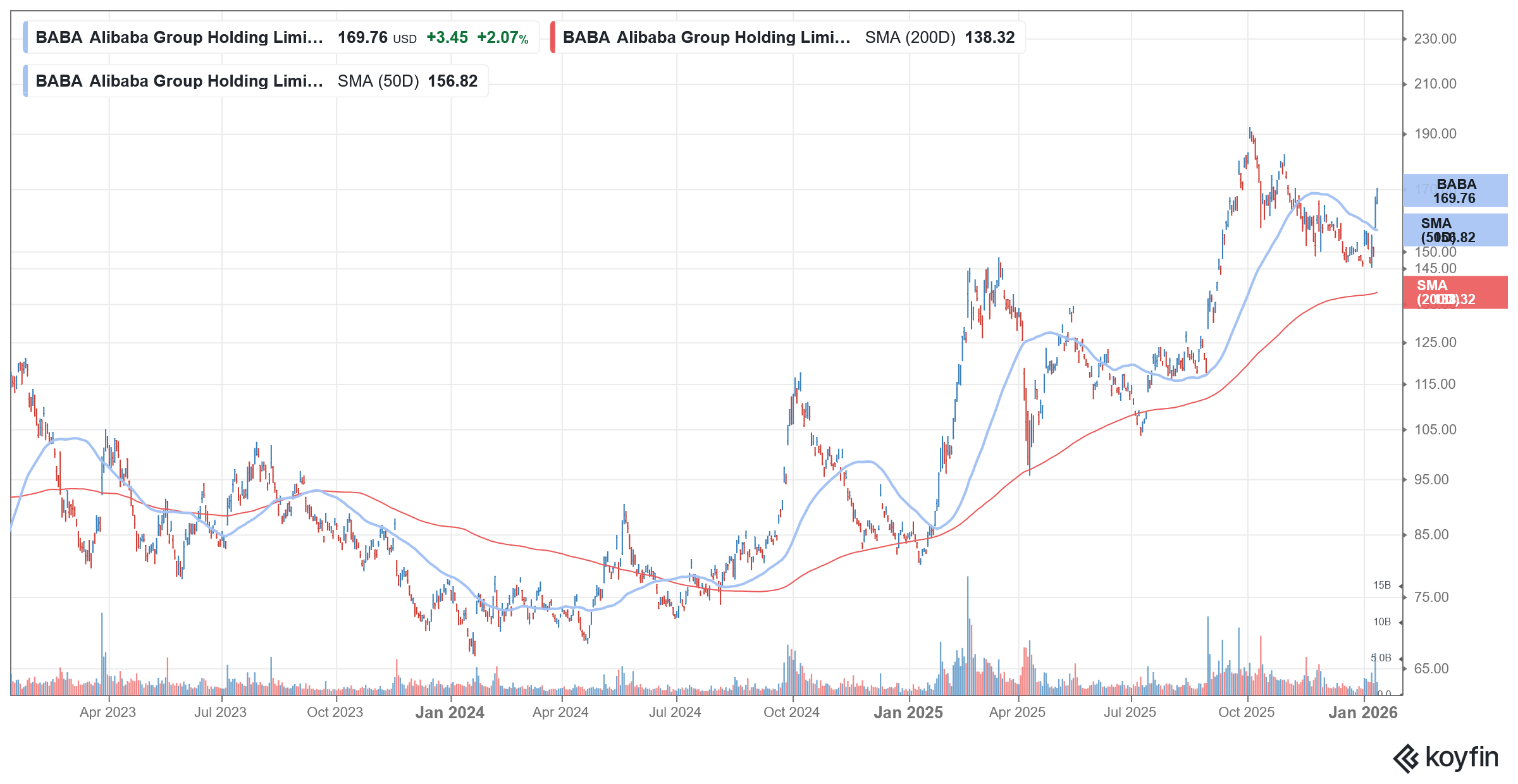
Alibaba’s AI Investments Are Yielding Returns
Notably, while there have been concerns over tech companies’ ability to generate commensurate returns on their burgeoning AI capex, Alibaba said that it is seeing strong returns and is already breaking even on AI investments in its e-commerce business.
Alibaba vice president Kaifu Zhang, who heads the company’s e-commerce AI applications, told reporters in October 2025 that the company saw a 12% rise in advertising spend returns from AI-deployed tools, a “very rare” double-digit change that forecasts a “very significant positive impact” on the company’s Gross Merchandise Volume (GMV) during major shopping festivals.
Alibaba’s AI Glasses Went On Sale in November
Alibaba has launched two variants of the Quark AI glasses, whose mass sales began in China in November. The glasses function as a hands-free gateway to Alibaba’s AI and commerce ecosystem, enabling a variety of real-time functions like translation, online shopping. It also integrates other Alibaba apps like Alipay for visual payment verification and hands-free payment.
Alibaba’s launch intensifies the competition in the consumer wearable AI space, directly challenging products like Meta’s Ray-Ban smart glasses (which also run AI and feature integrated cameras). Chinese rivals like Xiaomi and Baidu have also released AI-based glasses.
Alibaba views this launch as a strategic move to extend its dominance from cloud computing and e-commerce into the next generation of consumer AI hardware, positioning the glasses as a “next-generation traffic gateway” to its platform.
Notably, the competition among major technology companies like Meta, Google, and the ecosystem surrounding OpenAI to dominate the nascent AI-powered smart glasses market is rapidly intensifying. This new wave of wearables is being positioned as the post-smartphone computing interface, with each company leveraging its core strengths from social media to AI models to secure an early lead.
BABA Is Developing AI Chips
Alibaba is also developing AI chips, and last month it secured a major deal with state-owned telecom company China Unicom to supply AI chips for a new data center.
This partnership is particularly noteworthy in the context of the ongoing US-China technology standoff. The United States has imposed strict export controls on advanced AI chips, primarily targeting products from industry leader Nvidia, to prevent them from being used for military and national security purposes in China. This has created a vacuum in the Chinese market and spurred domestic companies to accelerate their own chip development.
China Is Backing Its AI Companies
Notably, China is backing its tech companies amid the apparent tech war with the US.
In a major move to solidify its manufacturing prowess, China’s Ministry of Industry and Information Technology (MIIT) recently released a comprehensive action plan for the high-quality development of industrial internet platforms (2026–2028).
The plan is designed to bridge the gap between China’s massive industrial data and the burgeoning power of AI, aiming to cultivate “new quality productive forces” across the country’s manufacturing landscape.
China’s 15th Five-Year Plan (2026-2030) signals a strategic pivot from groundbreaking innovation (“zero-to-one”) to widespread application and scaling (“one-to-100”).
By standardizing and boosting industrial internet platforms, China aims to secure its supply chains against global volatility and ensure its manufacturing sector remains the most competitive and technologically advanced in the world.





