Alibaba Launches Quark AI Glasses as Race for The Next Computing Platform Heats Up

Please note that we are not authorised to provide any investment advice. The content on this page is for information purposes only.
Chinese tech giant Alibaba (NYSE: BABA) has launched artificial intelligence (AI) glasses that went on sale yesterday. The move comes at a time when the race for the next big computing platform heats up with companies including Meta Platforms, Apple, and Alphabet betting on smart glasses.
Alibaba has launched two variants of the Quark AI glasses, whose mass sales began in China on Thursday with plans for global sales to follow next year. The glasses function as a hands-free gateway to Alibaba’s AI and commerce ecosystem, enabling a variety of real-time functions like translation, online shopping. It also integrates other Alibaba apps like Alipay for visual payment verification and hands-free payment.
Alibaba Launches AI Glasses
The flagship Quark S1 is priced at RMB 3,799 (around $538) and features dual micro-OLED displays for AR overlays, dual chips (including a Snapdragon AR1 processor), and a swappable dual-battery system for up to 24 hours of use. The variant is designed for AR and high-performance AI tasks.
The second model, Quark G1, is priced at RMB 1,899 (around $268). It has an audio-first design and is lighter for everyday wear, but lacks the micro-OLED displays of the S1.
Both models are equipped with a camera, bone conduction microphones, and run on the Qwen AI model via the new Qwen App. Notably, Alibaba had relaunched the Qwen App recently, and it hit the milestone of 10 million downloads within the first week of launch.
The momentum is largely attributed to the app’s relaunch and rebranding strategy, which saw Alibaba unify several existing AI offerings, including its “Tongyi” app, under the single, streamlined Qwen banner. This strategic consolidation, coupled with the absence of key Western competitors like ChatGPT in mainland China, has created a clear path for Qwen to dominate the nascent domestic consumer AI space.
Competition Is Rising in the AI Smart Glass Market
Alibaba’s launch intensifies the competition in the consumer wearable AI space, directly challenging products like Meta’s Ray-Ban smart glasses (which also run AI and feature integrated cameras). Chinese rivals like Xiaomi and Baidu have also released AI-based glasses.
Alibaba views this launch as a strategic move to extend its dominance from cloud computing and e-commerce into the next generation of consumer AI hardware, positioning the glasses as a “next-generation traffic gateway” to its platform.
Notably, the competition among major technology companies like Meta, Google, and the ecosystem surrounding OpenAI to dominate the nascent AI-powered smart glasses market is rapidly intensifying. This new wave of wearables is being positioned as the post-smartphone computing interface, with each company leveraging its core strengths from social media to AI models to secure an early lead.
Incidentally, at the launch of its AI glasses, Alibaba vice president Wu Jia said, “AI glasses are the intelligent devices that truly usher in a revolution in human-computer interaction in the AI era. Wu added, “In this respect, their importance is no less than that of mobile phones.”
Meta Is Currently the Market Leader in AI Smart Glasses
Meta is currently the dominant player in the consumer smart glasses space, largely thanks to its strategic partnership with eyewear giant EssilorLuxottica (owner of Ray-Ban and Oakley). The glasses are deeply integrated with Meta AI, powered by the company’s Llama large language models.
While Google’s initial attempt with “Google Glass” faced challenges, the company is now refocusing its strategy, leveraging its powerful AI models and Android’s extended reality (XR) ecosystem.
Google has partnered with hardware companies like Samsung Electronics for its Galaxy XR headset, supplying AI features to the broader market. The company is investing in AR hardware development and optimizing its supply chain, signaling a long-term commitment.
While OpenAI itself does not have a branded AI glass product in the market, it has been working with former Apple design chief Jony Ive on a new AI device, which is rumored to be a consumer wearable, signaling a potential direct entry into the hardware space.
The AI glass market is a pivotal platform for the next computing paradigm, moving interaction from the smartphone screen directly to a hands-free, real-world experience. Even Apple, which is projected to become the biggest smartphone seller this year, is reported to have doubled down on glasses while scaling back its VR headset ambitions.
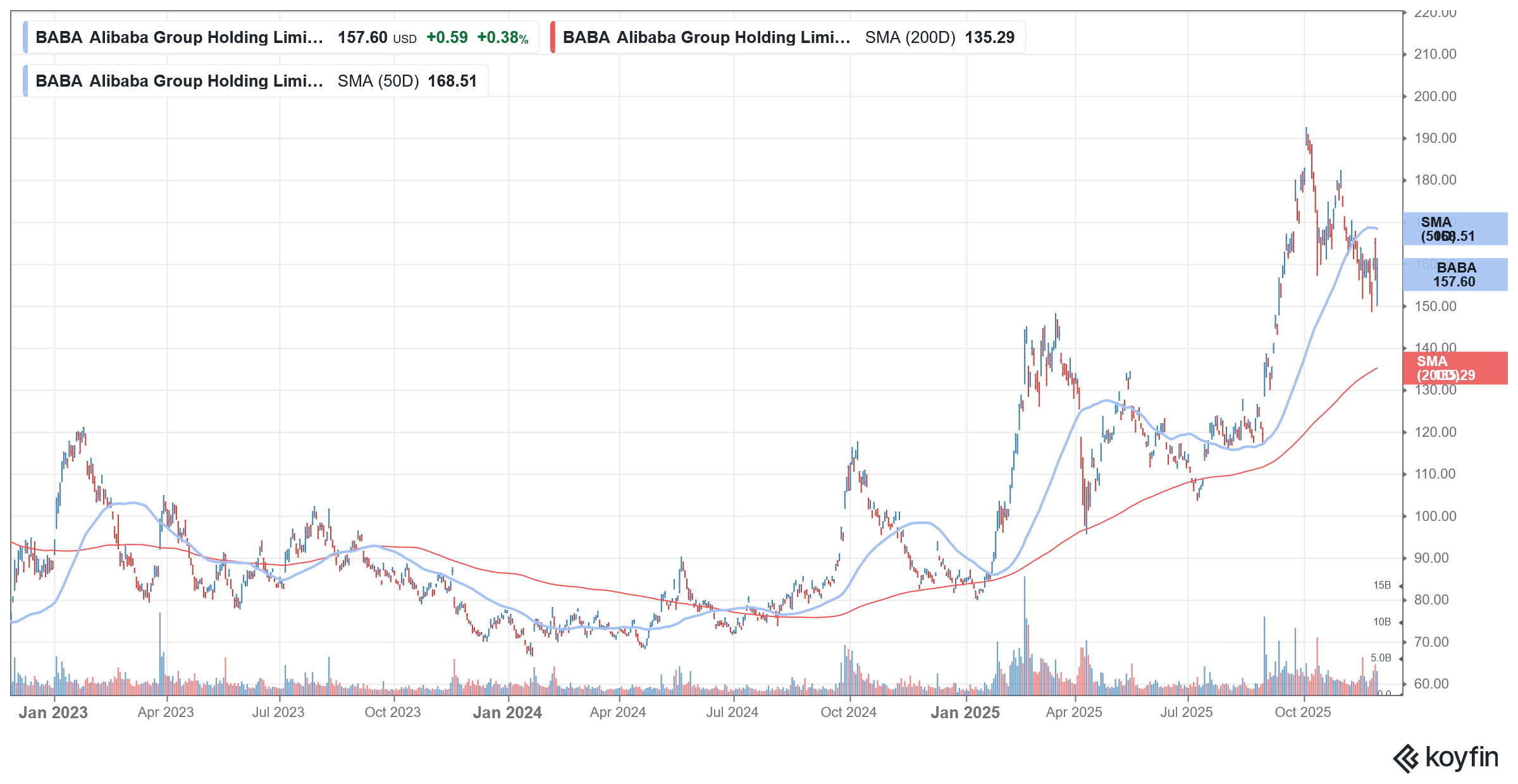
Alibaba Has Positioned Itself as An AI Play
After their US rivals successfully pivoted to AI, Chinese tech companies are also following the lead. Alibaba’s most recent quarterly earnings report paints a clear picture of the company’s aggressive, AI-driven transformation.
Alibaba’s cloud revenue jumped 34% year-on-year in fiscal Q2 2026, a significant acceleration from the previous quarter’s 26% growth. Management explicitly attributed this surge to soaring demand for AI computing, including AI model training and enterprise adoption of cloud-based AI services.
Revenue from AI-related products achieved triple-digit year-on-year growth for the ninth consecutive quarter, demonstrating that AI is not just a strategic talking point but a monetizable revenue stream for the company.
During the earnings call, Alibaba CEO Eddie Wu emphasized that the company is “in an investment phase to build long-term strategic value in AI technologies and infrastructure.” BABA has poured approximately 120 billion yuan into AI and cloud infrastructure over the past year and has signaled that its initial 380 billion yuan commitment over three years may be too conservative to meet surging customer demand.
Alibaba Is Developing AI Chips
Alibaba is also developing AI chips, and last month it secured a major deal with state-owned telecom company China Unicom to supply AI chips for a new data center.
This partnership is particularly noteworthy in the context of the ongoing US-China technology standoff. The United States has imposed strict export controls on advanced AI chips, primarily targeting products from industry leader Nvidia, to prevent them from being used for military and national security purposes in China. This has created a vacuum in the Chinese market and spurred domestic companies to accelerate their own chip development.
Meanwhile, reports have surfaced alleging that Alibaba has provided technological support and customer data to the People’s Liberation Army (PLA) for operations targeting the United States. These claims, primarily sourced from a White House national security memo, have sparked a vigorous denial from the company and escalated geopolitical tensions over technology and data security.
Alibaba Group has vehemently denied the claims, labeling the report and the underlying memo as “completely false” and “complete nonsense.”