
Retail Distribution in India

Please note that we are not authorised to provide any investment advice. The content on this page is for information purposes only.
The distribution sector bridges the gap between the producer and consumer and thus forms a crucial link. Distribution of retail in India has multiple dimensions. Its uniformity is difficult to decide and easy to argue. Distribution in any sector is usually measured by the reach of its products to people. But in case of the retail sector in India it also implies the dispersion among the organized and unorganized spheres. The question of distribution hovers mainly around the intentions of private players to reach out to the less rich people. But the point that has caught the public eye recently is the ambiguous mood of the beneficiaries and the chauvinist government that produces civil service.
Propagation of the retail sector:
The expansion of the retailing in India has been magnificent specially after the advent of liberalization and the abolition of licensing. A comparative study with other developed countries indicates that the retail sector has achieved a fantastic breakthrough in the Indian economy. India topped the A.T. Kearney’s Global Retail Index in both 2005 and 2006as can be seen below:
the GRDI Score as calculated by A.T. Kearney is a weighted average of market attractiveness, market
saturation, country risk and time pressure. India had a GRDI score of 100 in both 2005 and 2006.implying market potential and attractiveness. As the graph clearly depicts, India’s contenders like Russia and China are nowhere in competition. This result has been obtained mainly because of a higher APC(Average Propensity to consume) of the Indian people. According to IMF, India has a APC of more than 60% while the corresponding figure for Japan is 57% and China is 39%. Also Indians tend to exhaust 40% of their consumer spending on groceries(foodstuffs). These figures are intensified by the fact that Indians have special preference for lifestyle products and they feel comfortable in buying against credit as the credit card and mortgage market has been growing by more than 30%
We present the results from another survey below in order to strengthen our findings.
Availability of Retail Stores
Country
Number of stores per 1,000 people
India
22
Japan
10
USA
3.8
The above table reinforces our view that India has done a great job in retailing. One noteworthy point here is that Japan in spite of being one of the most densely populated countries has fared poorly than India. But this euphoria loses its charm if we compare the percentage of organized retail in the total value generated by the retailing sector. 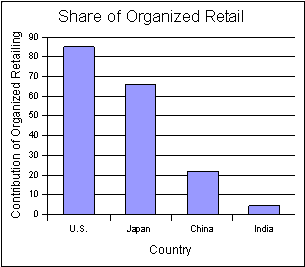
According to international standards, a retail store is nominated as organized only when it features more than 10 employees. The above chart clearly portrays the miserable condition of India’s organized retail A forecast of 40% annual growth in the organized retail sector seems sound. The number of shopping malls in India has grown from 1 in 2001 to 100 in 2005 but still more effort is needed to turn the predictions into reality.
Studies have further showed that non-urban areas account for only about 15% of organized retailing So it is high time that the retail industries pay importance to diversification and reach out to non-urban markets. If they remain confined to the metropolis then they will soon hit a ceiling and will be able to grow no more. But at the same time they must realize that the rustic people are sceptic about the urbane lifestyle habits. The mega retail players will have to drop their policy of full extraction of consumer surplus and will have to employ the local people to over come the myth that entry of a branded retail will displace the millions of traders, shopkeepers and hawkers. Protests must be welcomed and meetings encouraged to make life saner.
Retail markets in Germany, South Africa and many other countries allow 100% foreign investment in retail. This has helped in setting up of cash and in creating wholesale markets. However, in India, only 51% FDI is allowed in single-brand retail and that too with prior approval. In case of multi-brand retail, FDI is completely prohibited. This is a perfect beginning but foreign investment should be gradually liberalized to modernize farming and help farmers scale up. Moreover, restricting FDI for protecting mom-and-pop stores seems unjustifiable since Tata, Reliance and Bharti have already made a foray in the sector.
Conclusion:
There are many hurdles in the path of smooth growth of the retail sector but a burgeoning and aware middle class and cultural and ethnic diversifications surely wait a revolution in the retail sector.



