China to Probe Meta’s Acquisition of AI Startup Manus

Please note that we are not authorised to provide any investment advice. The content on this page is for information purposes only.
In a significant escalation of the global tech rivalry, Meta Platforms is facing a high-stakes probe by Chinese regulators following its multibillion-dollar acquisition of artificial intelligence (AI) agent startup Manus.
The investigation, confirmed by China’s Ministry of Commerce (MOFCOM) centers on whether the deal violated strict technology export control laws and national security regulations.
Manus, known for its “general-purpose AI agent,” can autonomously perform complex tasks like software coding, market research, and travel planning. Originally founded as Butterfly Effect in Beijing, the startup relocated its headquarters to Singapore in mid-2025, a tactic often referred to as “Singapore washing,” to distance itself from Chinese regulatory scrutiny and attract Western investment.
Manus Reached $100 Million in ARR
The startup’s meteoric rise saw it reach $100 million in annual recurring revenue (ARR) within just eight months of launch, making it one of the fastest-growing AI companies in history.
Meta announced the acquisition of Manus in late December 2025, a move designed to bolster its “agentic AI” capabilities across Facebook, Instagram, and WhatsApp. The deal was estimated to be between $2 billion and $3 billion and marked Meta’s third-largest deal in history, trailing only its $19 billion purchase of WhatsApp and its massive $14 billion investment in Scale AI last year.
China to Probe Meta’s Manus Acquisition
Chinese authorities are investigating whether Manus and its founders bypassed mandatory government approvals before transferring core intellectual property and personnel out of the country.
Under China’s Export Control Law, advanced algorithms and strategic AI technologies require a government license to be transferred to foreign entities. MOFCOM is reviewing whether the relocation to Singapore was a bad-faith attempt to evade these rules.
Beijing is reportedly concerned that allowing the Meta-Manus deal to proceed unchallenged would set a precedent, encouraging other top-tier Chinese AI talent to flee the country’s domestic ecosystem.
Ministry of Commerce spokesperson He Yadong stated that all enterprises engaging in outward investment or data transfers must comply with Chinese law. Regulators are assessing if the “agentic” capabilities of Manus could provide the US with a competitive edge that compromises Chinese interests.
“The Chinese government consistently supports enterprises in conducting mutually beneficial transnational operations and international technological cooperation in accordance with laws and regulations,” Yadong said at a press briefing.
Commenting on China’s probe, Nick Patience, AI lead at The Futurum Group, told CNBC that it “underlines that [the country] considers advanced AI agents, models and related IP to be strategic assets.”
He added, “The most likely outcome I see is a lengthier approval process and potential conditions around how Manus technology developed in China can be used, rather than an outright block, but the threat of stricter action gives Beijing bargaining power in a high-profile, US-led acquisition.”
Geopolitical Implications of Meta’s Acquisition
The probe places Meta in a delicate position between two superpowers who are vying for global AI dominance. Prior to the acquisition, US lawmakers (including Senator John Cornyn) questioned the involvement of American VC firm Benchmark in a startup with Chinese roots. In an effort to appease regulators in Washington, Meta has stated there will be “no continuing Chinese ownership interests” in Manus and that the startup will discontinue all operations within mainland China.
Meta Is Focusing on “Personal Superintelligence”
Notably, under the leadership of Mark Zuckerberg, Meta is shifting its focus toward “Personal Superintelligence.” By integrating Manus’s technology, Meta plans to transform its “Family of Apps” (Facebook, Instagram, and WhatsApp) into hubs for productivity. Imagine a WhatsApp bot that not only suggests a restaurant but also coordinates with friends, checks calendars, and completes the reservation.
Meta has been on an AI talent hiring spree and hired Daniel Gross, co-founder and former CEO of Safe Superintelligence. His expertise in building AI products from the ground up will be instrumental in translating cutting-edge research into tangible user experiences. The company has poached key AI talent from tech giants like OpenAI, Google, and Apple as Zuckerberg doubles down on the company’s bets in artificial intelligence.
Meta’s Other Key AI Acquisitions
Additionally, Meta completed three other specialized acquisitions to round out its ecosystem. It acquired EchoLink to provide real-time, low-latency speech translation for the Ray-Ban Meta glasses. The Mark Zuckerberg-led company acquired CoreCompute to optimize AI hardware performance on mobile devices.
Meta also acquired Veloce Labs to enhance the speed and efficiency of LLM inference across Meta’s global server network. It also acquired California-based startup Play AI for an undisclosed sum. The move was widely seen as a response to OpenAI’s “GPT-4o” voice capabilities and Google’s Gemini Live.
Meta’s AI Capex Is Expected to Rise in 2026
Meta increased its 2025 capex budgets multiple times. Crucially, management warned that 2026 capital expenditure dollar growth would be notably larger than 2025’s growth and that total expenses would grow at a “significantly faster percentage rate” due to continued AI build-out.
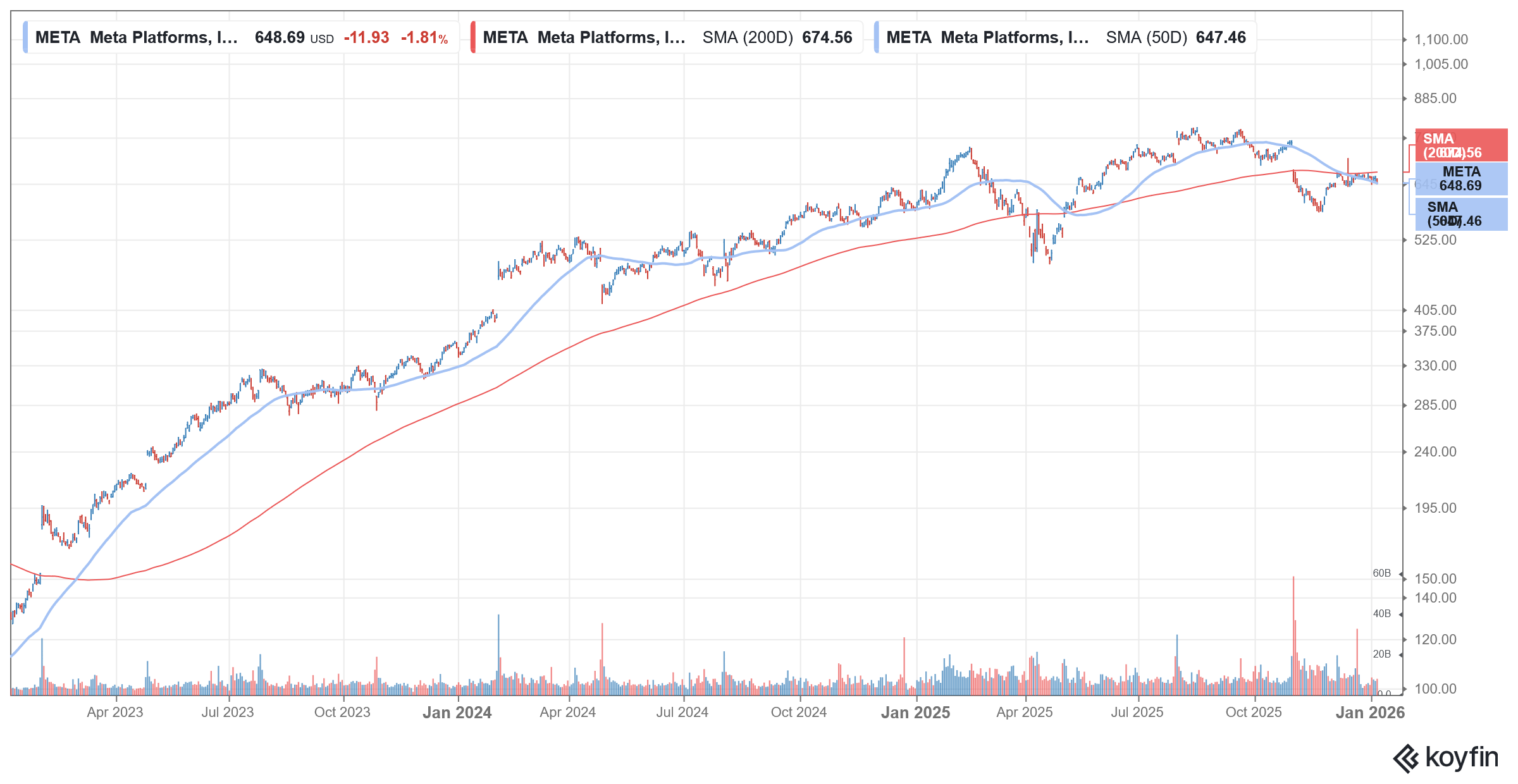
Meta stock plunged following its Q3 2025 earnings report, despite the core advertising business delivering strong revenue and user growth. The sharp decline was a direct reaction to two major concerns: an aggressive, and seemingly open-ended, increase in AI capex and a large, one-time accounting charge.
Unlike Microsoft and Google, which can offset their AI infrastructure costs by selling cloud services (Azure/Google Cloud) to external customers, Meta is building its infrastructure primarily for internal use (improving ads, content ranking, and future products). This lack of an immediate, external revenue stream makes the massive spending inherently riskier in the eyes of the market
Meta Is Reportedly Looking to Cut Metaverse Spending
Notably, while Meta has doubled down on AI and increased its capex towards building the required infrastructure, it is reportedly looking to cut down spending towards metaverse.
The company’s Reality Labs, which is building the metaverse, has been a significant drain on Meta’s finances, losing over $70 billion since 2021. The segment posted an operating loss of $4.4 billion in the third quarter of 2025, continuing to weigh on the company’s operating income.
Analysts and investors have consistently urged the company to reduce its spending or demonstrate a clearer path to profitability.
The anticipated industry-wide momentum and mainstream adoption for metaverse technologies, particularly Meta’s consumer-facing products, have been slower than initially projected.