Meta Platforms Buys AI Agent Firm Manus For Over $2 Billion

Please note that we are not authorised to provide any investment advice. The content on this page is for information purposes only.
Meta Platforms announced the acquisition of Manus, a high-profile developer of autonomous general-purpose artificial intelligence (AI) agents. This deal, valued between $2 billion and $3 billion, represents one of Meta’s most ambitious bets on “agentic AI,” which is touted as the next frontier of AI where systems move beyond simple chat to executing complex, multi-step tasks independently.
Meta Acquires Manus
The acquisition of Manus (Latin for “hand”) marks Meta’s third-largest deal in history, trailing only its $19 billion purchase of WhatsApp and its massive $14 billion investment in Scale AI earlier this year.
Manus, founded by Butterfly Effect Technology, gained global fame in early 2025 for its ability to function as an “autonomous worker.” Unlike standard LLMs that generate text, Manus agents can:
- Navigate Web Browsers: Book travel, perform market research, and interact with online tools.
- Manage Data: Analyze massive datasets and generate visualized reports.
- Asynchronous Execution: Tasks run in a cloud-hosted virtual environment, meaning the AI continues working even after the user closes their device.
The startup’s meteoric rise saw it reach $100 million in annual recurring revenue (ARR) within just eight months of launch, making it one of the fastest-growing AI companies in history.
Meta Is Focusing on “Personal Superintelligence”
Under the leadership of Mark Zuckerberg, Meta is shifting its focus toward “Personal Superintelligence.” By integrating Manus’s technology, Meta plans to transform its “Family of Apps” (Facebook, Instagram, and WhatsApp) into hubs for productivity. Imagine a WhatsApp bot that not only suggests a restaurant but also coordinates with friends, checks calendars, and completes the reservation.
Manus will continue to operate its standalone service from its headquarters in Singapore, while its core technology is woven into Meta AI.
Manus Deal Could Face Regulatory Scrutiny
The Manus deal is not without its complexities. Given the startup’s Chinese origins and its recent relocation to Singapore, the acquisition is expected to face regulatory scrutiny in both Washington and Beijing. However, for Meta, the risk is a necessity to keep pace with rivals like OpenAI and Google.
With the 2026 roadmap reportedly including new advanced models codenamed Mango and Avocado, Meta enters the new year with the talent and infrastructure to define the “Agentic Era” of the internet.
Meta Has Been On an AI Investment Spree
Beyond Manus, Meta’s 2025 was defined by its massive $14.3 billion investment in Scale AI, securing a 49% stake in the data-labeling giant. This deal was a strategic “talent-and-tech” play that brought Scale AI founder Alexandr Wang into Meta to lead the newly formed Meta Superintelligence Labs. This move ensured Meta has a proprietary, high-quality data pipeline to train its future Llama models.
Notably, such deals have become quite popular as they help evade regulatory scrutiny. Looking at some of the other such instances, in July, Google recruited Varun Mohan, the co-founder and CEO of AI coding startup Windsurf, along with a substantial portion of his research and development team. This strategic move is valued at an estimated $2.4 billion in licensing and compensation over several years.
Tech Companies Are Doubling Down on AI
As part of the deal, Google did not acquire Windsurf outright nor did it take an equity stake in the company. Instead, it was structured as a strategic “acquihire” combined with a non-exclusive licensing agreement for some of Windsurf’s intellectual property. This arrangement allows Windsurf to remain independent and continue licensing its cutting-edge AI coding technology to other firms, while Google gains direct access to the talent and expertise that will significantly advance its Gemini project, particularly in the domain of “agentic coding” – AI tools designed to act more like autonomous software development collaborators.
Most recently, Nvidia acquired the assets and hired leaders and employees of AI in a deal that’s reportedly valued at $20 billion.
Zuckerberg Has Been On an AI Talent Hiring Spree
Meta has also hired Daniel Gross, co-founder and former CEO of Safe Superintelligence. His expertise in building AI products from the ground up will be instrumental in translating cutting-edge research into tangible user experiences. The company has poached key AI talent from tech giants like OpenAI, Google, and Apple as Zuckerberg doubles down on the company’s bets in artificial intelligence.
Other Acquisitions That Meta Announced In 2025
Additionally, Meta completed three other specialized acquisitions to round out its ecosystem. It acquired EchoLink to provide real-time, low-latency speech translation for the Ray-Ban Meta glasses. The Mark Zuckerberg-led company acquired CoreCompute to optimize AI hardware performance on mobile devices.
Meta also acquired Veloce Labs to enhance the speed and efficiency of LLM inference across Meta’s global server network. It also acquired California-based startup Play AI for an undisclosed sum. The move was widely seen as a response to OpenAI’s “GPT-4o” voice capabilities and Google’s Gemini Live.
Meta Has Increased AI Capex
Meta has also increased its 2025 capex budgets multiple times. Crucially, management warned that 2026 capital expenditure dollar growth would be notably larger than 2025’s growth and that total expenses would grow at a “significantly faster percentage rate” due to continued AI build-out.
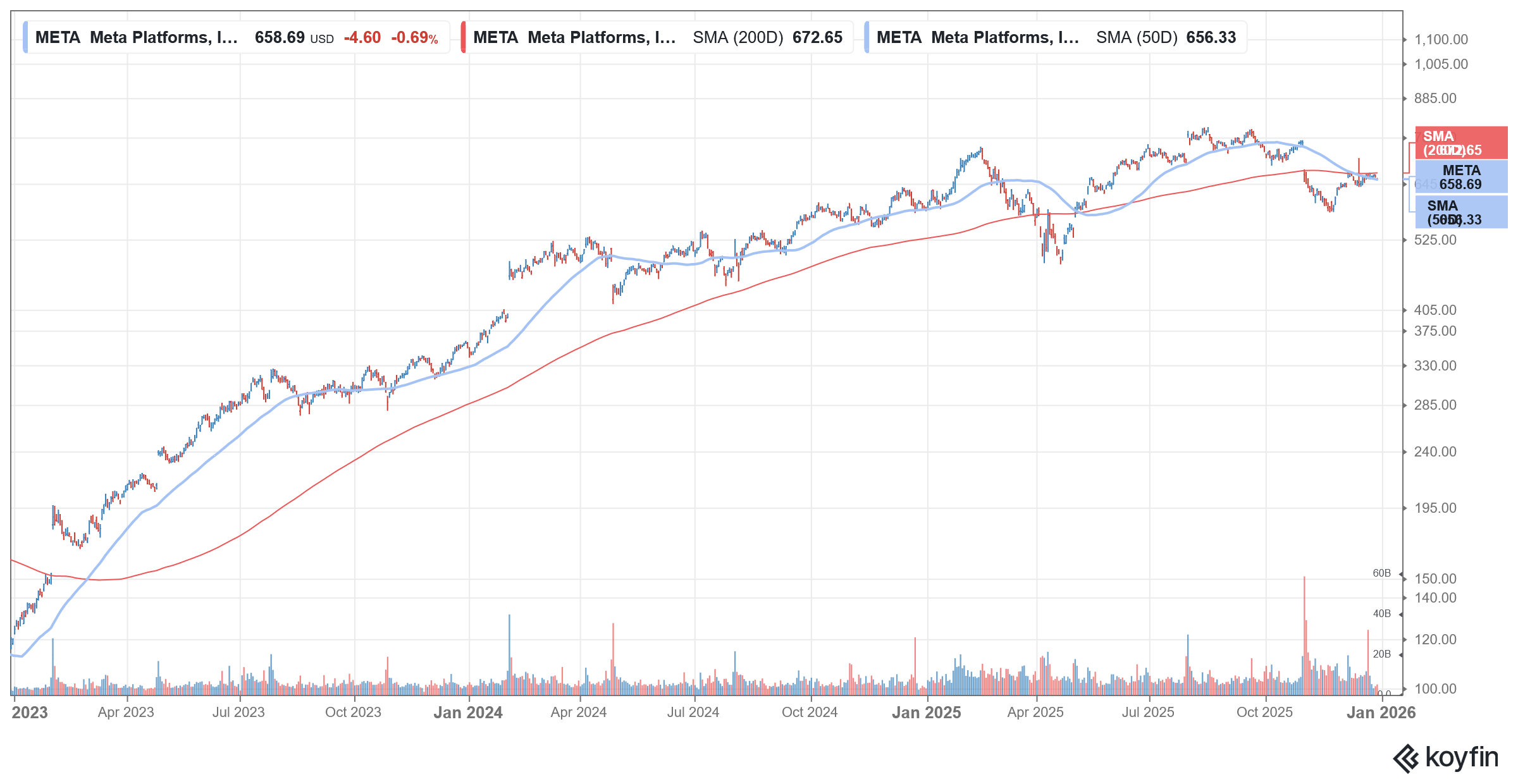
Meta stock plunged following its Q3 2025 earnings report, despite the core advertising business delivering strong revenue and user growth. The sharp decline was a direct reaction to two major concerns: an aggressive, and seemingly open-ended, increase in AI capex and a large, one-time accounting charge.
Unlike Microsoft and Google, which can offset their AI infrastructure costs by selling cloud services (Azure/Google Cloud) to external customers, Meta is building its infrastructure primarily for internal use (improving ads, content ranking, and future products). This lack of an immediate, external revenue stream makes the massive spending inherently riskier in the eyes of the market
Meta Is Reportedly Looking to Cut Metaverse Spending
Notably, while Meta has doubled down on AI and increased its capex towards building the required infrastructure, it is reportedly looking to cut down spending towards metaverse.
The company’s Reality Labs, which is building the metaverse, has been a significant drain on Meta’s finances, losing over $70 billion since 2021. The segment posted an operating loss of $4.4 billion in the third quarter of 2025, continuing to weigh on the company’s operating income.
Analysts and investors have consistently urged the company to reduce its spending or demonstrate a clearer path to profitability.
The anticipated industry-wide momentum and mainstream adoption for metaverse technologies, particularly Meta’s consumer-facing products, have been slower than initially projected.