
Belarus Economic Structure

Please note that we are not authorised to provide any investment advice. The content on this page is for information purposes only.
Belarus’ economic structure is undergoing a strict and much needed overhauling. The currency has been devalued and other administrative measures have been taken to get Belarus trade on the international platform. Russia has been the main helping neighbor with trade, contributing more than 50% of the nation’s trade. In fact, the new steps taken by Russia to help the Belarus economic structure perform well will provide the much needed impetus, although growth might take a beating in the first few years of its implementation.[br]
Belarus’ economic structure is undergoing a strict and much needed overhauling. The currency has been devalued and other administrative measures have been taken to get Belarus trade on the international platform. Russia has been the main helping neighbor with trade, contributing more than 50% of the nation’s trade. In fact, the new steps taken by Russia to help the Belarus economic structure perform well will provide the much needed impetus, although growth might take a beating in the first few years of its implementation.[br]
Belarus Economic Structure
To foster growth, Belarus’ economic structure has started focusing on energy efficiency and diversifying export. However, since growth was mainly possible through external borrowings, the credit markets are not as willing post recession as it once was, and therefore growth might be limited in the near term.
However, as far as internal structuring is concerned, services still lead the way when it comes to adding to the GDP. Here is what the break up looks like:
-
Agriculture: 9.3%
-
Industry: 39.7%
-
Services: 51% (2009 est.)[br]
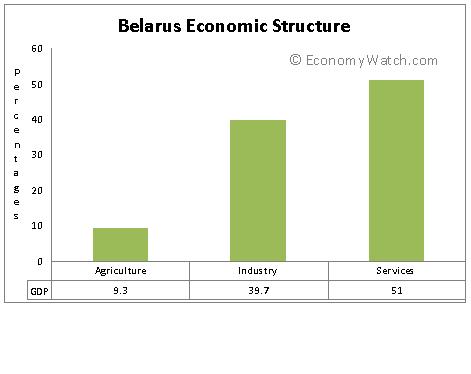
The workforce has, therefore, been best absorbed by the service sector, where knowledge based products have become the highlight. The sector employs almost 52% of the work force, followed by industries, which employ around 35% of the workforce. Agriculture employs 14% of the workforce.



