Alibaba Revamps AI App to Take on OpenAI’s ChatGPT

Please note that we are not authorised to provide any investment advice. The content on this page is for information purposes only.
Alibaba (NYSE: BABA) is making its boldest move yet into the consumer artificial intelligence (AI) space, announcing a major overhaul of its flagship mobile AI application to compete with OpenAI’s ChatGPT directly. The Chinese e-commerce giant is consolidating its AI efforts under a single, powerful brand, aiming to transform its chatbot into a fully functional AI agent.
The revamp is set to reposition Alibaba’s consumer-facing AI service as a central hub for the company’s vast digital universe, signaling a strategic shift to monetize AI services for individual users.
Alibaba To Rename “Tongyi” App to “Qwen”
The existing “Tongyi” applications on iOS and Android are slated for an update and a rename to “Qwen”, taking the name of Alibaba Cloud’s proprietary and highly advanced Large Language Model (LLM) family. This move is designed to unify the company’s AI brand and deliver a more cohesive user experience.
The core of this new offering is the Qwen LLM, a model that has shown formidable capabilities in various benchmarks, challenging the performance of top global competitors.
Key Features of the Revamped Qwen App
The new Qwen app is designed to go far beyond simple conversational AI, with plans to evolve into an intelligent “AI agent.”
The most significant change is the gradual introduction of “agentic-AI” features. This allows the AI to perform complex actions and complete multi-step tasks on behalf of the users. It can assist with online shopping on platforms like Taobao, including searching for products, providing personalized recommendations, and even making purchases. Future capabilities are envisioned to include complex tasks like scheduling a grocery delivery or finding the best deals for a specific item, all without constant user input.
By rebranding and streamlining the user interface, Alibaba aims to make Qwen the definitive one-stop AI platform for its mobile users, contrasting its previous approach of separate, more specialized apps.
This major investment, which has seen the deployment of over 100 dedicated developers, underscores CEO Eddie Wu’s vision for “full-stack AI development,” where AI becomes a core growth engine for the next decade.
Alibaba to Provide Qwen for Free for Now
The revamped Qwen app is expected to remain free for users initially, allowing Alibaba to quickly build a massive user base. The company’s long-term strategy, however, includes exploring monetization models for these consumer-facing services.
Notably, while there have been concerns over tech companies’ ability to generate commensurate returns on their burgeoning AI capex last month, Alibaba said that it is seeing strong returns and is already breaking even on AI investments in its e-commerce business.
Alibaba vice president Kaifu Zhang, who heads the company’s e-commerce AI applications, told reporters in October that the company saw a 12% rise in advertising spend returns from AI-deployed tools, a “very rare” double-digit change that forecasts a “very significant positive impact” on the company’s Gross Merchandise Volume (GMV) during major shopping festivals.
Alibaba Has Hiked AI Spending
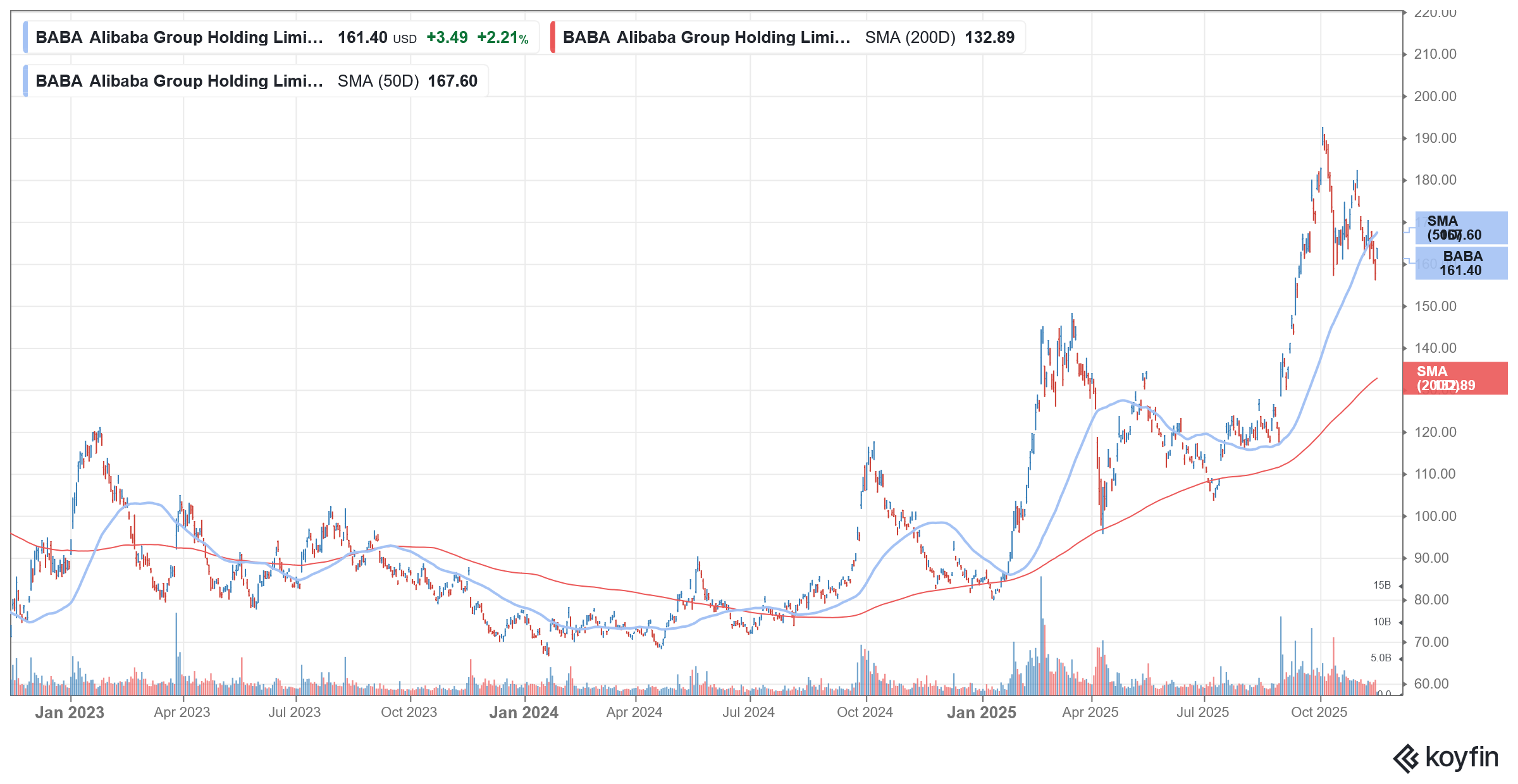
Notably, last month, Alibaba announced new AI models and said that it plans to hike its AI spending as the Chinese tech giant strives to solidify its position as a major player in the global AI landscape.
The industry’s development speed far exceeded what we expected, and the industry’s demand for AI infrastructure also far exceeded our anticipation,” Alibaba’s CEO, Eddie Wu, told a developer conference in Hangzhou last month.
This bold move underscores Alibaba’s determination to solidify its position not only as an e-commerce giant but also as a comprehensive AI service provider. The company has declared artificial general intelligence (AGI) as its primary strategic objective, signaling a fundamental shift in its long-term vision.
Alibaba Cloud, which is the company’s cloud computing arm, showed strong momentum with revenues rising by 26% year-over-year in the June quarter, accelerating from the previous quarter. The company harped on the triple-digit year-over-year growth of its AI-related product revenue. It marked the eighth consecutive quarter of such growth, underscoring the strong market adoption of its AI solutions.
Competition in the Chinese AI Sector
Alibaba is facing fierce competition in China’s AI sector, where domestic rivals like ByteDance’s Doubao and Tencent’s Yuanbao are also vying for market share. By integrating its AI agent directly into its e-commerce powerhouse, Alibaba is leveraging its traditional strength to attract and retain users.
The company’s advancements in its underlying LLM have already made an international impression, with some global tech leaders reportedly choosing Alibaba’s Qwen over rivals like ChatGPT for its cost-efficiency and performance in certain applications.
Ultimately, the Qwen revamp is a powerful statement of intent: Alibaba is leveraging its cutting-edge AI model and extensive digital ecosystem to create a multifunctional, indispensable AI assistant, positioning itself as a major contender in the global race for AI dominance.
Alibaba Is Developing AI Chips
Alibaba is also developing AI chips, and last month it secured a major deal with state-owned telecom company China Unicom to supply AI chips for a new data center.
Of the nearly 23,000 domestically made AI chips currently powering the initial phase of the data center, Alibaba’s chip unit, T-Head, supplied approximately 72%. The remaining chips were sourced from other Chinese companies, including MetaX, Biren Tech, and Zhonghao Xinying, with plans to procure additional chips from Tecorigin (Wuxi), Moore Threads, and Enflame.
This partnership is particularly noteworthy in the context of the ongoing US-China technology standoff. The United States has imposed strict export controls on advanced AI chips, primarily targeting products from industry leader Nvidia, to prevent them from being used for military and national security purposes in China. This has created a vacuum in the Chinese market and spurred domestic companies to accelerate their own chip development.
China Is Pushing for Domestic Chips
As a state-owned enterprise, China Unicom’s decision to favor domestic chips over foreign alternatives reflects a broader government mandate to reduce reliance on US technology. It also signals a growing preference for homegrown solutions, with a China Unicom briefing even stating that Alibaba’s AI chip offers better hardware performance than Huawei’s Ascend 910B, a chip previously championed by authorities.
A key feature of Alibaba’s new chip is that it is being manufactured by a Chinese company. This marks a significant departure from the past, where Alibaba’s earlier AI processors were fabricated by Taiwan Semiconductor Manufacturing Company (TSMC), a firm that the US has since restricted from producing cutting-edge AI chips for China. This shift to domestic manufacturing is in direct alignment with China’s broader national strategy to build a homegrown semiconductor ecosystem and lessen its dependence on foreign technology.