Alibaba Stock Rises After Company Launches New AI Model and Hikes Spending

Please note that we are not authorised to provide any investment advice. The content on this page is for information purposes only.
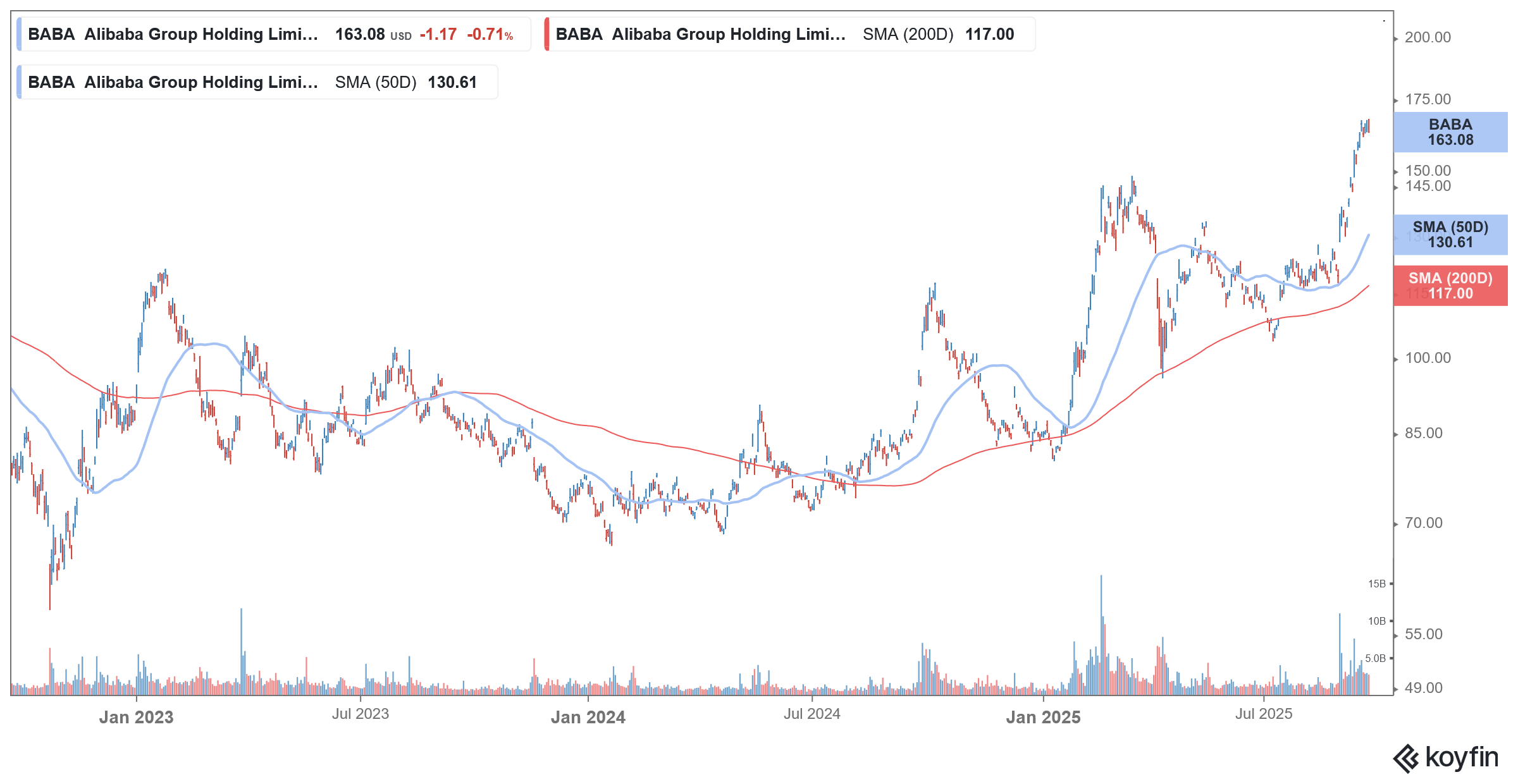
Alibaba stock (NYSE: BABA) hit a four-year high in Hong Kong trading today after the company launched a new artificial intelligence (AI) model and announced plans to hike its AI spending as the Chinese tech giant strives to solidify its position as a major player in the global AI landscape.
Alibaba released its Qwen 3 model in April and has since been launching new updated models. At the heart of Alibaba’s latest push is the Qwen3-Max, a massive language model boasting over 1 trillion parameters. According to the company, this model sets a new performance benchmark, outperforming rivals like OpenAI’s GPT-4o, Anthropic’s Claude, and other leading models from competitors such as DeepSeek on various benchmarks, particularly in the areas of code generation and autonomous agent capabilities.
Alibaba launches new AI model
Autonomous agent functionality is a key feature, allowing the AI to make decisions and execute tasks with minimal human intervention, moving beyond the traditional role of a simple chatbot.
The Qwen3 series also introduces a “hybrid reasoning” approach. This dual-mode system enables the models to provide both rapid responses and more in-depth, complex analysis, offering a flexible and powerful tool for a wide range of applications.
Along with the Qwen3-Max, Alibaba announced several other new models. These include
- Qwen3-Omni: A new open-source, multimodal model that can simultaneously process text, images, audio, and video inputs. This makes it a versatile system for applications in virtual and augmented reality, smart glasses, and intelligent cockpits.
- Qwen-VLo: An advanced AI model for image generation and modification. This model offers greater control to the user, allowing for precise alterations without disrupting other elements in the image.
- 5-VL: A multimodal model with enhanced visual comprehension, capable of understanding charts, diagrams, and videos. It can even process long videos and generate structured outputs from unstructured data.
- 2-animate: A new digital-human video generation model focused on character animation and replacement. This open-source tool simplifies the creation of realistic digital avatars by allowing users to animate a character from a single image and a reference video.
Alibaba Scales Up AI Investments
Meanwhile, Alibaba’s CEO, Eddie Wu, has announced that Alibaba plans to increase its spending on AI infrastructure and development, exceeding the previously announced three-year, 380-billion-yuan ($53 billion) initiative.
“The industry’s development speed far exceeded what we expected, and the industry’s demand for AI infrastructure also far exceeded our anticipation,” Wu told a developer conference in Hangzhou yesterday.
This bold move underscores Alibaba’s determination to cement its position not just as an e-commerce giant but as a full-stack AI service provider. The company has declared artificial general intelligence (AGI) as its primary strategic objective, signaling a fundamental shift in its long-term vision.
BABA’s AI Business Is Gaining Traction
Alibaba Cloud, which is the company’s cloud computing arm, showed strong momentum with revenues rising by 26% year-over-year in the June quarter, accelerating from the previous quarter. The company harped on the triple-digit year-over-year growth of its AI-related product revenue. This marks the eighth consecutive quarter of such growth, underscoring the strong market adoption of its AI solutions.
While there were previously concerns over tech companies’ ability to generate commensurate return on investment (ROI) on their AI investments, many, including Alibaba, have shown strong progress.
“Companies only gain confidence to invest more when the visibility of the returns improve,” said Vey-Sern Ling, managing director at Union Bancaire Privee. He added, “So when they say they are raising investments in AI it indicates good demand from customers and good ROI.”
Alibaba Signed Up First Major Customer for Its AI Chip
Meanwhile, Alibaba’s new AI models come a few days after the company secured a major deal with state-owned telecom company China Unicom to supply AI chips for a new data center.
Of the nearly 23,000 domestically made AI chips currently powering the initial phase of the data center, Alibaba’s chip unit, T-Head, supplied approximately 72%. The remaining chips were sourced from other Chinese companies, including MetaX, Biren Tech, and Zhonghao Xinying, with plans to procure additional chips from Tecorigin (Wuxi), Moore Threads, and Enflame.
This partnership is particularly noteworthy in the context of the ongoing US-China technology standoff. The United States has imposed strict export controls on advanced AI chips, primarily targeting products from industry leader Nvidia, to prevent them from being used for military and national security purposes in China. This has created a vacuum in the Chinese market and spurred domestic companies to accelerate their own chip development.
BABA’s Chip to Compete With Nvidia
Alibaba’s AI chip, developed by its T-Head unit, has been positioned as a direct competitor to Nvidia’s H20, a less powerful chip that the U.S. company is currently permitted to sell in China. The Chinese tech giant’s chip reportedly features 96 gigabytes of memory and HBM2e, a type of vertically stacked DRAM designed for AI semiconductors, placing it in a strong position to fill the void left by restricted foreign technology.
For Alibaba, the deal with China Unicom is a significant validation of its long-term investment in chip research and development. The company has committed to investing at least $50 billion over the next three years in AI and cloud infrastructure, aligning with the national strategy to build a robust, homegrown semiconductor ecosystem. By securing a flagship client like China Unicom, Alibaba not only strengthens its position in the domestic market but also demonstrates the viability of its in-house technology on a large, commercial scale.
China Is Pushing for Domestic AI Chips
As a state-owned enterprise, China Unicom’s decision to favor domestic chips over foreign alternatives reflects a broader government mandate to reduce reliance on US technology. It also signals a growing preference for homegrown solutions, with a China Unicom briefing even stating that Alibaba’s AI chip offers better hardware performance than Huawei’s Ascend 910B, a chip previously championed by authorities.
A key feature of Alibaba’s new chip is that it is being manufactured by a Chinese company. This marks a significant departure from the past, where Alibaba’s earlier AI processors were fabricated by Taiwan Semiconductor Manufacturing Company (TSMC), a firm that the US has since restricted from producing cutting-edge AI chips for China. This shift to domestic manufacturing is in direct alignment with China’s broader national strategy to build a homegrown semiconductor ecosystem and lessen its dependence on foreign technology.