Mortgage Market In Europe

Please note that we are not authorised to provide any investment advice. The content on this page is for information purposes only.
According to the European MortgageFederation’s statistical publication on
European Mortgage markets, Hypostat2003 has revealed a strong growth in Europe’s mortgage markets. Though the GDPgrowth in European union area was of just 0.4% in the 2003 still the mortgagemarkets grew by 7.4%. At end 2003 the total value of residential mortgage debtoutstanding in the EU15 was €4.24 trillion, equivalent to €11,200 worth ofhousing debt per capita.
According to the European MortgageFederation’s statistical publication on
European Mortgage markets, Hypostat2003 has revealed a strong growth in Europe’s mortgage markets. Though the GDPgrowth in European union area was of just 0.4% in the 2003 still the mortgagemarkets grew by 7.4%. At end 2003 the total value of residential mortgage debtoutstanding in the EU15 was €4.24 trillion, equivalent to €11,200 worth ofhousing debt per capita.
Recent Stance Of European Mortgage Market
The following points highlight the recenttrends of European Mortgage market.
- The average rate of home ownership in the EU15 member countries is 64%.The lowest rate is in Germany (41%) and
thehighest rates in Spain and Greece(83%). - The average rate of growth of the residential mortgage market over the last 5 Years is 9% and 8% over the last 10 years.
- The total value of residential and non-residential mortgage loans at the end of 2003 was approximately €5.1 trillion.
Germany and UK, the front line Players in European Mortgage Market
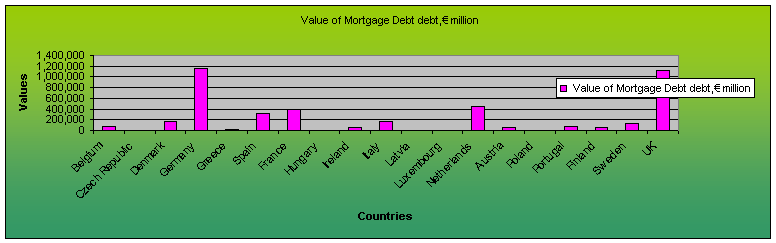
The top players in the mortgage market ofEurope represent over half of all Europe’s outstanding mortgage debt had toface slower rates of growth at 1.2% and 4.4% respectively, compared to an EUaverage rate of growth of over 7%.
Poorer macro-economic position in Germany hasmarked repercussions on itsHousing and mortgage markets.
The UKmarket has slowed down following a number of years of very rapid growth.Over all picture of European Mortgage Market
Countries like German and UK with otherEuropean markets have faced a slower rate of growth in comparison to thesouthern countries where the housing debt is very less.
The Mortgage market in the countries likeLatvia, Poland, Czech Republic and Hungary have experienced a phenomenal growthaveraging in excess of 50% per annuam. Some old EU members have also facedstrong growth due to rising home prices.
Countries like Greece, Spain, Italy, andIreland have faced a mortgage market growth of
Around 25% during 2003.
Rising House Prices In European Market
There is an overall increase in the housingprices in EU areas in recent years by supporting to the consumption activity inthe country. The strongest prices increase was felt in the countries likeLatvia, Portugal, Spain and the UK. However the higher house prices have fueled the demand of more mortgages.
The breakdown of a mortgage payment based on interest can be determined with a mortgage loan calculator.
The European Mortgage Federation
It is a European trade association, whichplays a significant role in the credit sector.
It groups together financial institutions consisting of granting mortgage loans inthe Member States of the European Union and Norway. This Federation was foundedin 1967 and based in Brussels. The Federation has brought together private andpublic mortgage lenders, including universal/commercial banks, mortgage banks,savings banks, mutual &
co-operative banks, building societies,umbrella companies and insurance companies. Together they grant around 75% ofresidential and commercial mortgage loans in Europe.
The below graphs give a true picture of theMortgage market of EU nations.
Overview of European Residential Mortgage Markets, 2003
- Sources : EMF, Mortgage Bankers of America, EUROSTAT, Federal Reserve Reserve