
Belize Industry Sectors

Please note that we are not authorised to provide any investment advice. The content on this page is for information purposes only.
The Belize industry sectors revolve around processing plants that thrive on the flourishing agricultural products. Industries such as textiles or food processing are the most common. Other industries include tourism, which contributes a significant amount towards the national income.[br]
The Belize industry sectors revolve around processing plants that thrive on the flourishing agricultural products. Industries such as textiles or food processing are the most common. Other industries include tourism, which contributes a significant amount towards the national income.[br]
Belize Industry Sectors
Beside the processing segment that produces sugar, citrus and banana products, the manufacturing sector is relatively small. Although the garment sector appeared stable for long, it fell against the stiff competition from the US and Mexico in the late 90s.
Other manufacturing units, such as beer, batteries and beverages, are yet to fully develop and therefore make minimal contribution.
The Belize industry sectors contributed 16.9%, besides 54.1% by the service sector, which included the tourism industry as well. The diagram below shows the contribution of different segments in the GDP: (Figures are in percentage of contribution).
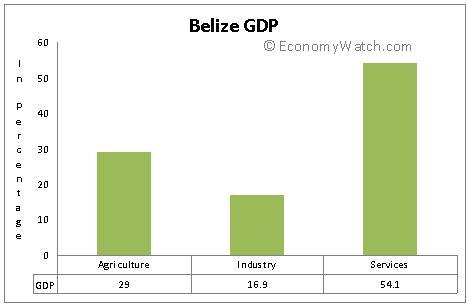
[br]The industry segment, along with the service sector, employs 89.8% (2009 estimates) of the total working population, which has been recorded at 122,300 in 2008. Agriculture employs 10.2% of the population and the unemployment rate is around 8.1%.
Ever since oil has been found in the country, growth has been given the much awaited impetus. Despite the recession, the industry segment could register a positive growth rate of 0.5% in 2009. The country has 6.7 million barrels of proved resources. It currently produces 3,551 barrels a day.
However with the recession fading away, the tourism industry seems to be the most potent instrument for Belize to collect foreign exchange and replenish its current bank account and trade deficit.



