
The Economics of Dissent

Please note that we are not authorised to provide any investment advice. The content on this page is for information purposes only.
In the revolution of the Middle East, the Internet and social media sites such as Twitter and Facebook have certainly tipped the revolutionary equation. As Othman Larki pointed out in hisblog;
Perhaps it is time to update the phrase “The pen is mightier than the sword” to “The Internet is mightier than dictators”
In the revolution of the Middle East, the Internet and social media sites such as Twitter and Facebook have certainly tipped the revolutionary equation. As Othman Larki pointed out in hisblog;
Perhaps it is time to update the phrase “The pen is mightier than the sword” to “The Internet is mightier than dictators”
In a time of accelerated change, regimes that have been in power for decades are being challenged, especially in oppressed populations. The advent of social media seems to be a big factor in affecting that change.
However, the (social media) has yet to change the fundamental fabric of society, but could it in time?
Channels such as Facebook and Twitter are unlikely to be the revolutionary coordination weapon the world has been waiting for:
[quote]Revolutions have always been the tipping of unstable systems, where some relatively minor events offer a coordination point around which dissent congeals. At the heart of the “Revolutionary Equation” is a perspective that revolutions are triggered and won based on information and signaling. Individuals revolt because they expect to make a difference and they expect to be sufficiently numerous that they will overcome their governments’ ability to suppress them. Twitter and Facebook have created an environment in which dissent can reach critical mass outside of governments’ ability to suppress it. The Social Internet has altered the “Revolutionary Equation” by reducing the cost of dissent and increased the cost of suppressing it. [/quote]The Revolutionary Equation: People revolt as a function of three variables: discontent (general measure of dissatisfaction), cost of dissent (personal cost dispensed by the government to those who dissent), and expected mass (expected volume of people who are willing to express their dissent).
Discontent: Let’s consider a distribution of discontent among a population.
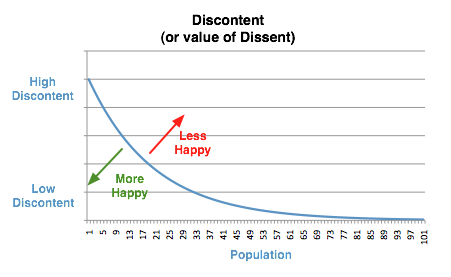
The graph points out that any population will have a distribution of (dis)satisfaction. Happier countries will have a steeper and more concave curve and less happy countries will have a flatter more convex curve. Essentially, the least happy people attribute the highest utility to a revolution.
Cost of Dissent: A government has a relatively fixed ability to dispense “cost” for dissent.
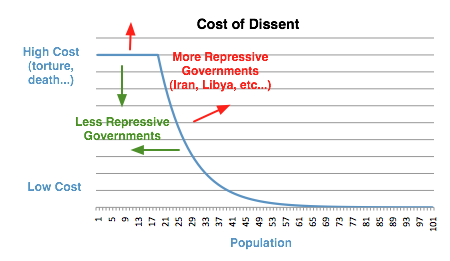
The illustration above is a gross oversimplification of any government that is willing to kill (or severely punish) some of its citizens in order to remain in power. However, no government can kill 100% of its population, so there is a limit to the amount of cost that a government can dispense. Generally, when there are signs of unrest, the more repressive governments will quickly signal to the population that their cost curve stretches up and to the right. As an example, in its reaction to protests against rigged elections in Iran, the government quickly signaled that they were willing to kill their own people in order to maintain control.
Expected Mass and Utility of Dissent: In a stable state, it is not worthwhile for the majority of the population to revolt. You will always have a few anarchists, terrorists or heroes who are sufficiently unhappy that it is worthwhile for them to fight – they know they won’t succeed in overthrowing a regime, but will fight nonetheless.
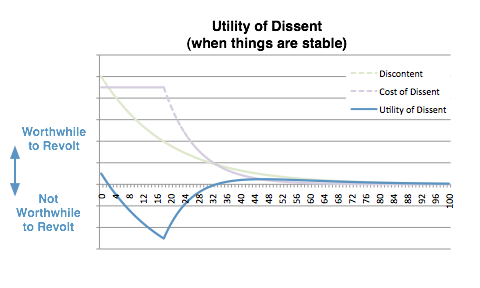
People will revolt when their expected mass exceeds the cost that they expect the government is able or willing to dispense. When people revolt, they are essentially betting that their expected mass is greater than what the government is able to repress. If you assume that the most dissatisfied people will dissent first, you effectively end up with a revolution when you have enough highly dissatisfied people who are willing to dissent at a high cost to get to the point where the government’s ability to suppress dissent breaks down.
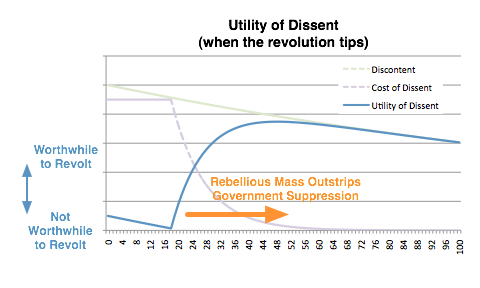
Triggering events are usually caused by the expectation of mass – essentially how people perceive this graph to be. What usually happens next is a race between the population increasing the expected mass (visibility going up as people go to the streets) and the government reducing the expected mass (through information or by breaking up protests) and signaling the ability/willingness to dispense high cost (by bringing out the army or killing/jailing people).
Read the full post on Othman Larki’s blog.
And check out the Corruption Perceptions Index, new on the EconomyWatch.com Economic Statistics Database.



