Tesla Begins Unsupervised Robotaxi Testing in Austin

Please note that we are not authorised to provide any investment advice. The content on this page is for information purposes only.
Tesla (NYSE: TSLA) has taken a significant step in its autonomous vehicle ambitions by beginning fully driverless testing of its Robotaxis on public roads in Austin, Texas.
Footage and reports emerged over the past weekend of Tesla Model Y vehicles, configured for Robotaxi use, navigating city streets with no human occupants in either the driver’s or passenger’s seat. This marks a major shift from the company’s previous Robotaxi pilot in Austin, which launched in June 2025 and featured human “safety monitors” in the passenger seat.
Tesla Begins Testing Unsupervised Robotaxi in Austin
Tesla CEO Elon Musk confirmed the development on X (formerly Twitter), stating: “Testing is underway with no occupants in the car.” This move aligns with Musk’s recent statements, including one made just last week, that he expected the company to remove safety drivers from its Austin fleet within three weeks.
The driverless operation is powered by Tesla’s Full Self-Driving (FSD) software, tailored for Robotaxi use, which demonstrates increased internal confidence in the system’s ability to handle complex urban environments autonomously.
The unsupervised testing appears to be confined to a limited, geo-fenced area of Austin, specifically the downtown and South Congress vicinity, where the pilot program has been running.
The removal of human safety monitors brings Tesla closer to competitors like Waymo, which already operates truly driverless ride-hailing services in several U.S. cities. However, critics point out that, unlike Waymo, Tesla has not publicly released granular safety or disengagement data for its FSD system.
The transition from a system requiring human oversight to one operating entirely autonomously is considered a critical milestone in the development of self-driving technology. While this phase is currently for testing purposes only and not yet open to the general public for rides without human monitors, it is seen as a tangible demonstration of progress toward Tesla’s long-term vision of a widespread, driverless ride-hailing network.
Musk Has Positioned Tesla As An AI Play
During the third-quarter earnings call, Elon Musk emphasized the strategic importance of the Robotaxi program and shared a highly optimistic view of its near-term rollout.
Musk characterized the current time as a “critical inflection point” for the company, stressing that Tesla is the “leader in real-world AI” and that the combination of FSD and Robotaxi will fundamentally change the nature of transport.
The Tesla CEO reaffirmed his ambitious goal to launch the robotaxi service in eight to ten metro areas by the end of 2025, which is a high bar given the short timeline remaining in the year. The company is reportedly targeting major cities like Phoenix, Las Vegas, Dallas, Houston, and Miami next.
Notably, Musk, whose $1 trillion compensation was approved by shareholders at the annual meeting last month, has been positioning Tesla as an AI play.
The most ambitious product reveal at that annual meeting was the Cybercab, the fully autonomous robotaxi designed without a steering wheel, pedals, or side mirrors. Musk confirmed that mass production is scheduled to begin in April 2026 at Gigafactory Texas, with the staggering goal of achieving a 10-second cycle time per vehicle on the production line, six times faster than the Model Y. This manufacturing efficiency is intended to allow for an annual production capacity of up to 2-3 million units, which is central to Tesla’s objective of deploying 1 million robotaxis in commercial service as part of Musk’s long-term compensation milestones.
TSLA’s Deliveries Sag
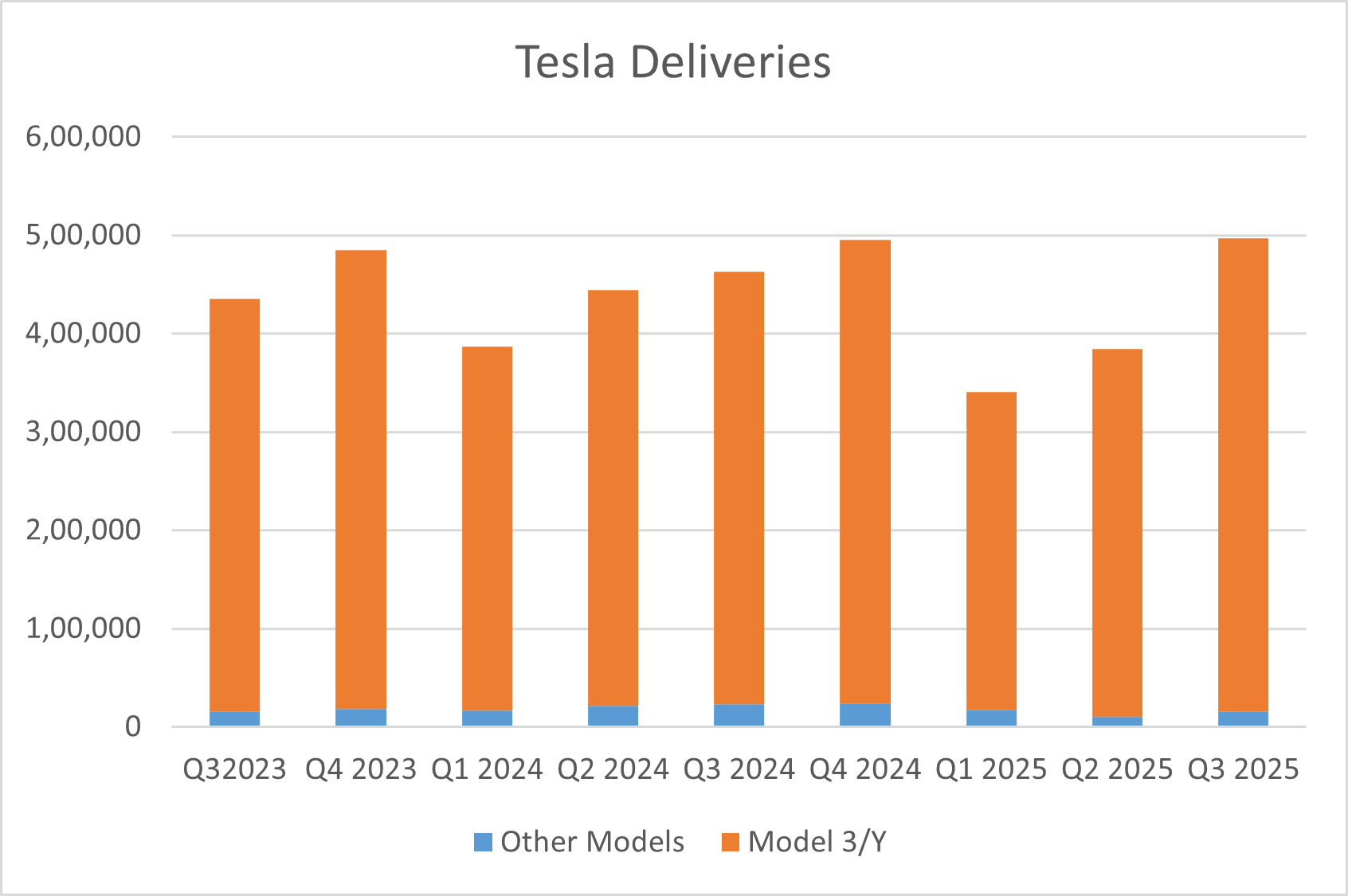
Meanwhile, even as Tesla pivots to AI products like robotaxis and the Optimus humanoid, its automotive business has sagged. The electric vehicle (EV) maker has been navigating what its CEO himself described as a “rough” environment, facing slowing sales growth and intensifying competition globally, particularly in China and Europe.
Tesla experienced a significant downturn in China in October 2025, with its domestic sales hitting their lowest level in three years. This slump comes as the EV market in China intensifies, with local manufacturers gaining substantial market share.
In the US, while Tesla saw a bump in deliveries in Q3 as buyers expedited purchases ahead of the expiration of the EV tax credit, consensus estimates call for a sharp decline in Q4 deliveries. The company looks set to report a yearly decline in deliveries for the second consecutive year amid rising competition and tepid demand.
While Barclays argues that deliveries “likely won’t matter” for Tesla stock, the Future Fund Managing Partner, Gary Black, is cautious on Tesla amid the slowdown in EV sales.
Musk Says Tesla Can Become the Most Valuable Company
Musk has also said multiple times that non-automotive products account for the bulk of Tesla’s valuation. While previously Musk said that Tesla would be more than the combined worth of Apple and Saudi Aramco, he has since been making even bolder predictions, and last year said that the company’s Optimus humanoid would make it a $25 trillion company.
At the shareholder meeting last month, Musk stated the robot represents the future of the company, announcing the incredibly ambitious target of 1 million units delivered to meet one of his $1 trillion pay package requirements over the next decade. He projected that once production scales, the cost of an Optimus unit could be controlled to approximately $20,000, making it an affordable product that would dramatically expand Tesla’s economic scale. The robot’s debut performance, where it danced alongside Musk, was presented as a precursor to a future where Optimus could “eliminate poverty” and perform complex tasks, potentially better than humans.
Musk Touted the Possibility of Chip Production
At that event, Musk revealed details about the next-generation AI5 chip, designed to power the advanced autonomous systems of the Cybercab and Optimus. Acknowledging that the projected needs for this chip far exceed the capacity of current suppliers like TSMC and Samsung, Musk stated Tesla would likely have to construct its own massive chip fabrication facility, which he coined a “terafab.” This facility would be necessary to produce chips at the required volume and would be optimized for power efficiency, consuming roughly a third of the power of competitors’ flagship AI chips at a fraction of the cost.