Intel Unveils Its First AI PC Chip Built on New 18A Manufacturing Technology

Please note that we are not authorised to provide any investment advice. The content on this page is for information purposes only.
Intel (NYSE: INTC) today revealed the full architectural details for its next-generation client processor, the Intel Core Ultra series 3 (code-named “Panther Lake”), which is set to be the first high-volume product built entirely on the company’s leading-edge Intel 18A manufacturing process.
The announcement is a pivotal moment for the US semiconductor giant, aiming to demonstrate the success of its multi-billion-dollar manufacturing turnaround plan and reclaim market leadership in the high-end mobile computing space, which has seen increasing competition.
“Panther Lake” is the first client System-on-Chip (SoC) to leverage Intel 18A, a process node Intel touts as its 2-nanometer class equivalent. The manufacturing is taking place at the new, state-of-the-art Fab 52 in Chandler, Arizona, underscoring Intel’s investment in strengthening U.S. technology and manufacturing leadership.
Intel Unveils New AI PC Chip
Key to the 18A process are two groundbreaking innovations:
- RibbonFET: Intel’s new gate-all-around transistor architecture, enabling greater transistor scaling and improved energy efficiency.
- PowerVia: A backside power delivery system that enhances power flow and signal delivery across the chip.
Intel claims the 18A node delivers up to 15% better performance per watt and 30% improved chip density compared to its previous generation Intel 3 process.
Designed primarily for the next wave of high-end, AI-enabled laptops, the Intel Core Ultra series 3 processors are a convergence of performance and power efficiency.
“We are entering an exciting new era of computing, made possible by great leaps forward in semiconductor technology that will shape the future for decades to come,” said Intel CEO Lip-Bu Tan.
He added, “Our next-gen compute platforms, combined with our leading-edge process technology, manufacturing and advanced packaging capabilities, are catalysts for innovation across our business as we build a new Intel. The United States has always been home to Intel’s most advanced R&D, product design and manufacturing – and we are proud to build on this legacy as we expand our domestic operations and bring new innovations to the market.”
Intel Also Announced a New Server Processor
Intel didn’t limit the announcement to mobile chips, also providing a first look at its next-generation server processor, the Intel Xeon 6+ (code-named “Clearwater Forest”), which is also built on the 18A process. Clearwater Forest is an E-core dominant processor designed for hyperscale data centers, promising major power and performance gains, with configurations of up to 288 Efficiency cores.
While “Panther Lake” architecture details were unveiled today, the first SKUs are slated to begin shipping to customers before the end of this year, with broad market availability in consumer and commercial devices starting in January 2026. The Xeon 6+ server processors are expected to launch in the first half of 2026.
Industry analysts are calling Panther Lake a “must-win” product for Intel. Its success will be a crucial validation of the company’s ability to execute its aggressive manufacturing roadmap and solidify its position as a global leader in advanced semiconductor technology.
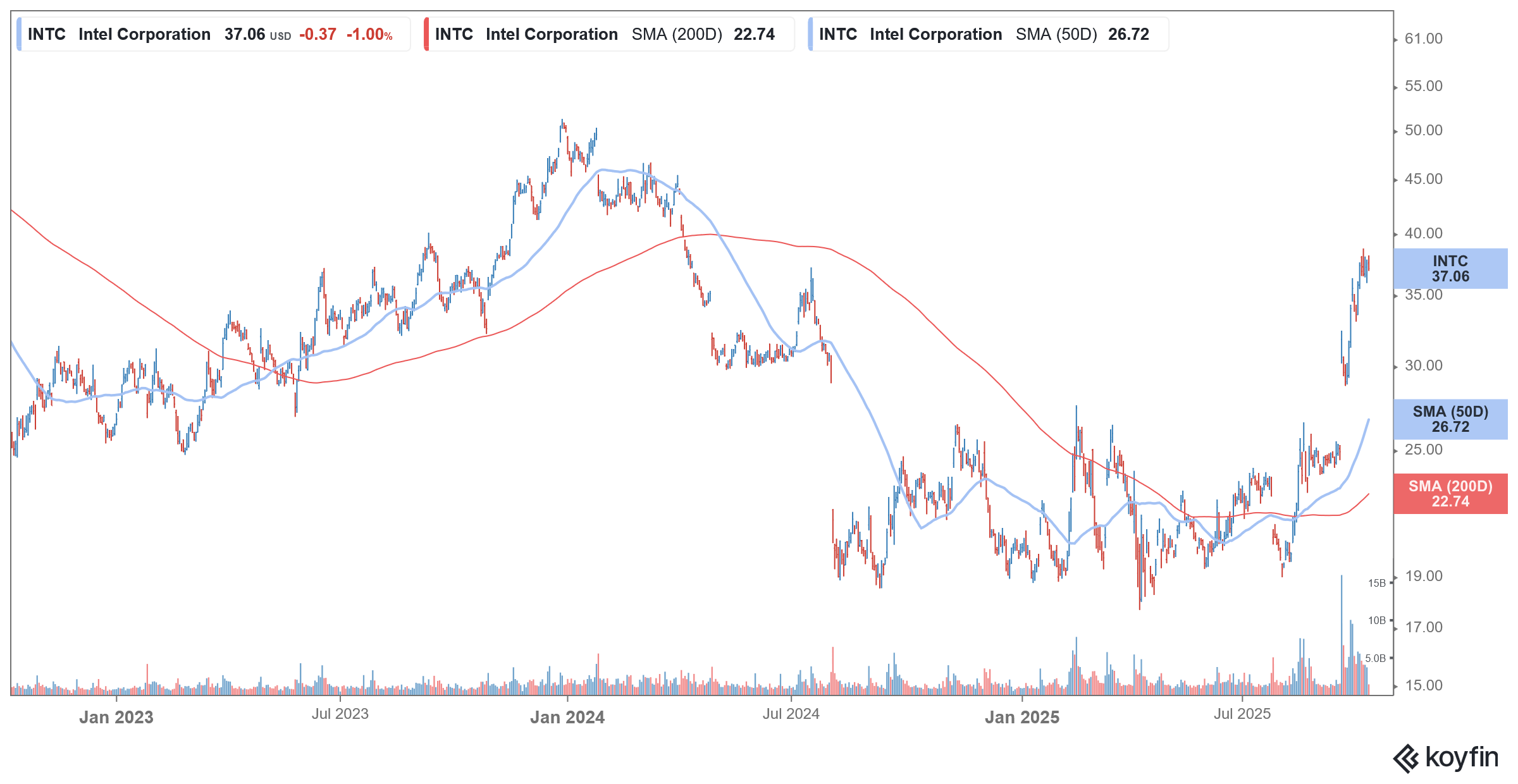
Nvidia Invested in INTC
Meanwhile, Intel has attracted billions of dollars in investments over the last couple of months. Last month, Nvidia announced a $5 billion investment in the company. As part of the agreement, Nvidia will acquire common stock and forge a strategic partnership to co-develop products for AI infrastructure and personal computers.
This deal was a substantial lifeline for Intel, which has struggled financially and technologically after missing the shift to mobile computing and, more recently, falling behind in the AI boom. The company posted significant losses last year and in the first half of this year.
For Nvidia, this investment was a strategic power play. It enhances its ability to control more of the computing stack, especially in AI infrastructure, by aligning with the dominant CPU provider. It also reduces reliance on external bottlenecks and gives it greater influence over integrated solutions that combine CPUs and GPUs. By tightly integrating its technology with Intel’s widely adopted x86 architecture, Nvidia strengthens its dominance in the AI market and poses a formidable challenge to competitors like AMD, which has built its market position on strong CPU-GPU integration.
SoftBank Took a Stake in Intel
In August, SoftBank, which vowed to invest $100 billion in the US over four years following a meeting with Donald Trump in December 2024, said that it would invest $2 billion in Intel at $23 per share.
A few days after SoftBank’s announcement, the US government confirmed that it had acquired a 10% equity stake in Intel, a move that represents one of the biggest federal interventions in a private company since the 2008 financial crisis. The $8.9 billion purchase, which makes the government one of Intel’s largest shareholders, is being funded by converting previously promised grants from the CHIPS Act and the Secure Enclave program into shares.
The government’s equity stake in Intel will be funded by the $3.2 billion awarded to the company as part of the Secure Enclave program, as well as through the remaining $5.7 billion in grants that it was awarded, but not yet paid under the CHIPS and Science Act.
Under the new arrangement, the government acquires 433.3 million shares of Intel at a discounted price of $20.47 per share, a move Commerce Secretary Howard Lutnick hailed as a way to get “equity for the American people.”
Additionally, the government will receive a five-year warrant, at $20 per share for an additional 5% of stake, which would be exercised only if Intel’s stake in its foundry business falls below 51%.
Chips Are Crucial for Building AI Infrastructure
Meanwhile, Intel is far more than just a chipmaker; it’s a critical component of US manufacturing, economic strength, and national security. As the only leading-edge semiconductor company in the US that both designs and manufactures its own chips, Intel plays an irreplaceable role in the domestic technology ecosystem. This position has become even more vital as the US seeks to re-shore critical manufacturing and reduce its reliance on foreign supply chains.
The ability to manufacture advanced semiconductors domestically is a strategic imperative for the US. Chips are the essential building blocks for virtually all modern technology, from personal computers and smartphones to military hardware and artificial intelligence systems.
Intel is a crucial piece for US manufacturing, especially as demand for AI chips skyrockets amid the AI pivot.