GM Stock Rises After Upbeat 2026 Outlook and Buyback Announcement

Please note that we are not authorised to provide any investment advice. The content on this page is for information purposes only.
General Motors (GM) stock is trading sharply higher in US price action today after an impressive Q4 2025 earnings report. While the automaker comfortably beat Wall Street’s profit expectations and rewarded shareholders with a dividend hike, the headline numbers were muddied by massive one-time charges as the company pivots away from its once-aggressive electric vehicle (EV) targets.
GM reported revenues of $45.29 billion in the final quarter of the year, which fell slightly short of the $45.8 billion that analysts were expecting.
GM Posted Better-Than-Expected Earnings
Despite a slight miss on revenue, GM’s adjusted earnings of $2.51 per share significantly outpaced the consensus estimate of roughly $2.20. This was driven by disciplined pricing in North America and a steady demand for high-margin internal combustion engine (ICE) trucks and SUVs.
The reported $3.3 billion net loss was due to $7.2 billion in special charges. These charges stem from a realignment of EV capacity, as GM adjusts to slower consumer adoption and recent shifts in U.S. federal emissions policies and tax incentives.
GM isn’t alone in this retreat. Its primary rival, Ford, took an even larger $19.5 billion hit in December 2025 to scale back its “Model e” division and cancel several future electric truck programs. Both companies are now doubling down on hybrid technology and high-margin gasoline vehicles as a bridge to an uncertain electric future.
General Motors’ 2025 Market Share Was at a Decade High
GM continued to gain market share last year, making it the fourth consecutive year of gains. In fact, its U.S. market share in 2025 was the highest in a decade, which came amid steep tariffs on imported vehicles.
Following a transformative 2025 marked by significant restructuring and a recalibrated EV strategy, General Motors has issued confident financial guidance for 2026. The Detroit automaker expects to deliver adjusted earnings before interest and taxes (EBIT) in the range of $13 billion to $15 billion, reflecting a robust recovery from a charge-heavy 2025. This optimism is underpinned by anticipated adjusted earnings per share (EPS) of $11.00 to $13.00, narrowly exceeding analyst expectations and signaling the company’s resilience in a shifting regulatory landscape.
The company projects automotive operating cash flow to reach between $19 billion and $23 billion, with adjusted free cash flow holding steady between $9 billion and $11 billion.
General Motors Hiked Dividend and Announced New Buyback
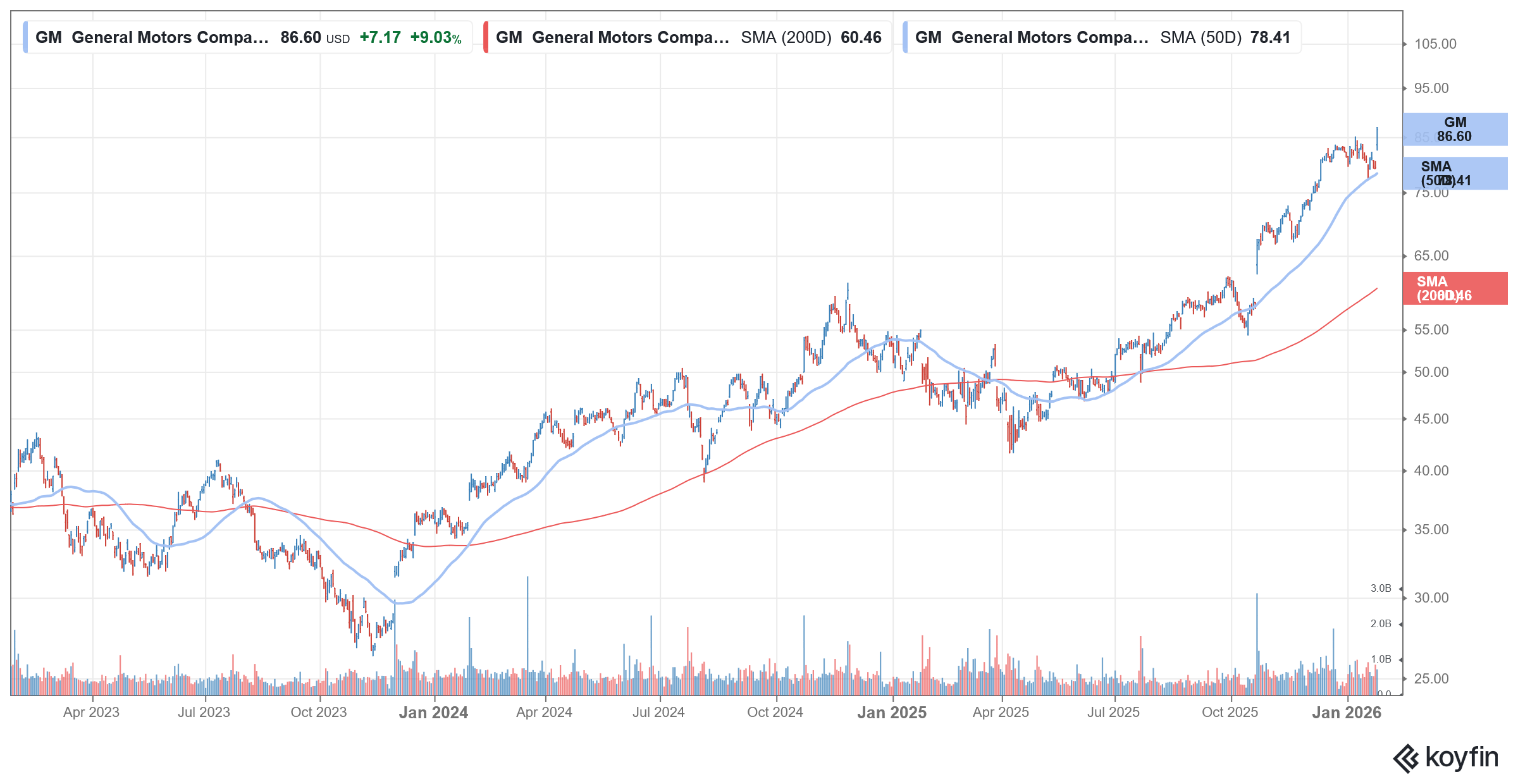
Meanwhile, GM hiked its dividend by 20% to 18 cents and announced a new $6 billion buyback authorization. Notably, GM began aggressively buying back shares in November 2023, and during the Q4 earnings call, CFO Paul Jacobson highlighted that the stock is up 170% since then.
He added, “This performance reinforces our conviction that repurchasing GM’s stock at current valuation levels, which are back to historical norms, but remain well below our peers, represents one of the most compelling opportunities to continue to generate long-term shareholder value.”
Notably, while GM has spent billions on share buybacks and its outstanding share count was 904 million last year, as compared to 1.2 billion at the end of 2023, Ford has prioritized dividends.
GM Incurred $3.1 Billion In Tariffs Costs Last Year
Last year, GM incurred $3.1 billion in gross tariff costs, which was below the guidance that it had provided. Commenting on the tariff impact, Jacobson said, “When we provided updated guidance in October, we were tracking towards the low end of this range, but took a conservative approach given the dynamic trade and tariff environment. We were able to do even better based on strong execution and favorable policy developments during the quarter, including the benefit from a lower tariff rate for Korea.”
Meanwhile, tariff uncertainty is back on the table as President Donald Trump has increased the tariffs on South Korea to 25%. The tariffs would hit GM as the company imports vehicles from the country to the U.S. On its part, GM is trying to offset the tariff impact by onshoring production and is spending billions of dollars in increasing its U.S. production.
GM Is Increasing Production in the U.S.
In the shareholder letter, CEO Mary Barra said, “Looking ahead, we are operating in a U.S. regulatory and policy environment that is increasingly aligned with customer demand. As a result, we continue to onshore more production to meet strong customer demand for our vehicles. Over the next few years, our annual production in the U.S. is expected to rise to an industry-leading 2 million units.”