
Microsoft Stock Plunged After Fiscal Q2 2026 Earnings: Here’s How Analysts Reacted

Please note that we are not authorised to provide any investment advice. The content on this page is for information purposes only.
Microsoft (NYSE: MSFT) released its fiscal Q2 2026 earnings on Wednesday after the close of markets. The report wasn’t received well by markets, and the stock fell almost 10% yesterday, which was its single-day loss since 2020. Here are the key takeaways from the report and how analysts reacted to the earnings.
Table of Contents
Key Takeaways from MSFT’s Earnings Report
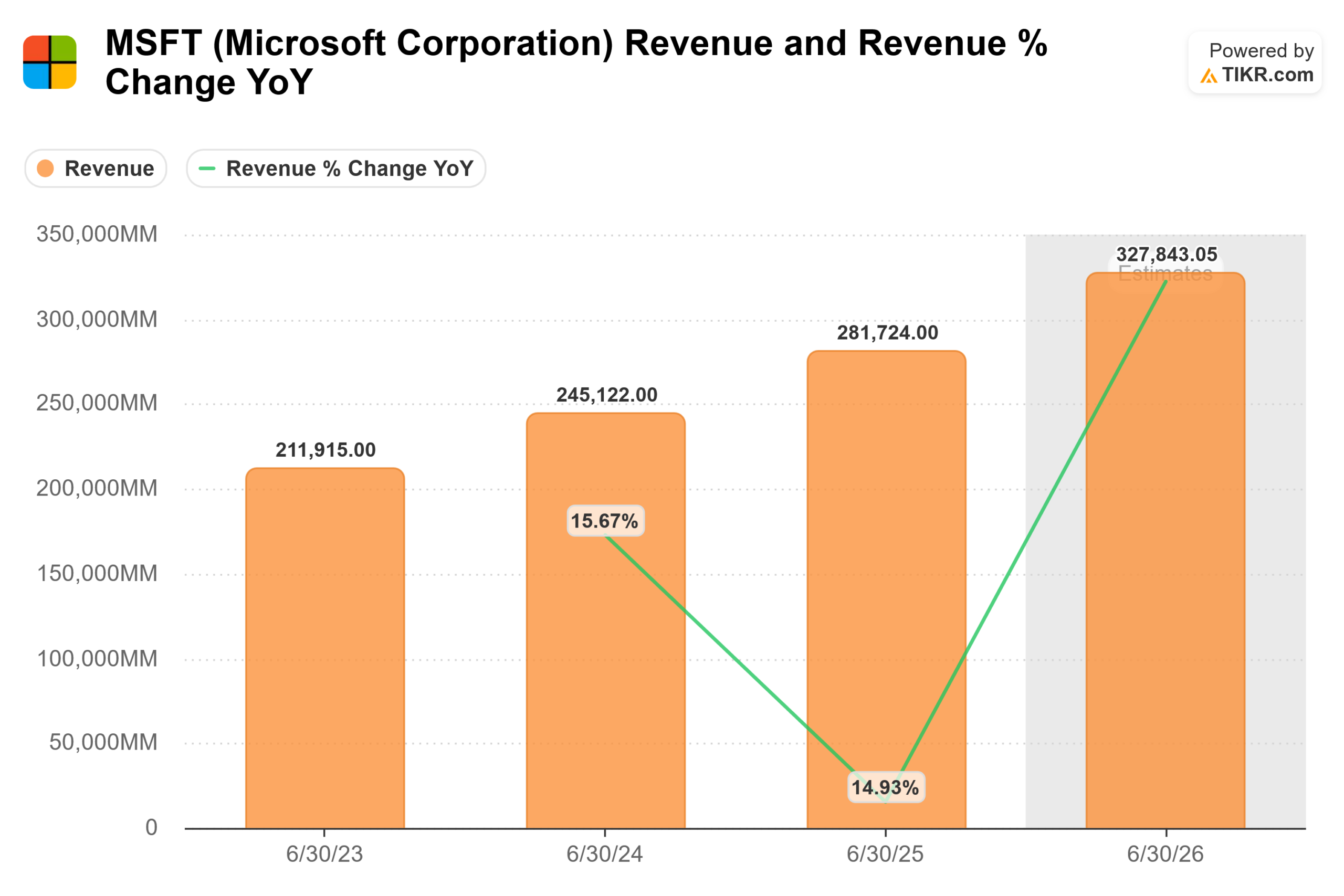
Microsoft reported revenues reached $81.3 billion, a 17% year-over-year increase, and ahead of consensus estimates of $80.27 billion. The company’s non-GAAP earnings per share came in at $4.14, beating analyst expectations of $3.97. The company’s massive investment in artificial intelligence (AI) infrastructure was evident, with capital expenditures surging 66% to $37.5 billion as Microsoft builds out the physical capacity, including custom Maia and Cobalt chips, to meet relentless demand for generative AI services.
Microsoft Saw Broad-Based Growth
Here’s how Microsoft’s different business segments performed in the quarter.
- Intelligent Cloud: This segment remains the company’s primary growth engine, with revenue rising 29% to $32.9 billion. Within this, Azure and other cloud services revenue grew by 39%, fueled by massive demand for AI-enabled infrastructure and a customer base increasingly migrating workloads to the cloud to support large-scale model training and inferencing. The growth rate, however, slightly moderated from the 40% growth that Microsoft reported in the previous quarter.
- Productivity and Business Processes: Revenue increased 16% to $34.1 billion. Growth was driven by Microsoft 365 Commercial cloud (up 17%) and a notable 29% surge in Consumer cloud revenue. Additionally, Dynamics 365 grew 19%, highlighting the steady integration of AI “agents” into business workflows through platforms like Agent 365.
- More Personal Computing: This segment saw a slight contraction, with revenue decreasing 3% to $14.3 billion. While Windows OEM revenue showed resilience with 5% growth (aided by the approaching end-of-support for Windows 10), the segment was weighed down by a 32% drop in Xbox hardware sales, reflecting a cooling global console market.
Microsoft Cloud Revenues Top $50 Billion
Meanwhile, Microsoft reached a key milestone, and its cloud revenues surpassed $50 billion in the December quarter for the first time. The company is quite bullish on the AI opportunity, and during the earnings call, CEO Satya Nadella said, “We are in the beginning phases of AI diffusion and its broad GDP impact. Our TAM will grow substantially across every layer of the tech stack as this diffusion accelerates and spreads. In fact, even in this early innings, we have built an AI business that is larger than some of our biggest franchises that took decades to build.
Microsoft Provided Upbeat Guidance
Looking ahead to the third quarter of fiscal 2026, Microsoft provided a confident outlook with expected revenue between $80.65 billion and $81.75 billion, representing a growth rate of 15–17%. The company anticipates Azure revenue growth to remain strong at approximately 37–38% in constant currency. The guidance was largely in
While heavy capital spending is expected to continue to pressure short-term margins, CFO Amy Hood indicated that Microsoft Cloud gross margins should hover around 65%, as efficiency gains from custom silicon and “tokens per watt” optimizations begin to offset the high cost of GPU procurement.
Analysts Lower Their Target Prices on Microsoft
Despite the slide in Microsoft’s stock price, Wall Street analysts maintained their bullish opinion even as many lowered their target prices.
Morgan Stanley’s Keith Weiss noted that the market is “not seeing the forest for the trees.” The perceived slowdown isn’t due to a lack of customers; it’s a lack of hardware. CFO Amy Hood revealed that if Microsoft hadn’t prioritized internal AI needs (like Copilot) over external Azure customers, the growth KPI would have exceeded 40%.
“The debate is no longer about demand; it is about capacity timing,” added Kirk Materne of Evercore.
Dan Ives of Wedbush Securities lowered his target price from $625 to $575. “The company is capitalizing on the heightened momentum seen in the AI Revolution… weakness in the share price represents strong buying opportunities for long-term investors. We have said this is a multi-year journey,” said Ives in his note.
JPMorgan also lowered Microsoft’s target price from $575 to $550 while maintaining its outperform rating. In his note, JPMorgan analyst Mark Murphy said, “Microsoft showed a ‘solid demand picture’ in its quarterly results… The underlying drivers include softness in less-critical Gaming and Search segments and CPU/GPU capacity constraints in Azure.”
Goldman Sachs Lowered MSFT’s Target Price
Gabriela Borges of Goldman Sachs lowered Microsoft’s target price from $655 to $600 while maintaining her buy rating. “We believe the stock reaction reflects another consecutive quarter of higher-than-expected capex without a commensurate increase in Azure growth. Trading short-term Azure growth now could lead to more AI-positioned growth in the long term.”
KeyBanc also lowered Microsoft’s target price from $630 to $600, and in his note, analyst Jackson Ader said, “We know the short-term pain is real—we’re living it right now. What we don’t know is if the long-term gain is real. We have to wait for the investments to pay off.”
Matt Britzman of Hargreaves Lansdown also expects AI to drive long-term growth for Microsoft.
“Demand for AI is so strong that Microsoft can’t build capacity fast enough. AI services are delivering a big, and growing, chunk of Azure’s growth… that’s a trend we expect to continue.”
OpenAI Accounts For a Big Chunk of MSFT’s Cloud Backlog
Microsoft disclosed that its commercial remaining performance obligation (RPO) stood at $625 billion. However, what’s concerning is the fact that OpenAI accounts for 45% of this backlog. Notably, Microsoft is OpenAI’s largest investor, and its fortunes are closely intertwined with the AI startup.
“The backlog is really good, but the disclosure that OpenAI is 45% of their backlog, it goes back to the situation where, Can OpenAI achieve these financial goals to pay Oracle, Microsoft and many of the providers,” said Jefferies analyst Brent Thill, speaking with CNBC.





