Tether’s Tokenized Gold Accelerates While Dollar Stablecoins Grow Slowly

Please note that we are not authorised to provide any investment advice. The content on this page is for information purposes only.
Tether’s January 26 attestation shows a growing shift toward gold-backed digital assets, with the Tether Gold (XAUT) token expanding faster than stablecoins while Bitcoin struggles with tighter market liquidity.
📉 The combined marketcap of the top 12 stablecoins in crypto has declined by $2.24B in the past 10 days alone. This drop has coincided with a -8% drop in Bitcoin's price. A few things to interpret from this:
🥇🥈 Capital is rotating into traditional safe havens like gold and… pic.twitter.com/jfk1NSGygA
— Santiment (@santimentfeed) January 26, 2026
Recent market data suggests investors are easing off crypto and moving toward safer assets.
Santiment data shows that the total stablecoin supply dropped by about $2.24 billion over ten days, a pattern that usually indicates people cashing out to fiat rather than preparing to buy dips.
In past cycles, stronger crypto recoveries have only taken shape after stablecoin supply levels off and start growing again, something that hasn’t happened yet.
The shift has coincided with a surge in the value of precious metals.
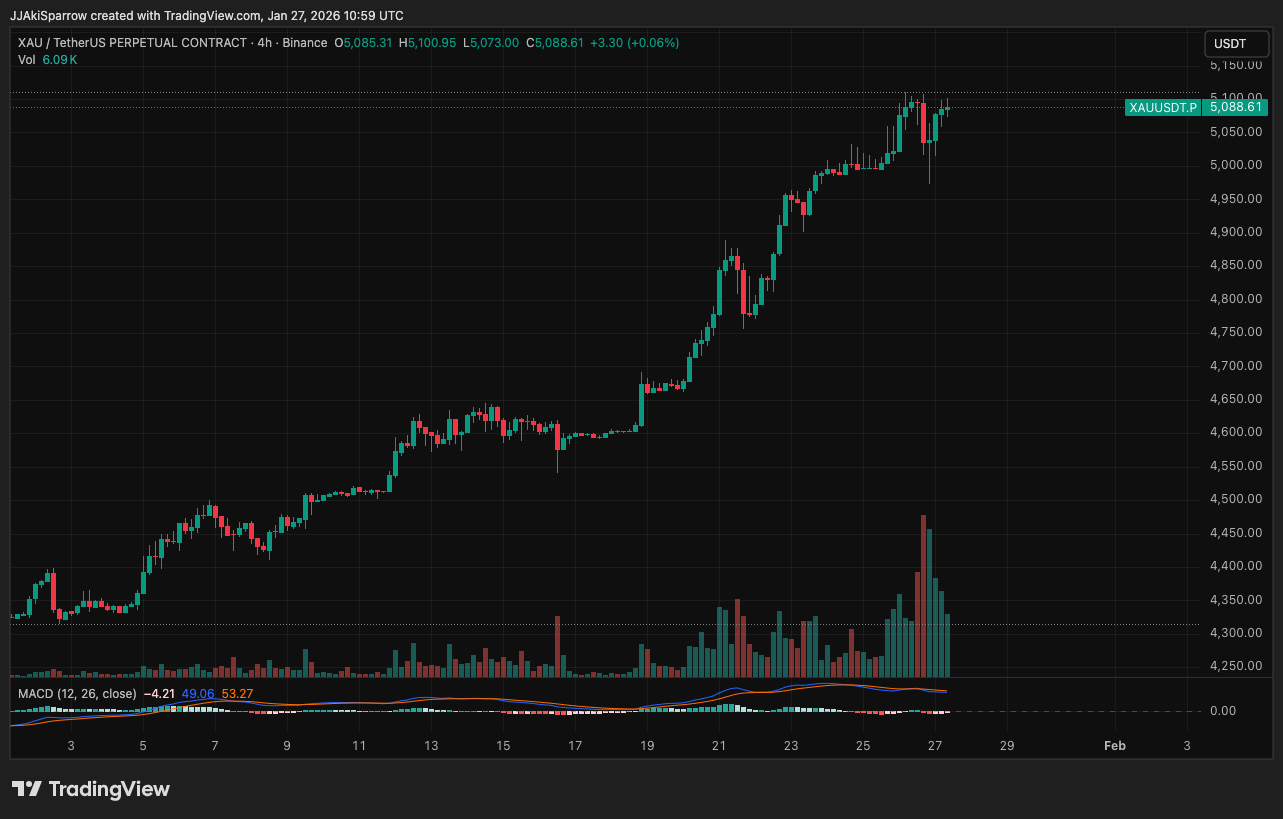
Gold has now hit a new record high above $5,000 an ounce, with silver also posting strong gains, both outperforming Bitcoin since October’s crypto sell-off.
Bitcoin has pulled back from recent highs and, while it has fared better than most altcoins, remains constrained by weaker market liquidity.
Issuer behavior reinforces this defensive tilt. Tether has sharply expanded its exposure to tokenized gold through Tether Gold (XAUT).
BDO Italia data shows Tether’s gold-backed token, XAUT, grew much faster than USDT in the fourth quarter, showing rising demand for gold-linked assets.
Tether also said that it bought a lot of gold during this time. showing that it is relying more on precious metals as part of its own reserve strategy.
Still, until more stablecoins are issued and new money comes in, gains in the crypto markets, especially in riskier altcoins, are likely to stay small, even though Bitcoin is acting as a relative anchor.
Bitcoin Buying Persists Under Pressure as Stablecoin Scrutiny Eases Beyond the U.S.
Bitcoin prices remain under pressure, but institutional investors see things differently.
Funds, company treasuries, and long-term holders have continued to add Bitcoin, even as interest from smaller traders has slowed.
This steady accumulation has helped keep prices from falling further. Similar behaviour has shown up before during weak markets, when institutions add positions while short-term traders stay on the sidelines.
Regulation has also moved back into focus. In the United States, banks are objecting to yield-bearing stablecoins as new crypto bills move through Congress.
The debate reflects ongoing disagreements between banks and blockchain-based financial products.
🏦U.S. Bank Lobby Targets Stablecoin Yields in 2026@ABABankers says banning stablecoin yield is a top 2026 priority, warning that interest-bearing stablecoins could drain bank deposits and weaken lending, according to @Cointelegraph.
ABA urges lawmakers to close loopholes that… pic.twitter.com/LEEobWYQ8m
— ME Group (@MetaEraHK) January 23, 2026
Outside the U.S., governments are also revisiting stablecoin rules. Australia is among the countries working on clearer frameworks, though final decisions have not been made.
In earlier market cycles, activity only picked up after stablecoin supply started to grow again. That has not happened yet, leaving the market quiet while buying continues in the background.