Intel Stock Falls On Reports of Nvidia Halting 18A Chip Test

Please note that we are not authorised to provide any investment advice. The content on this page is for information purposes only.
Intel stock (NYSE: INTC) is trading lower in US price action today, following reports that Nvidia has halted its evaluation of Intel’s most advanced chipmaking technology, the 18A process node.
The news, first reported by Reuters, represents a major technical and psychological blow to Intel’s turnaround strategy. The 18A node (1.8nm-class) is the cornerstone of Intel’s plan to reclaim manufacturing leadership from Taiwan Semiconductor Manufacturing Company (TSMC).
Nvidia Reportedly Halts Testing of INTC’s 18A Chip
Nvidia is currently the world’s most influential designer of AI chips. An endorsement from Nvidia in the form of a manufacturing contract would have served as the ultimate validation of Intel’s foundry capabilities.
According to sources familiar with the matter, Nvidia recently tested whether it could manufacture its high-performance chips using Intel’s 18A process but decided not to move forward with further testing at this time.
While Intel claims the 18A process is “progressing well,” a halt by a major partner suggests that the manufacturing yields (the percentage of usable chips on a wafer) may not yet meet the rigorous standards required for mass-producing complex AI hardware.
Intel Has Been Looking to Expand Its Foundry Business
Intel has been aggressive in courtships with “fabless” companies like Nvidia and Broadcom. A rejection from the industry leader makes it more challenging to persuade other high-volume customers to switch away from TSMC.
Intel’s goal is to begin high-volume manufacturing for its own products (like Panther Lake) on 18A in 2025. Any delay in external customer adoption creates a revenue gap in its expensive new fabrication plants.
Nvidia Announced a $5 Billion Investment in Intel
The reported testing halt is particularly jarring because it follows a $5 billion equity investment Nvidia made in Intel earlier this year. However, analysts note that the investment was always a strategic partnership focused on product collaboration, such as integrating Nvidia RTX GPUs into Intel x86 chips rather than a binding manufacturing agreement.
As part of that agreement, Nvidia will acquire common stock and forge a strategic partnership to co-develop products for AI infrastructure and personal computers.
The deal was a substantial lifeline for Intel, which has struggled financially and technologically after missing the shift to mobile computing and, more recently, falling behind in the AI boom. The company posted significant losses in 2024 and in the first half of this year.
For Nvidia, this investment was a strategic power play. It enhances its ability to control more of the computing stack, especially in AI infrastructure, by aligning with the dominant CPU provider. It also reduces reliance on external bottlenecks and gives it greater influence over integrated solutions that combine CPUs and GPUs. By tightly integrating its technology with Intel’s widely adopted x86 architecture, Nvidia strengthens its dominance in the AI market and poses a formidable challenge to competitors like AMD, which has built its market position on strong CPU-GPU integration.
SoftBank Also Invested in Intel
In August, SoftBank, which vowed to invest $100 billion in the US over four years following a meeting with Donald Trump in December 2024, said that it would invest $2 billion in Intel at $23 per share.
A few days after SoftBank’s announcement, the US government confirmed that it had acquired a 10% equity stake in Intel, a move that represents one of the biggest federal interventions in a private company since the 2008 financial crisis. The $8.9 billion purchase, which makes the government one of Intel’s largest shareholders, was funded by converting previously promised grants from the CHIPS Act and the Secure Enclave program into shares.
The government’s equity stake in Intel was funded by the $3.2 billion awarded to the company as part of the Secure Enclave program, as well as through the remaining $5.7 billion in grants that it was awarded, but not yet paid under the CHIPS and Science Act.
Under the new arrangement, the US government acquired 433.3 million shares of Intel at a discounted price of $20.47 per share, a move Commerce Secretary Howard Lutnick hailed as a way to get “equity for the American people.”
Additionally, the government received a five-year warrant, at $20 per share for an additional 5% of stake, which would be exercised only if Intel’s stake in its foundry business falls below 51%.
Intel Lost Out to Other Chip Companies
Intel, which was once the world’s biggest chipmaker, is now a pale shadow of its glorious past.
A lot went wrong with Intel over the last two decades. It made the strategic blunder of turning down the offer to supply processors for the Apple iPhone. The company believed that Apple might not be able to sell enough of these, and it was a tiny market to bet on.
Intel was relatively slow with innovation, and AMD gradually gained market share in the PC market. Apple, too, stopped using Intel chips for its Mac and instead pivoted to its own chips.
Intel was pivoting to the foundry model and hoped to make chips for other chip designers. However, despite burning billions of dollars on that business, Intel hasn’t been able to secure enough clients for its foundries. If Nvidia indeed pulls out of 18A testing, it would be yet another blow to Intel.
INTC Stock Trades At a Fraction of Its All-Time Highs
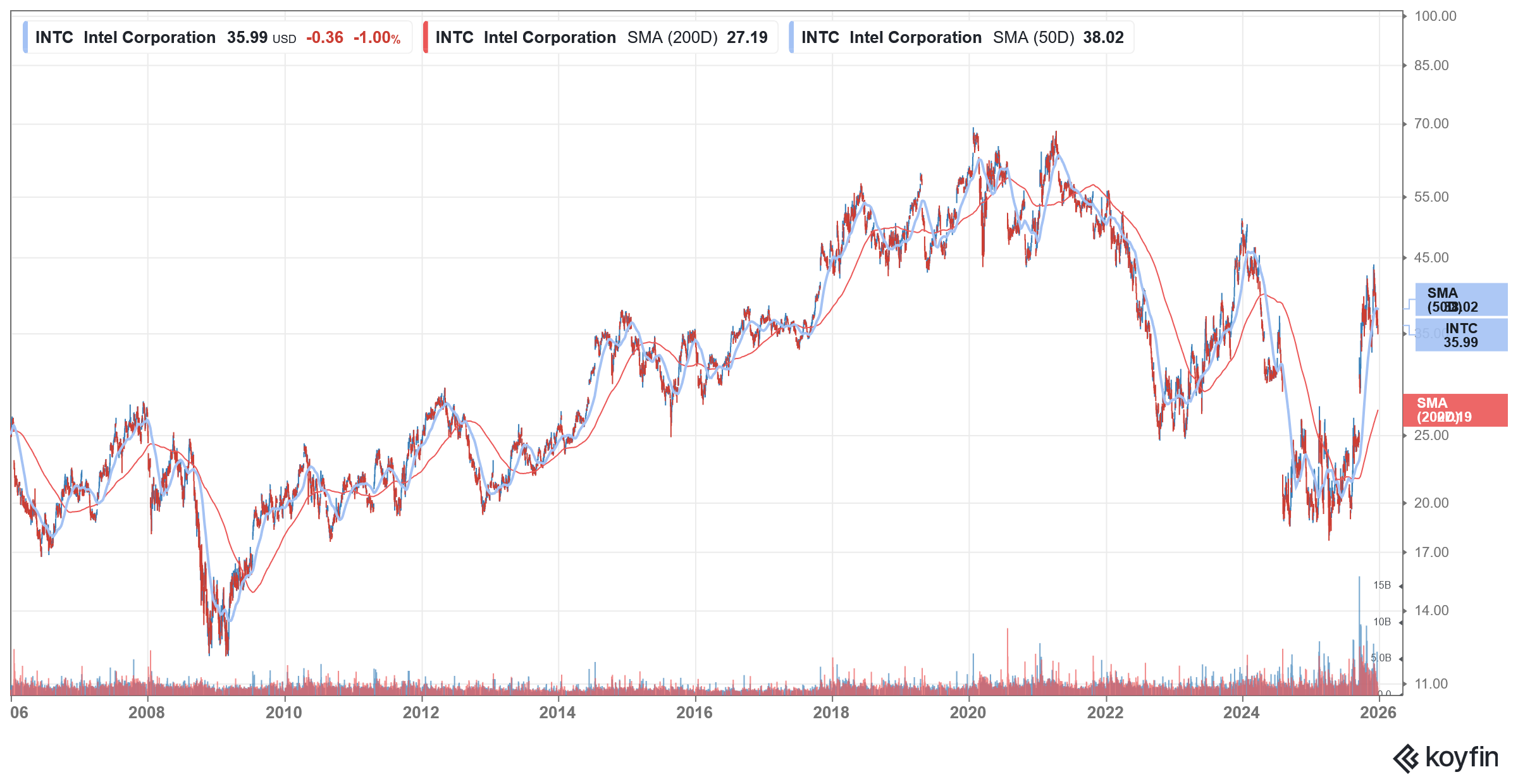
Despite being the biggest beneficiary of the CHIPS Act, Intel has not yet been able to turn the corner, even as the turnaround remains a work in progress. While Intel stock has seen some upward momentum over the last six months, it trades at a fraction of its all-time highs, even as Nvidia has become a 4 trillion-dollar behemoth riding the AI euphoria.
Intel Is a Key Piece of US Manufacturing
Meanwhile, Intel is far more than just a chipmaker; it’s a critical component of US manufacturing, economic strength, and national security. As the only leading-edge semiconductor company in the US that both designs and manufactures its own chips, Intel plays an irreplaceable role in the domestic technology ecosystem. This position has become even more vital as the US seeks to re-shore critical manufacturing and reduce its reliance on foreign supply chains.
The ability to manufacture advanced semiconductors domestically is a strategic imperative for the US. Chips are the essential building blocks for virtually all modern technology, from personal computers and smartphones to military hardware and artificial intelligence systems.
However, time and again, Intel has been found wanting on innovation and execution, and while it now has the financial capital and political backing from the US government, the company has yet to showcase its ability to compete with Asian chipmakers.