Baird Upgrades Rivian Ahead of R2 Launch Next Year

Please note that we are not authorised to provide any investment advice. The content on this page is for information purposes only.
Baird analyst Ben Kallo has upgraded Rivian Automotive (NYSE: RIVN) from “Neutral” to “Outperform” while raising its target price from $14 to $25. The revision signals a potential upside of over 40% from its current trading levels, reflecting a shifting sentiment on Wall Street as Rivian nears a pivotal 2026.
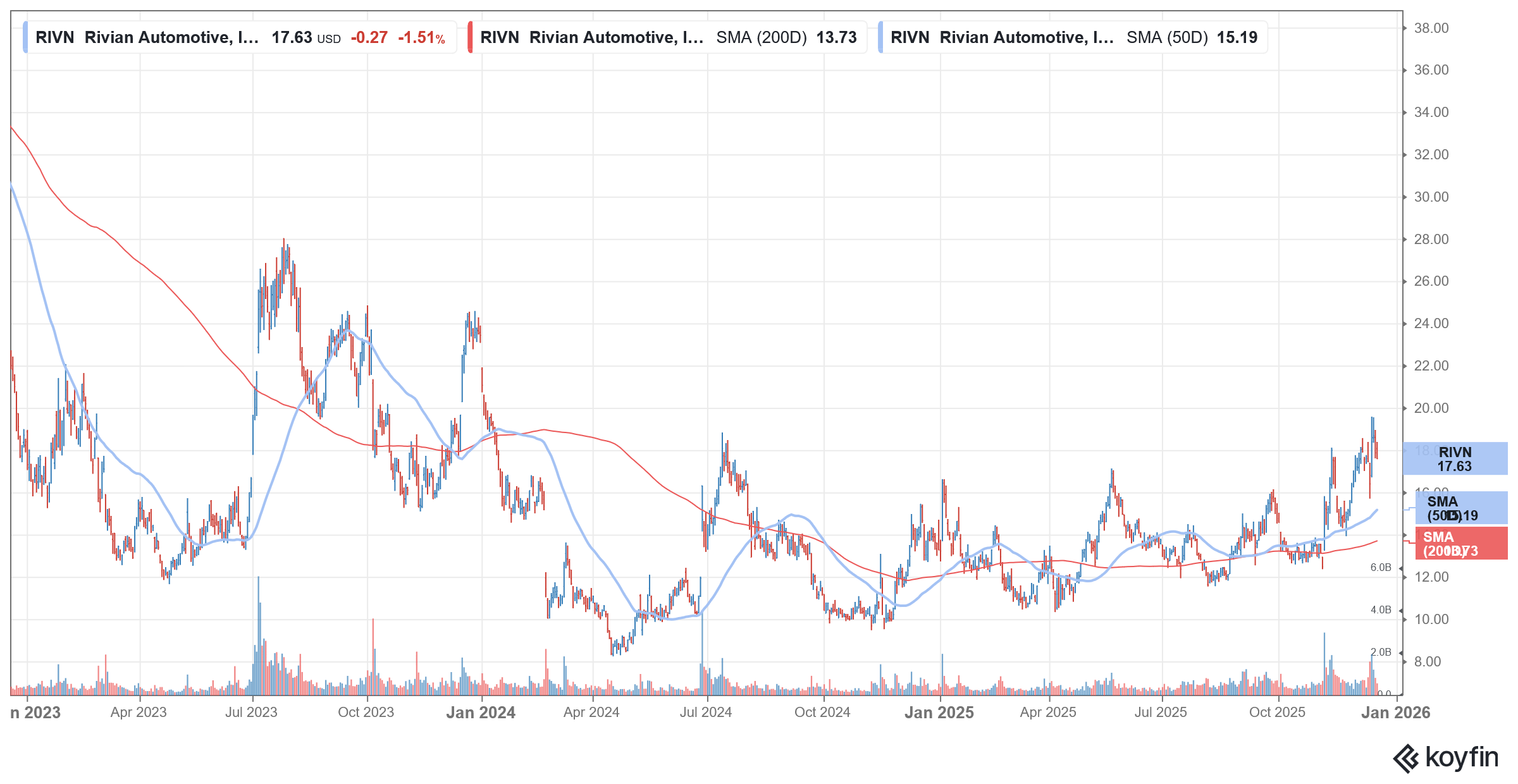
Rivian stock is trading higher in US premarket price action today and looks set to add to its YTD outperformance. The stock is on track to have its best year since the 2021 listing, when its market cap soared above $150 billion amid bullish sentiments towards electric vehicle (EV) companies. Meanwhile, startup EV companies failed to live up to the promise, and while some have gone out of business, Rivian trades at a fraction of its 2021 highs.
Baird Upgrades Rivian
Baird’s decision to move Rivian to a “Buy” equivalent rating is driven by three primary catalysts. These include.
- The R2 “Product Cycle” Advantage: The most immediate driver is the upcoming R2 SUV, Rivian’s mid-sized, more affordable platform, whose deliveries are expected to commence next year. Baird noted that they “want to own into the new product cycle,” expecting the R2 to expand Rivian’s addressable market significantly. The R2 is seen as a direct competitor to the Tesla Model Y, providing the volume necessary for Rivian to scale toward profitability.
- Technological “Autonomy” Breakthroughs: Following Rivian’s recent Autonomy & AI Day, analysts have been impressed by the company’s vertical integration. Rivian unveiled its proprietary Rivian Autonomy Processor (RAP1), a custom 5nm chip designed to handle massive vision-centric AI tasks. By moving away from off-the-shelf NVIDIA chips to in-house silicon, Baird believes Rivian can accelerate software development while lowering long-term hardware costs.
- Financial Stability and the Volkswagen Partnership: Rivian’s balance sheet looks much healthier than it did a year ago. The $5 billion joint venture with Volkswagen has provided a vital capital infusion, effectively bridging the gap to the R2 launch. With over $7 billion in cash and equivalents, Rivian has the “runway” to survive the expensive ramp-up of its new manufacturing lines in Normal, Illinois.
Morgan Stanley Downgraded Rivian and Tesla
Meanwhile, the analyst community is divided over the outlook for the EV sector, and earlier this month, Morgan Stanley issued a sweeping “EV reset,” downgrading both Tesla and Rivian. The move signaled a transition from “EV optimism” to a more cautious “EV winter” outlook as the market grapples with slowing adoption, fading government incentives, and valuation concerns.
The reports were led by analyst Andrew (Justin) Percoco, who recently took over coverage of the sector from longtime Morgan Stanley bull Adam Jonas. While Baird is bullish on Rivian ahead of the R2 launch, Morgan Stanley believes that the model would cannibalize the sales of the current R1 lineup.
Morgan Stanley projects Rivian will burn through roughly $4.2 billion in free cash flow in 2026 alone.
Rivian Lowered Its 2025 Guidance
While Rivian’s Q3 deliveries were better-than-expected, it revised its 2025 full-year delivery forecast to a range of 41,500 to 43,500 vehicles, down from its prior guidance range of 40,000 and 46,000 vehicles. Notably, even the top end of the guidance implies a 16% year-over-year fall in deliveries. The company’s deliveries fell last year, also amid a slowdown in the US EV market, where even market leader Tesla is struggling and reported its first annual drop in deliveries last year.
US EV Sales Soared in Q3
Q3 was a strong quarter for Tesla and other EV companies. One significant factor contributing to the bump in Q3 sales was the expiration of the $7,500 U.S. federal EV tax credit for leases at the end of September 2025. This “tax credit cliff” is expected to temper demand in the final quarter of the year, as consumers who rushed to purchase or lease before the deadline are now out of the market, and the financial incentive for new buyers is diminished.
Meanwhile, amid all the slowdown noise, Rivian broke ground at its Georgia plant in September. The Georgia plant would have an annual nameplate capacity of 400,000 units, and the company announced plans for the facility shortly after its blockbuster IPO in late 2021, which was the largest listing since Facebook’s (now Meta Platforms) 2012 listing.
Georgia provided a generous $1.5 billion incentive package in 2022, and by October 2023, the site was reported to be 95% graded and nearly ready for construction.
Rivian Has Resumed Construction At the Georgia Plant
However, in March 2024, Rivian announced a pause in construction at its Georgia plant. The aim was to reduce capital expenditure and accelerate the R2’s market entry. Notably, amid the perennial cash burn, Rivian’s cash reserves have decreased, and the company made a prudent decision to conserve cash.
The R2 is critical for Rivian’s long-term success and profitability. By offering a more affordable and mainstream EV, Rivian aims to attract a larger customer base beyond the niche premium segment. Moreover, the model would help drive higher production volumes, which is essential for achieving economies of scale and improving gross margins.
US EV Price War Might Escalate
With a flurry of companies working on affordable EV models, the competition in that space is set to intensify. This might lead to an escalating price war as these models compete for market share. There is some economic rationale behind companies cutting prices. For instance, as production volumes increase, manufacturers achieve greater economies of scale. Fixed costs are spread over more units, further reducing the per-vehicle production cost.
As market leader, Tesla cut costs; other players like Rivian are forced to lower prices to stay competitive. However, while Tesla’s profitable and cash-generating operations give it the leeway to cut prices, EV startups are already saddled with losses and cash burn, and the price war is making things only complicated for them.