Rivian Reportedly Looking at Layoffs Amid Tepid EV Demand

Please note that we are not authorised to provide any investment advice. The content on this page is for information purposes only.
Startup electric vehicle (EV) manufacturer Rivian (NYSE: RIVN) is reportedly planning to lay off more than 600 employees, or approximately 4% of its workforce, as the company navigates a challenging market and intensifies its focus on cost efficiency.
According to sources familiar with the matter, these layoffs follow a smaller reduction just last month, underscoring the ongoing pressure facing EV startups. The layoffs are reportedly concentrated in commercial roles within the servicing and sales departments.
Rivian Is Looking to Layoff 600 Employees
The move is part of Rivian’s aggressive strategy to reduce costs and preserve cash as it works toward achieving a positive gross margin and prepares for the 2026 launch of its more affordable R2 SUV. The company’s financial health has been under increasing scrutiny, with significant losses and high volatility in its stock.
Rivian’s latest round of job cuts is a stark indicator of the turbulence in the automotive sector, where even highly valued startups are forced to make tough decisions to navigate economic headwinds and a rapidly evolving regulatory landscape. The company, which had just under 15,000 employees at the end of last year, is now under pressure to prove that its cost-cutting measures will be enough to stabilize its financials before the R2 launch.
Several factors are contributing to the company’s decision to downsize:
- Softening EV Demand: While Rivian reported a rise in third-quarter sales, the overall U.S. electric vehicle market has shown signs of weakening, particularly as high interest rates make vehicle financing more expensive for consumers.
- Policy Shifts: Changes in government policy, including the discontinuation of a significant federal EV tax credit, have impacted the company’s revenue stream. Rivian had previously estimated that such policy revisions could stall roughly $100 million in revenue from compliance credit sales.
- Cost Efficiency Drive: The layoffs align with Rivian’s stated goal of “aggressively focused on driving cost efficiency throughout the business” to ensure long-term growth and profitability. This goal has been consistently communicated by CEO R.J. Scaringe amid prior rounds of layoffs and lowered production forecasts.
Rivian Reported an Increase in Q3 Deliveries
Rivian delivered 13,201 vehicles in Q3 as compared to 10,018 vehicles in the corresponding quarter last year. However, a closer look at the numbers reveals a complexity in the ramp-up. The production figure of 10,720 vehicles was notably lower than the 13,157 vehicles produced in the corresponding quarter of 2024. This production-delivery gap, where the company delivered significantly more vehicles than it built, indicates a strategy of clearing existing inventory built up in prior quarters.
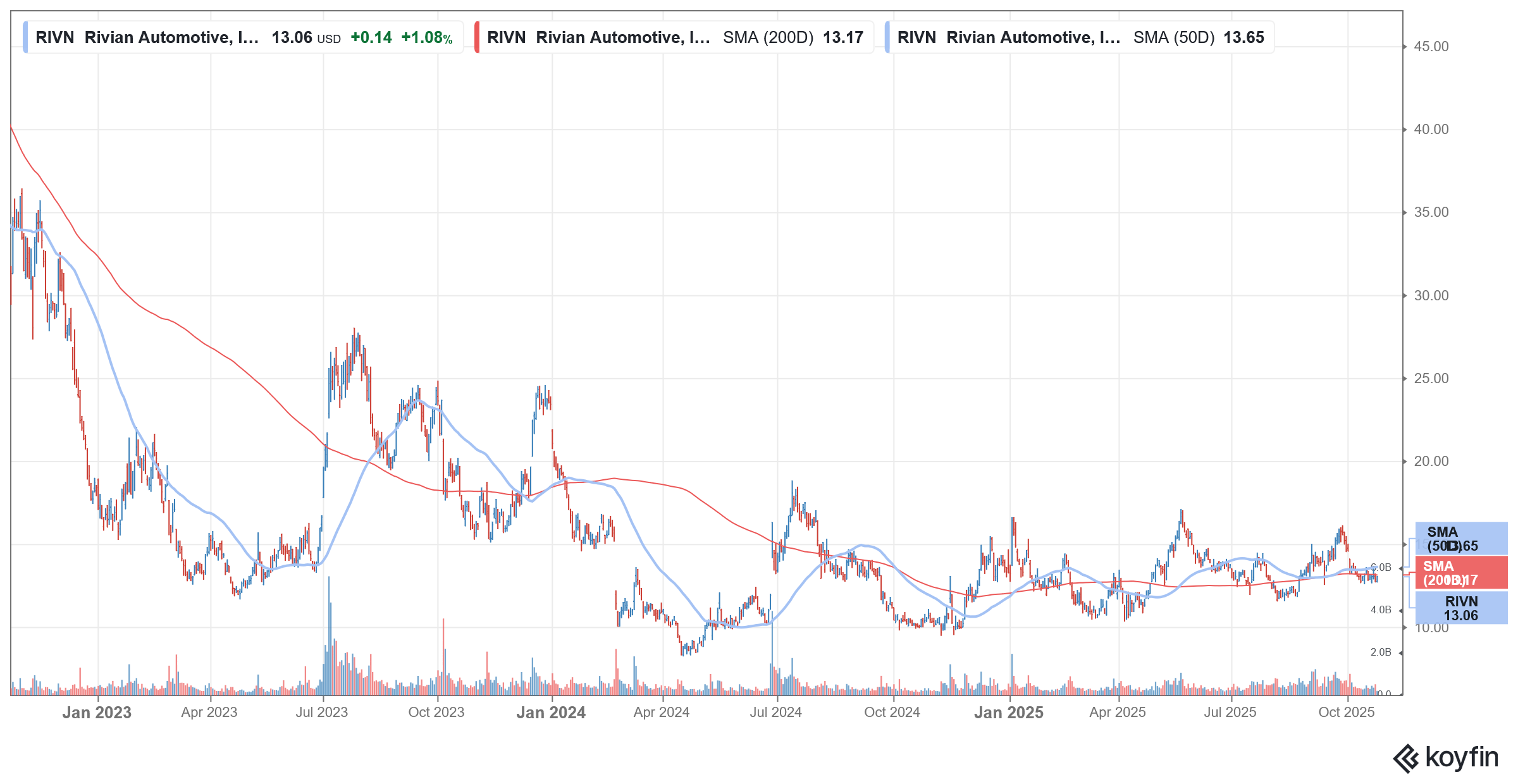
Despite the strong delivery beat, the company’s simultaneous announcement to narrow its full-year delivery guidance injected a note of caution into the market. Rivian revised its 2025 full-year delivery forecast to a range of 41,500 to 43,500 vehicles, down from its prior guidance range of 40,000 and 46,000 vehicles. Notably, even the top end of the guidance implies a 16% year-over-year fall in deliveries. The company’s deliveries fell last year, also amid a slowdown in the US EV market, where even market leader Tesla is struggling and reported its first annual drop in deliveries last year.
GM Took a $1.6 Billion Charge
Legacy automakers’ EV business is also struggling, and General Motors (NYSE: GM) took a $1.6 billion charge in Q3, including approximately $1.2 billion in non-cash impairments and about $400 million in cash supplier cancellation costs, signaling the company’s move to “right-size” its EV assets amid a more tempered pace of electric vehicle adoption than initially projected.
US EV Sales Soared in September
The US EV market saw a significant acceleration in adoption in September, with sales and market share hitting a new record high for the month. This surge was primarily fueled by a rush from consumers to take advantage of impending deadlines for federal tax credits.
According to market data, EVs, including Battery Electric Vehicles or BEVs, and Plug-in Hybrid Electric Vehicles or PHEVs, the market share of new light-duty vehicle sales climbed to an estimated 12.2% to 13% in September. This is a notable increase from earlier in the year, helping push the overall EV share for the third quarter to a new record of around 10.5%.
BEVs reached a record market share of approximately 11.8% of all new vehicles sold in September, demonstrating robust consumer interest in fully electric models.
Rivian Broke Ground At Georgia Plant
Meanwhile, amid all the slowdown noise, last month Rivian broke ground at its Georgia plant, whose construction it previously halted. The Georgia plant would have an annual nameplate capacity of 400,000 units, and the company announced plans for the facility shortly after its blockbuster IPO in late 2021, which was the largest listing since Facebook’s (now Meta Platforms) 2012 listing.
Georgia provided a generous $1.5 billion incentive package in 2022, and by October 2023, the site was reported to be 95% graded and nearly ready for construction.
However, in March 2024, Rivian announced a pause in construction at its Georgia plant. This decision was driven by a strategic move to prioritize the launch of its more affordable R2 SUV, with initial production slated for its existing plant in Normal, Illinois. The aim was to reduce capital expenditure and accelerate the R2’s market entry.
Notably, amid the perennial cash burn, Rivian’s cash reserves have decreased, and the company made a prudent decision to conserve cash.
Volkswagen Invested in Rivian
Prospects of Rivian restarting the Georgia plant brightened last year after German auto giant Volkswagen announced a multi-billion-dollar investment in the company, some of which is linked to its meeting pre-set milestones.
The agreement is expected to bolster Rivian’s financial position and facilitate cost reductions through joint component sourcing. This strategic partnership is crucial for Rivian as it continues its path towards profitability.
During their Q4 2024 earnings call, Rivian said that it expects to realize revenues of $2 billion from Volkswagen over the next four years as their joint ventures deliver on the pre-set milestones. This, Rivian said, would include the cash received from Volkswagen for licensing of intellectual property, coupled with equity premiums and other noncash benefits.