Apple Stock Surges On Reports Of Strong iPhone 17 Sales in China and the US

Please note that we are not authorised to provide any investment advice. The content on this page is for information purposes only.
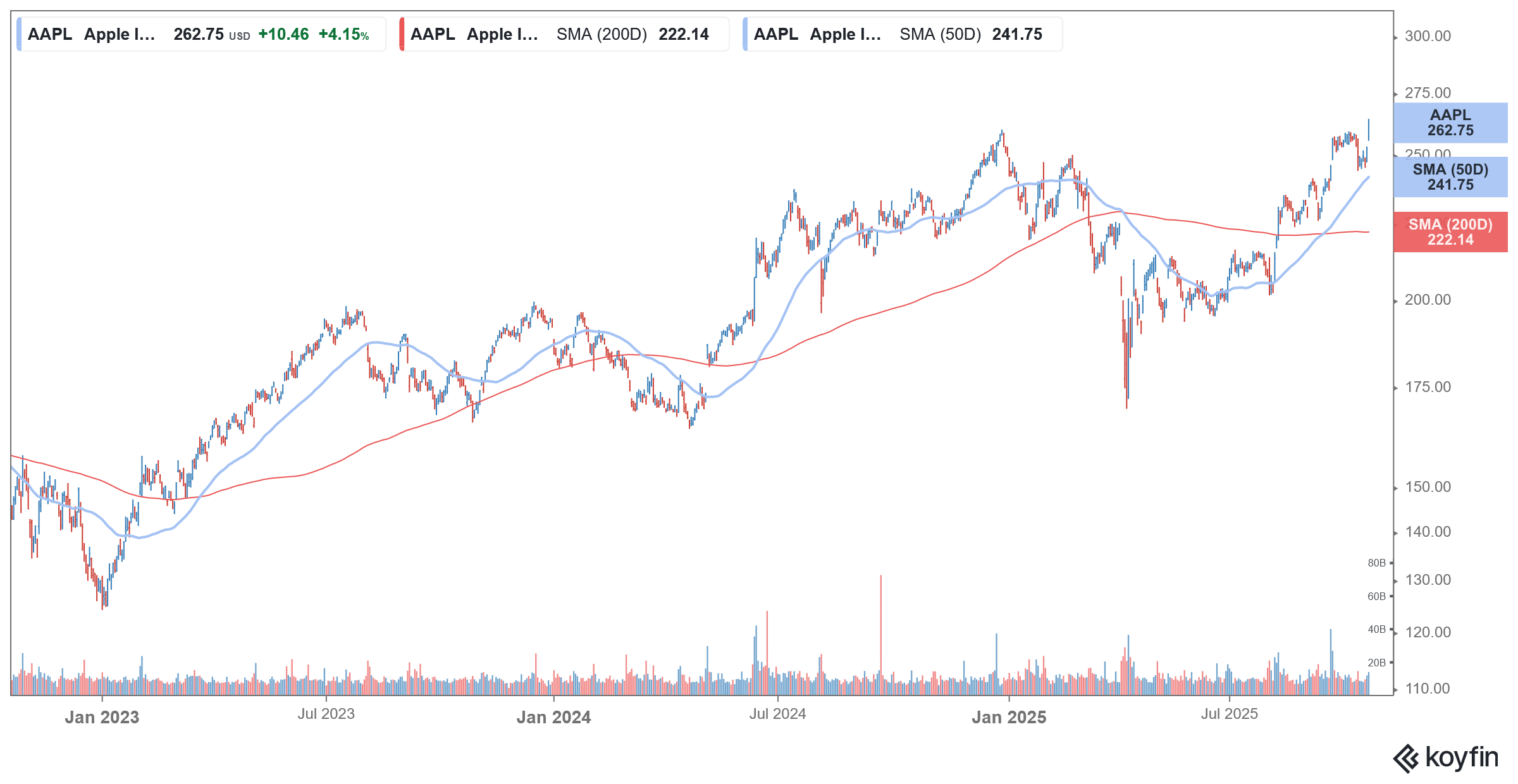
Apple stock (NYSE: AAPL) is trading sharply higher today in reports of strong early sales for its new iPhone 17 series in its two most critical markets, namely the United States and Greater China. Recent data indicates the iPhone 17 lineup has significantly outpaced its predecessor, the iPhone 16, in initial sales, driven by distinct yet effective product and pricing strategies tailored for each region.
iPhone 17 Sales Are Strong in the US
In the US, the strong sales are primarily being led by the iPhone 17 Pro Max. This surge is largely attributed to the country’s carrier subsidy model and a timely upgrade cycle.
Aggressive Carrier Promotions: Major US mobile carriers have strategically boosted their maximum subsidies and trade-in offers, making the high-end Pro Max model more financially accessible to a broader consumer base. These deals often tie customers into long-term financing contracts (24 or 36 months), a strategy that benefits both the carriers with stable service revenue and Apple by solidifying its high-value customer base within the ecosystem.
COVID-Era Upgrade Cycle: The strong demand is also fueled by a wave of users who purchased devices during the peak of the COVID-19 pandemic and are now ready for a high-end upgrade.
Ecosystem Loyalty: The combination of carrier subsidies and the desire for the top-tier device further reinforces the loyalty of American consumers to the established Apple ecosystem of hardware, software, and services.
What’s Driving the Surge in Apple Sales in China?
The dynamics in the Greater China market tell a slightly different, but equally successful, story. Here, the unexpected star is the base model iPhone 17.
Value-for-Money Proposition: Chinese consumers have responded warmly to the enhanced features and superior value of the standard iPhone 17. The new model offers significant upgrades—including an improved chip, better display, more base storage, and an upgraded selfie camera—all for the same price as the previous base model. This compelling value proposition has been a major draw for value-conscious consumers.
Government and Channel Boost: Local discounts, coupons, and government-backed consumer goods trade-in programs have amplified the appeal of the iPhone, helping Apple navigate intense competition from domestic rivals like Huawei and Xiaomi.
Mac Performance: Beyond the iPhone, the Mac lineup has also seen a strong performance in China, with models like the MacBook Air and Mac mini leading their respective sales categories, demonstrating Apple’s broader product appeal.
Apple CEO Tim Cook Visited China Last Week
Notably, Apple iPhone Air sold out within minutes of its pre-sales opening on Friday. The frantic demand, which saw both online and brick-and-mortar stores deplete their initial stock almost instantly, coincided strategically with a high-profile visit by Apple CEO Tim Cook to the country last week.
The instant sellout for the ultra-thin, eSIM-only iPhone Air, which launched in China over a month later than the rest of the world due to regulatory hurdles, underscores the enduring and powerful appeal of the Apple brand among Chinese consumers, even amid intensifying competition from domestic rivals like Huawei and a generally contracting smartphone market.
Cook’s recent diplomatic and promotional tour of China appears to have been a perfectly timed masterstroke. During his visit, Cook not only engaged with local pop culture, including meeting the creator of the popular Labubu doll, but also held high-level meetings with top Chinese government officials, including Vice-Premier He Lifeng and Commerce Minister Wang Wentao.
iPhone Air Got Sold Off Within Minutes in China
The meetings reportedly focused on strengthening Apple’s commitment to the Chinese market, promoting cooperation, and discussing the company’s growth in the region. Importantly, Cook’s presence coincided with the regulatory clearance for the iPhone Air’s eSIM functionality, paving the way for the long-delayed launch.
The combination of the CEO’s personal endorsement and the removal of the regulatory block seemed to unleash pent-up consumer demand for the unique device. Minutes after pre-orders began at 9 am local time on Friday, the iPhone Air was sold out in major metropolitan centers like Beijing, Shanghai, and Tianjin. Apple’s official website quickly updated shipping times to a delay of one to two weeks, signaling a robust and overwhelming response.
Apple Intelligence Features Are Not Yet Available in China
Notably, iPhone 17 sales are strong in China despite Apple’s ambitious suite of generative AI features, collectively known as Apple Intelligence, remaining unavailable in China. This absence is not due to a technical limitation or a lack of user demand, but rather a complex entanglement of strict Chinese government regulations and the geopolitical sensitivities surrounding artificial intelligence (AI) technology.
The primary reason for the delay is China’s comprehensive regulatory framework for generative AI services. Unlike many Western markets, China requires all AI models that generate text or images for public consumption to be tested and approved by the Cyberspace Administration of China (CAC) before launch.
Apple is Seen as Lagging in AI
Notably, many believe that Apple slackened in AI even as rivals raced ahead. The company is currently facing a shareholder class action lawsuit that alleges that the iPhone maker overhyped its progress in AI and misled investors about the timeline for integrating advanced AI features into its Siri assistant.
Shareholders argue that at its June 2024 Worldwide Developers Conference (WWDC), Apple led them to believe that AI, particularly “Apple Intelligence” features designed to enhance Siri, would be a key driver for iPhone 16 devices and would be ready for launch. However, the lawsuit claims Apple lacked a functional prototype of these AI-based Siri features and had no reasonable basis to believe they would be ready for the iPhone 16.