AMD Stock Rallies After the Company Signs Chip Supply Agreement with OpenAI

Please note that we are not authorised to provide any investment advice. The content on this page is for information purposes only.
OpenAI has diversified its AI hardware strategy by announcing a sweeping, multi-year partnership with Advanced Micro Devices (AMD). This landmark agreement solidifies AMD as a core compute partner for OpenAI and directly challenges Nvidia’s long-standing dominance in the market for high-performance AI semiconductors.
The partnership is centered on an agreement for OpenAI to purchase and deploy a massive amount of AMD’s Instinct series GPUs that are specifically designed for AI workloads.
“We are thrilled to partner with OpenAI to deliver AI compute at massive scale,” said Dr. Lisa Su, chair and CEO, AMD. She added, “This partnership brings the best of AMD and OpenAI together to create a true win-win enabling the world’s most ambitious AI buildout and advancing the entire AI ecosystem.”
Key Takeaways from OpenAI-AMD Partnership
Here are the key takeaways from the OpenAI-AMD partnership
- Massive Deployment: OpenAI has committed to deploying 6 gigawatts (GW) of AMD GPUs over a multi-year, multi-generation timeline. To put the scale in perspective, the initial deployment alone will involve building a one-gigawatt facility powered by AMD’s forthcoming MI450 series chips, starting in the second half of 2026.
- Financial Impact: AMD anticipates that the deal will generate tens of billions of dollars in revenue and projects a ripple effect across the AI ecosystem that could result in more than $100 billion in new revenue over four years from OpenAI and related customers.
- Strategic Alignment and Investment: In a highly unusual move for a chip supply agreement, AMD has issued a warrant to OpenAI, giving the AI startup the option to purchase up to 160 million AMD shares. If fully exercised, this would give OpenAI a stake of approximately 10% of the chipmaker. The warrant is structured to vest in tranches, contingent upon both the achievement of specific chip deployment milestones and AMD’s stock price reaching certain targets.
OpenAI CEO Sam Altman also hailed the partnership and said, “This partnership is a major step in building the compute capacity needed to realize AI’s full potential.” He added, “AMD’s leadership in high-performance chips will enable us to accelerate progress and bring the benefits of advanced AI to everyone faster.”
Nvidia Also Invested in OpenAI
The AMD-OpenAI deal, following close on the heels of a separate multi-billion-dollar compute agreement between OpenAI and Nvidia, highlights the intensity of the AI infrastructure arms race.
The collaboration between OpenAI and AMD marks a definitive step towards a multi-vendor AI ecosystem, signaling that the era of near-monopoly in AI hardware may be facing its most significant challenge yet. The success of AMD’s MI450 deployment with OpenAI will be a crucial factor in determining the future balance of power in the world of high-performance computing.
“We view this deal as certainly transformative, not just for AMD, but for the dynamics of the industry,” AMD executive vice president Forrest Norrod told Reuters over the weekend.
Notably, while AMD shares are trading sharply higher today, Nvidia is down on fears of it losing its edge in the AI chip market.
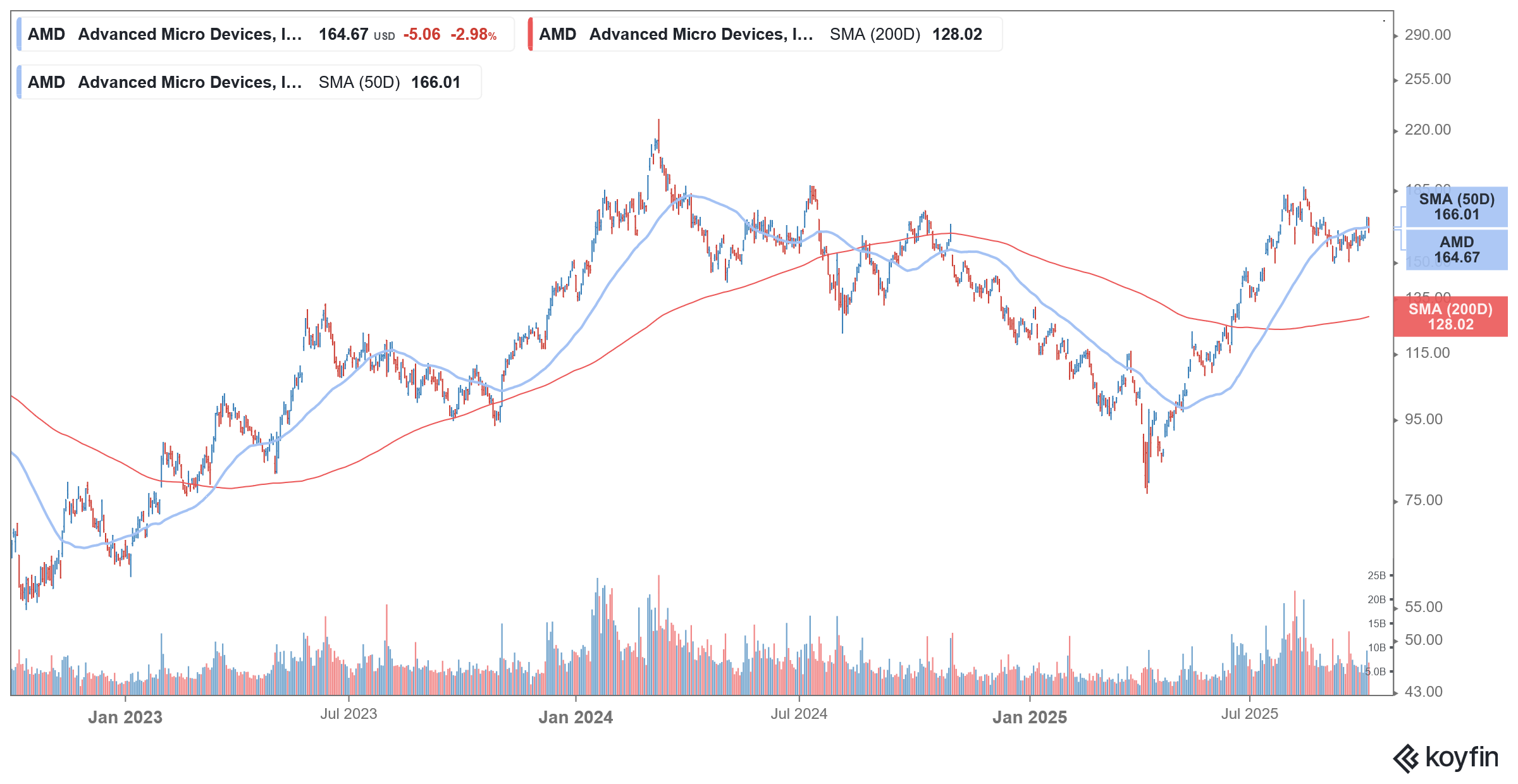
Chip Stocks Have Soared This Year
Notably, chip stocks have been a hot investment, and last month, Nvidia announced a $5 billion investment in Intel. As part of the agreement, Nvidia will acquire common stock and forge a strategic partnership to co-develop products for AI infrastructure and personal computers. This collaboration represents a significant development, particularly given the long-standing rivalry between the two tech giants.
Notably, this was the third major investment that Intel has bagged over the last month. In August, SoftBank, which vowed to invest $100 billion in the US over four years following a meeting with Donald Trump in December 2024, said that it would invest $2 billion in Intel at $23 per share.
The US Government Took a Stake In Intel
A few days after SoftBank’s announcement, the US government confirmed that it had acquired a 10% equity stake in Intel, a move that represents one of the biggest federal interventions in a private company since the 2008 financial crisis. The $8.9 billion purchase, which makes the government one of Intel’s largest shareholders, is being funded by converting previously promised grants from the CHIPS Act and the Secure Enclave program into shares.
OpenAI is Spending Billions on Building AI Infrastructure
OpenAI is spending billions of dollars on building AI infrastructure, and a big chunk of it is going towards buying Nvidia chips. Modern AI models, particularly large language models (LLMs) and deep neural networks, require a staggering amount of computational power, both for training (feeding the model vast datasets to learn) and inference (using the trained model to make predictions or generate content). These tasks rely heavily on performing billions of repetitive, independent calculations, primarily matrix multiplications, in parallel.
The AI chip market is not just a technical story but also a geopolitical one. The design and manufacturing of the most cutting-edge chips, those with transistors only a few atoms wide, are concentrated in a small number of countries, primarily in the US and East Asia. This concentration has turned the supply chain for leading-edge semiconductors into a critical area of international competition and policy focus.
OpenAI is Valued At $500 billion
Thanks to the AI euphoria, the valuations of AI startups have soared. OpenAI, for instance, was valued at $500 billion in a secondary share sale that allowed employees and former staff to cash out their equity. This dramatic jump from a $300 billion valuation just months prior underscores the fierce investor confidence in the future of Artificial Intelligence.
Investors view OpenAI as the clearest and most dominant proxy for investing in the entire Generative AI theme. They are willing to accept skyrocketing valuations, betting that the company that wins the race to build Artificial General Intelligence (AGI) will be worth trillions.
Meanwhile, while OpenAI’s valuation has soared, it also amplifies questions about the long-term sustainability and risks, as it is the most valued loss-making startup company ever. While OpenAI’s revenues have soared over the last year, the company is not expected to generate positive cash flows until 2029.