Bulgaria Trade, Exports and Imports

Please note that we are not authorised to provide any investment advice. The content on this page is for information purposes only.
Bulgaria’s economy, being a free open market, has a well developed private sector, which contributes significantly to Bulgarian trade. Other essential industries are regulated by the government for strategic reasons. In the recent years, Bulgaria has shown positive growth, although it still remains one of the lowest GDP nations in Europe.[br]
Bulgaria’s economy, being a free open market, has a well developed private sector, which contributes significantly to Bulgarian trade. Other essential industries are regulated by the government for strategic reasons. In the recent years, Bulgaria has shown positive growth, although it still remains one of the lowest GDP nations in Europe.[br]
Bulgaria produces a number raw materials as well as processed commodities, such as:
-
Iron
-
Copper
-
Gold
-
Bismuth
-
Coal
-
Electronics
-
Refined petroleum fuels
-
Vehicle components
-
Weapons
-
Construction materials
From a consumer perspective, Bulgaria’s trade reflects the presence of such commodities as well.
Bulgaria Trade, Exports and Imports
Bulgaria trade is normally plagued by its deficit. Imports are higher than exports, which does not help Bulgaria collect foreign exchange as much as it will like to.
In 2009, the reported export volume was $16.23 billion and placed the country in the 69th place in the world. This amount was, however, lesser than the earlier $22.71 billion exported in 2008. The drop could be attributed to the recession years.
The exported commodities include:
-
Clothing
-
Footwear
-
Iron and steel
-
Machinery and equipment
-
Fuel
Major export partners include:
-
Greece
-
Germany
-
Turkey
-
Italy
-
Romania
-
Belgium
-
France
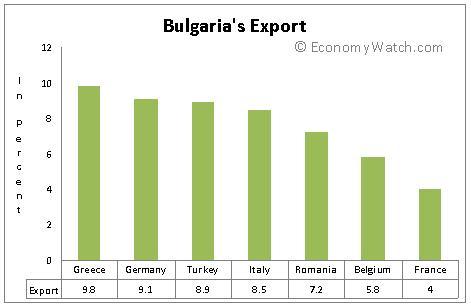
The following graph maps the individual contribution (in percentage) of the export partners:
In 2009, imports amounted to $23.27 billion, in contrast to a rather higher figure of $35.64 billion in 2008. The amount of imports put Bulgaria in the 62nd place in the world.
The imported commodities included:
-
Machinery and equipment
-
Metals and ores
-
Chemicals
-
Plastics
-
Fuels
-
Minerals
-
Raw materials[br]
Bulgaria’s major import partners are:
-
Russia
-
Germany
-
Italy
-
Ukraine
-
Romania
-
Turkey
-
Greece
-
Austria
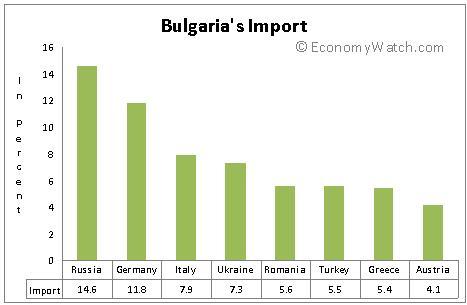
The following graphs maps the individual contribution (in percentage) of the import partners: