
Thailand’s SMEs Overcoming Financial Obstacles


Share of SMEs in the Thai economy

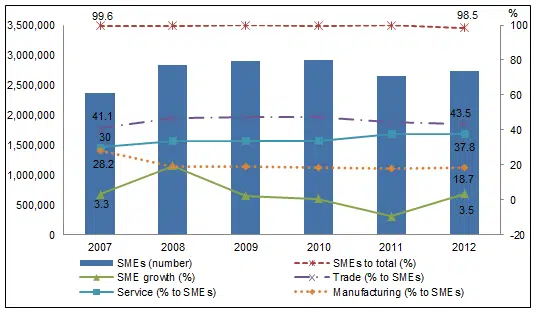
Small and medium-sized enterprises (SMEs) play a significant role in the Thai economy. In 2012, there were 2.7 million SMEs in Thailand (see Figure 1) comprising 98.5% of total enterprises. In the same year, SMEs accounted for 37.0% of gross domestic product (GDP) and 80.4% of the workforce. Thai SMEs also contributed to 28.8% of total exports and 31.9% of total imports by value in 2012.

Published
Categorized as Thailand

The Growing Influence of China in Asia


The world’s second largest economy, China made headlines when it became a part of two new banks in the Asia-Pacific region. The two new banks are a five member initiated BRICS-bank called ‘New Development Bank’ (NDB) and Beijing-led bank called ‘Asian Infrastructure Investment Bank (AIIB). A look at the purpose of these banks (see table below) can make one wonder if they share a common goal – infrastructure development in Asia-Pacific region. But the structure and number of members in these two banks reflect otherwise.

Published
Categorized as China

A Preview of Emerging Market News and Events


EM again starts the week on the back foot, but losses are (for now) concentrated in the commodity currencies.  With commodities (except for iron ore) already under pressure again, this trend looks set to continue.  US jobs data Friday is likely to bring the focus back on Fed liftoff, which is of course EM-negative.  MSCI EM has tried to get some traction, but the bounce was limited and it appears ready to test the cycle low from last week. 

Canadian Dollar Falling Like a Leaf


The Canadian dollar is the worst performing major currency over the past month.  It has lost nearly 4.5% against the US dollar.  That brings its year-to-date loss to almost 12%. 

Published
Categorized as Canada

Canadian Economy Contracted in May


According to Canadian statistics, the economy shrank 0.2 percent in May, falling below already low expectations of zero growth, according to Business Insider. The economy continues to suffer due to low oil and commodity prices.

The Ramifications of Japan’s Collective Self-Defense Leglisation


Japan is at a momentous turning point. On 16 July 2015, the government of Shinzo Abe used its big majority in the House of Representatives to override objections from opposition parties and pass legislation permitting collective self-defence (CSD). However, this is one of several misdirected solutions following years of conservative revisionism.

Published
Categorized as Japan

The Logistical Challenges of a Bouganvillean Election


Bougainville went to the polls in May 2015 for the third Autonomous Bougainville Government election since the signing of the Bougainville Peace Agreement in 2001. The election was a significant political milestone for the region, marking the beginning of a five-year window in which a referendum on independence is scheduled. It also saw the first woman elected in an open seat of the House of Representatives, Josephine Getsi of Peit constituency.

An Emerging Markets Status Update


1) S&P revised Brazil’s BBB- rating from stable to negative, 2) Banco de Mexico announced changes to its FX intervention program, which had been rumored since last week, 3) The Russian central bank has halted its daily USD purchases and slowed its pace of easing, 4) Turkey finally engaged the international community concerning ISIS/ISIL, asking NATO to hold a rare emergency meeting, 5) Turkey’s central bank is considering a move to a simplified monetary policy framework with one policy rate, 6) Bank of America decided to keep EM companies in its Global High Yield Index, 7) T

African Trade Agreement May Unify the Continent, Boost Economies


In a move that may boost the economies of an entire continent, 26 African nations have entered into a new free trade agreement. Called the Tripartite Free Trade Agreement (TFTA), the historic agreement was finalized on July 19, and it may signal a turning point in the history and economic strength of the entire African continent.

Zimbabwe Continues to Struggle in Crucial Areas


According to the Zimbabwe Revenue Authority, mining royalties declined by 39 percent, and overall royalties fell 65 percent when compared to 2014 earnings, according to Reuters. The nation also lacks energy and water services in certain areas, including old roads and bridges that need repair, discouraging further foreign investment.