
China’s Financial Inequality Gap Widens


Rising income and wealth inequality (measured by the Gini coefficient) have marked the last three decades of China’s remarkable economic transition from a centrally planned economy to an increasingly market-oriented one. When analysing the causes of China’s inequality, researchers frequently invoke rapid trade integration, technology, human capital differences and social security systems, but very little has been said about the role of monetary policy and the banking system.
Published
Categorized as China

Developed vs. Emerging Market Trends


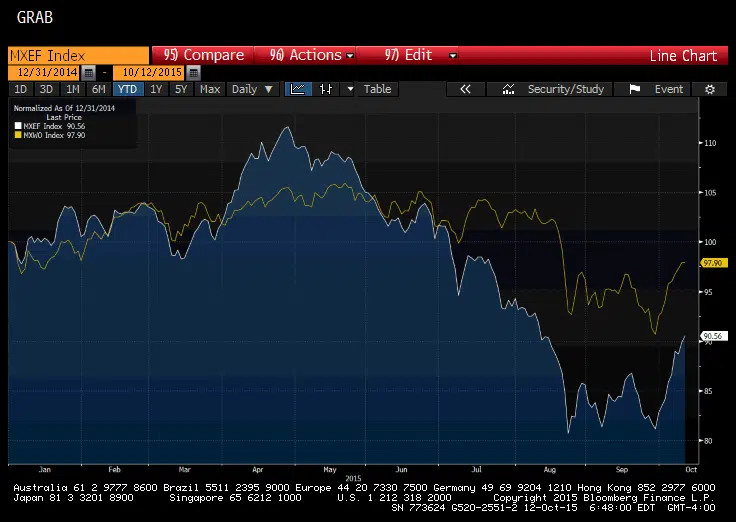
After a troublesome August and most of September, risk appetites were rekindled beginning in late September.  Aiding this are ideas that the period of extremely accommodative monetary policy by the major central banks will persist longer than previously anticipated.  This has weighed on the dollar, lifted equities and commodities.

Published
Categorized as Markets

Can the Sustainable Development Goals be Realized in Africa?


Recently, world leaders gathered in New York to commit to the new sustainable development goals. For the first time, a specifically urban goal is among the 17 goals to reach by 2030.

Published
Categorized as Africa

Brazil is this Week’s Emerging Markets Lowlight


1) The Brazilian central bank had a record monthly loss on its FX swap operations in September, 2) Also in Brazil, the impeachment process got a step closer, 3) Indonesia cuts energy prices and electricity tariffs for the industrial sector, 4) Vietnam’s central bank enacted new regulation to curb holdings of foreign currencies by businesses, 5) There were two policy initiatives from China during the holiday

Are Japan’s New Security Laws a Shift Away from Pacifist Ideals?


Japan’s new security laws, passed on 19 September, allow for limited forms of collective self-defence, have been described as a ‘move away from pacifism’, the opening of a ‘Pandora’s box’ and the ‘unsheathing of a new Japanese sword’. But considering the bill’s extreme limitations and significant domestic constraints — including a greying and shrinking population, mounting domestic debt and deeply embedded pacifist norms — one wonders how and why this narrative has taken root so deeply.

Published
Categorized as Japan

The Ideological Divide between Vietnam and the U.S.


On 7 July 2015, Communist Party of Vietnam (CPV) General Secretary Nguyen Phu Trong met US President Barack Obama at the Oval Office, marking a historic milestone in advancing US–Vietnam relations. However, the trip was largely symbolic as Trong returned to Hanoi with only modest progress on comprehensive US–Vietnam relations. So, when eloquent rhetoric collides with hard logistics, what was the main roadblock in furthering US–Vietnam relations?

Published
Categorized as Vietnam

IMF Cuts Thai Economic Forecast


The International Monetary Fund projects that Thailand’s economy will expand by 2.5 percent in 2015, as the Southeast Asian country contends with military rule and a turbulent economy. The IMF also cut growth from 4.0 to 3.2 percent for 2016.

Imagine an EU without the UK


Europe is always a heated topic at a Conservative party conference. This year much debate has focused on David Cameron’s ongoing renegotiation of terms for staying in the EU. By contrast, the terms on which a Brexit might happen have garnered little attention. Those advocating it oscillate between – and often treat as interchangeable – quite different and incompatible scenarios.

The Reserve Bank of India’s Great Escape


Hyperinflation during the 1970s and 1980s relegated fiscal policy as the macroeconomic policy of last resort, ushering in the golden age of monetary policy. With Paul Volcker’s spectacular use of monetary policy to tame hyperinflation, which saw policy interest rates breach 20 percent and the Volcker recession, ‘independent’ central bankers came to be seen as the masters of macroeconomic policy.

Published
Categorized as India

China Really Wants the Yuan in the SDR


China’s markets re-opened after the extended national holiday today.  Policymakers hit the ground running with two new initiatives.  China’s own reform efforts likely drive the initiatives, but they will also enhance the likelihood that the yuan is included in the SDR. 

Published
Categorized as China
