
Improving the Living Standards for Singapore’s Elderly


In 2015, the value of housing assets owned by households in Singapore at the aggregate level was 55% of their net worth. Ninety percent of Singapore households owned their homes, meaning that almost all households had wealth saved in housing, and households’ housing wealth was 2.1 times that of the country’s gross domestic product. In addition, Singapore is facing an aging population.
Published
Categorized as Singapore

Japan’s Abe Commits to Minimizing the Agricultural Impact of the TPP


Does Japan’s accession to the Trans-Pacific Partnership (TPP) agreement mean that the Abe government has set a course for agricultural reform? The short answer is no — for several reasons.

First, despite expectations that the TPP will encourage structural reform of low-productivity industries such as agriculture, just how much of an impact the deal will have on the domestic farm sector is contestable.

Published
Categorized as Japan

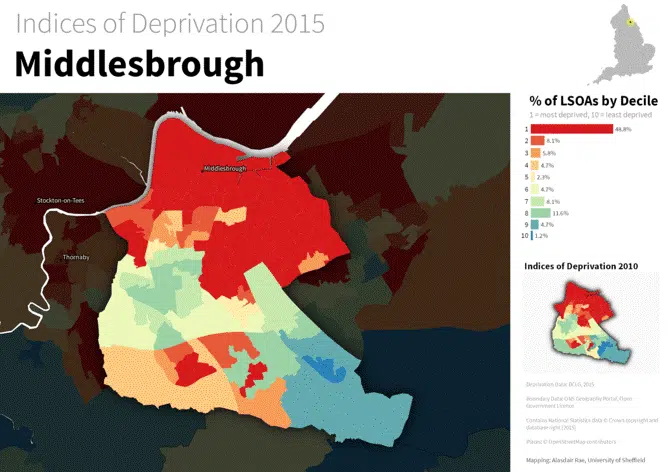
Inequality Stretches Across England


With its long history of feudal oppression, industrial workhouses, and dire slums, England is no stranger to deprivation. Even today, we are all too familiar with phenomena like “beds in sheds,” soaring food bank use and fuel poverty. Therefore, it is hardly surprising that, whenever there is a release of a new deprivation dataset, we tend to focus our attention on the “most deprived” places across England.

Market Participants May Want to Look Past Canada’s Election Outcome


Canada’s national election is Monday.  The latest opinion polls show a virtual dead heat between the governing Conservatives and Liberals.

Two main issues dominate.  The first is the economy.  Canada is struggling.  Although the contraction period is over, growth is fragile.  The economy contracted for the first five months of the year.  Unemployment has steadily risen over the past year.  Last month it stood at 7.1%, which matches the highest level since the end of 2013.  It was 6.6% in January. 

Published
Categorized as Canada

Neither Snow, nor Rain, nor Heat…Japan Post Goes Private


Japan is moving toward its largest privatization in two decades.  It is selling Japan Post.  It will consist of a holding company, a bank, and an insurance company.  It will likely raise the equivalent of $10-$12 bln. 

There will be 495 mln shares of the holding company that will be sold, 412 mln shares of the bank and 66 mln shares of the insurer.  Domestic investors will take 80% of the initial public offering, and the remaining 20% is earmarked for overseas investors. 

Published
Categorized as Japan

Vietnam’s Economy Surges Ahead


According to the latest data, Vietnam’s economy received a boost from lower energy costs and increased foreign investment. The nation’s central bank is also well situated in commencing more easing strategies in the event of an economic downturn. Vietnam’s central bank devalued the dong, increasing exports and foreign investment.

The RBA Regulates Interchange Fees Because It Always Has


Sometimes boring debates are important. Mind numbing detail gets in the way of good policy. Therefore, it is with an obscure feature of credit cards known as “interchange fees.”

Currently, these fees are both highly regulated, and inappropriately regulated by the Reserve Bank of Australia (RBA) and not the Australian Consumer and Competition Commission (ACCC).

Published
Categorized as Australia

China Imports Weaken


Imports into China fell for the 11th month in a row, raising concerns that Chinese growth is worsening.  Imports into China fell 17.7% in local currency terms in September, acceleration from the 14.3% decrease in August. China’s trade surplus rose to 376.2 billion yuan, or about $59.5 billion, above expectations. However, China’s weak trade surplus was worsened by a 1.1% decline in exports, although that was better than the 6.1% decline seen in August.

Chinese Trade Data and the Turkish Current Account Lead EM News


Positive momentum for EM assets looks to extend its moves from last week.  Buoying EM sentiment is gains in developed markets equity indices, the weaker dollar more broadly, and gains in the commodity space.  Regarding the latter, we note that the moves in the MSCI EM index, for example, have closely mirrored the moves in CRB commodity index, even though the benefits to EM countries from moves in commodity prices are far from uniform.

Doubts Arise over China’s Income per Capita Trajectory


When its GDP per capita hit almost US$7500 in 2014, China entered the middle-income stage of economic development. Relatively few countries that have made middle income status in the past three or four decades have graduated to high-income status, or achieved per capita incomes over US$16,000.

Now the Chinese economic slowdown has raised questions about whether China will be able to continue its steady economic growth to avoid this middle-income trap in the coming decade.

Published
Categorized as China
