
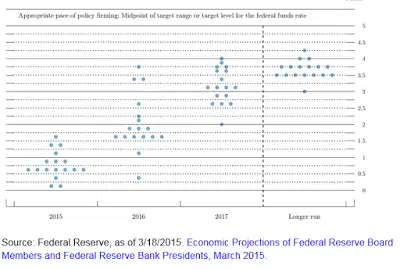
Dot-Plots 101: A Guide to Fed Opinions


Largely the Summary of Economic Projections, the infamous dot-plot, drove the dramatic reaction to last week’s FOMC meeting, which may still not be complete. This Great Graphic shows the latest iteration.
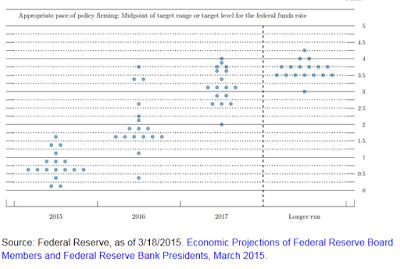
What riveted the investors was the sharp reduction in the dots compared with December 2014 iteration.  This was the essence of the market’s dovish read. 

Australia’s View of the Potential Closure of the U.S. Export-Import Bank


Both sides of US politics are mooting the closure of the US Export-Import Bank.

Commonly known as the Ex-Im bank, it helps support US exporters and the buyers of US goods. But it will cease its financing operations in June unless the US Congress extends its charter.  This is amid opposition from some Republicans who believe it helps foreign firms at the expense of local ones, and who want to lift the current restrictions on its funding of coal-fired power stations.

Federal Reserve Sees Below-Average Growth


The U.S. economy is growing at a lower-than-average rate, far short of expectations, as last-year’s optimism turns sour.

A new study by the Chicago Federal Reserve shows that economic fell 10% from January to February as the region’s National Activity Index (CFNAI) slipped to -0.11 from -0.10 in January. That marks the third month in a row of an economic decline, after extremely strong growth in September, October, and November of 2014.

China is Winning Friends and Influencing Countries with the AIIB


In what can only be seen an unexpected Chinese success, several US allies have agreed to participate in China and India’s Asian Infrastructure Investment Bank.  The UK not only appeared to break ranks with the US, but seemed to have preempted its European partners as well.  Once the UK expressed interest, it was if a dam burst and quickly others signed up as well.

What is Driving the Dollar Now?


The events of the past week will continue to reverberate in the capital markets in the week ahead. The key development was the market’s ultra-dovish read of the Federal Reserve. Although the dollar recouped the lion’s share of the knee jerk losses, the debt markets have not returned to status quo ante.

U.S. Home Sales Weaken Despite Lower Rates


Mortgage interest rates are falling, but that is not encouraging more Americans to buy houses, especially in higher-priced urban markets.

According to Freddie Mac, 30-year mortgage interest rates fell to 3.78%, remaining near the lowest levels seen in the first half of 2013. Fifteen-year mortgages also fell on a week-over-week basis to 3.06, a fall of 1.3% from the prior week and 8.5% from a year ago. Thirty-year mortgages have fallen 12.5% from a year ago.

Bangladesh’s Dysfunctional Two-Party System and Democratic Paralysis


Democracy in Bangladesh is broken.

The country recently witnessed political deadlock causing violence and crippling unrest. Bangladesh’s dysfunctional two-party system, dominated by the Awami League and Bangladesh Nationalist Party (BNP), has seen party leaders wage personal vendettas to grab power. The trigger for the political unrest and violence was a banned protest to mark the anniversary on 5 January of the controversial national election held in 2014.

Monty Python Star Takes on Institution of Economics Education in New Documentary


Economics is, at its core, the study of diverse financial systems and how they interact. It attempts to make sense of the ups and downs of various markets, the buying patterns of consumers, and the impacts of politics on the money in people’s pockets. But, at its heart, the academic study of economics relies on certain core principles that have not greatly changed in several hundred years.

Thailand’s Military Rule is Unlikely to Leave Much Room for Democracy in the Next Election


Thailand’s General Prayuth Chan-ocha announced in February that Thailand would hold elections to restore democracy in early 2016. Despite their many efforts to make the case for the military takeover, Prayuth has realised that the military and its supporters will not get off easy with long-time ally the US.

Could UEFA Help Russia Legitimize Crimean Annexation?


Russia is hoping football can become an instrument that it can use to help legitimize its annexation of Crimea.

Russian troops invaded Crimea in late February 2014, in response to the Euromaidan Revolution in Kyiv. Pro-Russian Crimean authorities signed an annexation pact with Russia on March 18, 2014, to formalize the first forceful change of a European border since the end of the Second World War. The European Union and the United States do not formally recognize Russia’s land grab, and have imposed economic sanctions on Russia to punish its aggressive actions.