
Is the UK Accommodating China by Becoming a Founding Member of the AIIB?


On 12 March 2015, the United Kingdom submitted its application to become a prospective founding member of the China-led Asian Infrastructure Investment Bank (AIIB). The application created a major diplomatic spat between the UK and the US. A spokesperson for the latter criticised the UK for its ‘constant accommodation’ of China.

Japan’s Abe Battles Interpretation in Setting New Self-Defense Guidelines


On 1 July 2014, the cabinet of Prime Minister Shinzo Abe issued a decision reinterpreting the Japanese constitution’s Article 9 ‘peace clause’ to allow the country to exercise collective self-defence — the right to use force to aid an ally under attack. Despite overturning decades of government interpretations, many observers have highlighted that the new interpretation has important limits.

Markets Surge as Federal Reserve Loses “Patience”


Equities rallied in the United States as the Federal Reserve hinted that interest rates will not rise in the near term, and that the Fed continues to wait until the labor market is stronger.

The Market’s Overreaction to Perceived Fed Dovishness is not Unexpected


The extremely dovish market reaction to the outcome of the FOMC meeting was more a function of the dot-plots than the FOMC statement or Yellen’s press conference. 

Methodologically, we have argued that the Federal Reserve is like the Chinese Communist Party in that policy emanates from a central committee.  That central committee at the Federal Reserve is composed of Yellen, Fischer and Dudley.  The FOMC statement is their organ–the most succinct expression of their views.

Regulating Multi-national Corporations is as Difficult as it Sounds


Bolivia, Cuba, Ecuador, South Africa and Venezuela proposed a treaty to regulate transnational corporations last year. You’d be forgiven for feeling a sense of déjà vu. It has been a long and complicated road tightening the leash on the giant, global corporations, which can dominate our lives.

The United Nations has had it on the agenda for around 40 years.

The FOMC Minutes Run Out of Patience


The Federal Reserve met the widespread market expectations.  It dropped the word patience and recognized growth had moderated.  It wanted to see more improvement in the labor market and needs to be confident that inflation will move toward its target in the medium term. 

The Rising Dollar’s International Effects


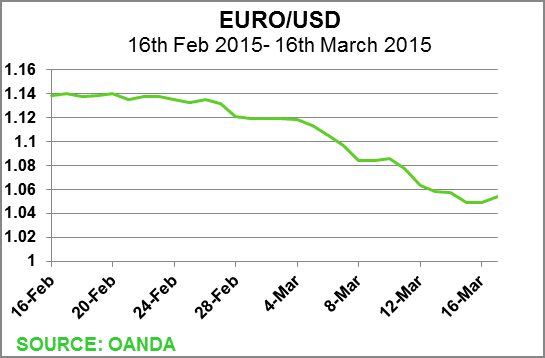
The US dollar has been on the rise every day setting new records. With the upward pressure on dollar, stronger dollar could tighten financial conditions across the globe. Further, the rising dollar could be offsetting the benefit of low cost oil within the US economy. Over the past six months, the trade-weighted dollar has risen 25% and faster than anytime the last 40 years. US dollar is a global unit of account in debt contracts and that could be a cause of slow down in the rest of the world. Not only that, if the dollar continues to increase, inflation and US economic could weaken.

Falling Unemployment and Rising Wages No Longer Strongly Linked, Puzzling Economists


For six years, the US economy has grown. Unemployment has slowly dropped and overall the health of the American economy has returned to levels comparable to those before the housing boom and bust. Yet, in a turn that has left many economists scratching their heads, salaries have not risen in conjunction with the drop in unemployment as predicted.

Housing Starts See Sudden Decline Despite Employment Gains


A fall in unemployment rate has not caused more demand for residences, as housing starts suddenly declined in February.

Private housing starts fell to a seasonally adjusted annual rate of 897,000 in February, far below expectations of 1.04 million starts, according to a report released by the U.S. Census Bureau.

The FOMC Meeting is This Week’s Highlight


The Federal Reserve meeting is the highlight of the week.  The most pressing issue is the continued evolution of its forward guidance that will maximize the room to maneuver.  Until now, officials have indicated that they are in no hurry to begin raising interest rates.  They have offered investors word cues of its intent.