
The Carefully Timed U.S. Visit by Vietnam’s Nguyen Phu Trong


The 7 July visit to the White House by Vietnam’s Communist Party chief Nguyen Phu Trong signaled just how far the United States and Vietnam have come in the past two decades in moving beyond their ‘difficult history’, as President Barack Obama put it after their meeting. The leaders discussed how they would advance ties between the two countries in areas ranging from economic and political relations to security and education cooperation.
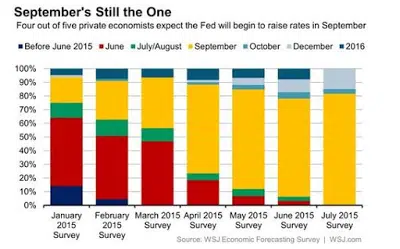

Survey Says: September Rate Hike


The latest Wall Street Journal survey found that 82% of economists expect a Fed hike in September, completely dismissing a July hike, as this Great Graphic illustrates.  A December hike is more likely to occur as noted by 15% of the survey participants. 

Last month the survey found 72% expected the hike in September, and 9% favored December.  None of the respondents thought the Fed would wait until 2016 to raise rates, which is a first for this year’s surveys.

OECD: Increase the Minimum Wage to Combat Member Nation Structural Unemployment


According to the OECD Employment Outlook for 2015, member nations, when taken as a whole, are still experiencing alarmingly high rates of unemployment. Indeed, the OECD report points out that unemployment rates in many European nations still exceeds 11 percent, leaving 42 million people in OECD’s member states unemployed. While that is down from the 45 million in 2014, it remains 10 million higher than pre-Global Recession rates.

The Week in Review: Rate Hike, China Demand, Greece


Major developments spanned three continents this week as the U.S. looks set to see a rise in interest rates, China’s imports continue to shrink, and European policymakers finally make a deal with Greece.

In the U.S., Federal Reserve Chairperson Janet Yellen clearly affirmed the likelihood of a rise in the central bank’s interest rate target later in 2015, despite several analysts arguing that a hike in 2016 is more likely.

With Some Greek Relief, Attention Turns Toward U.S. and Canadian Economic Data


Kicking the can just far enough down the road to push the Greek drama off center stage, the diverging monetary policies reemerged this week as a key force. Yellen and Carney’s comments underscore that less accommodative monetary policies are coming for the US and UK, while much of the rest of the high-income countries (and many emerging markets) are still in an easing mode.

Published
Categorized as Economics

Using the Power Bestowed Upon You for Good


It may seem that after several recent electoral defeats of prominent national dynasts, Asia’s ‘ruling families’ are in decline. However, a closer look suggests that reports of their political deaths are premature.

The most prominent recent setback was the crushing defeat of the Nehru-Gandhi dynasty-run Indian Congress Party in the May 2014 elections, which swept the Hindu nationalist Bharatiya Janata Party (BJP) to power and left the Congress Party with only 44 seats in the Indian parliament.

The Tangible Benefits to China from its Low Carbon Trajectory


China has submitted its formal pledge to the UN climate negotiations. China’s target is a 60–65 percent reduction in the emissions intensity of its economy compared to 2005 levels by 2030, with carbon dioxide emissions peaking around 2030, and ‘best efforts’ made to peak earlier. China’s pledge will require a sustained policy effort, and it tallies with underlying trends in the economy and with overarching national policy priorities.

The ECB Leaves Policy Unchanged, but Greece Gets More ELA


The ECB left policy unchanged.  The economic assessment was unchanged, in line with the staff forecasts made last month.  The asset purchases continue to go smoothly.  Inflation bottomed earlier this year, and it expects to remain low over the next several months before rising later in the year.  He saw the recent drop in oil prices as boosting the purchasing power of consumers, but did not link it to new pressure on headline inflation.  Both the supply and demand of credit has improved.

Do Environmental Treaties Threaten the Economies of Developing Nations?


While most think of environmental treaties as a positive turn for the world, a recent study indicates that these may actually be harmful to the developing economies of the world.

Janet Yellen Affirms 2015 Rate Hike


At her semiannual report to Congress, Yellen said that the American economy was showing signs of persistent strength. “Prospects are favorable for further improvement in the U.S. labor market and the economy more broadly,” she said, adding that low oil prices and increases in the employment rate were bolstering consumer spending. This rise in aggregate demand, she argued, would make a rise in interest rates appropriate later in the year.