
India’s Reserve Bank Independence is Endangered


India’s Reserve Bank has been doing a commendable job of maintaining price stability and securing Indian markets from external shocks. But a proposal from the government to remove control of interest rates from the central bank has economists and policy makers divided.

The government had recommended a new Monetary Policy Committee (MPC) of seven members, with four nominated by the government and three by the Reserve Bank of India. The plan calls for the removal of the current veto power of Reserve Bank Governor Raghuram Rajan.
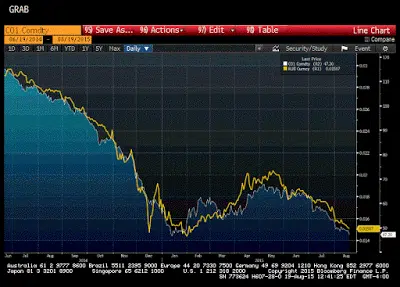
Be Wary of Eyeballing a Correlation


Oil prices have fallen to new lows following news of an unexpected 2.68 mln barrel build of US crude oil inventories.  The API data had prepared the market a small draw down.

Many view the sharp drop in oil prices through the lens of inflation/deflation.  For example, this is the traditional view of the ECB.  It hiked rates in mid-2008, between Bear and Lehman’s demise ostensibly because the near-$150 per barrel of oil was going to be inflationary.

Support for a Rate Hike could be in the FOMC Minutes


The US dollar has been mostly confined to yesterday’s ranges against the major currencies.  Outside of a larger than expected Japan trade deficit, and a jump in the Eurozone’s current account surplus, the data stream is light.  The main interest is the US CPI report and the FOMC minutes later in the session.

Mind the (Interest Rate) Gap


When the men and women of the committee that sets UK interest rates get together these days, they are dealing with a deceptively simple question. Rates will go up, but how far and how fast? Their answer will decide the fate of a fragile recovery.

The UK economy is getting back to normal. Output has overtaken its peak of 2007 and is growing at close to the average pre-crisis rate; unemployment is low, employment is increasing. Real wages and investment have finally begun to improve. There are even signs of a return to productivity growth.

The Symbolic versus Economic Value of the New Suez Canal


Egypt has opened a second lane to the Suez Canal amid much fanfare. The US$8 billion dollar expansion adds 35km of new channels to the existing canal and another 35km where existing bodies of water were dredged to make way for larger ships. This will supposedly increase capacity from 50 transits a day to 97 and cut waiting times from 18 to 11 hours, which the Suez Canal Authority claims will more than double annual revenue to US$13.2 billion by 2023.

The Same Old Trade Arguments Persist with the TPP


Ever since Jagdish Bhagwati coined the phrase ‘spaghetti bowl’ to describe the maze of overlapping preferential trade arrangements (PTAs), trade economists have been split over whether such deals are ‘building blocks’ or ‘stumbling blocks’ for the multilateral trading system.

U.S. Manufacturing, Japan GDP Falls despite Inflation Strength


Manufacturing is falling in parts of America and the trend may spread to the entire country, while in Asia Japan sees a fall in GDP and faster inflation.

In America, the Empire State Manufacturing Survey saw the index fall to -14.9, falling by over 50% from the prior reading. This was the lowest the index has been since 2009 at the height of the Global Financial Crisis.

U.K. Inflation, Shaky Chinese Equities and Tomorrow’s German Vote on Greece


Firmer UK inflation has helped sterling recover from yesterday’s decline. Sterling overcame resistance near $1.5700 making $1.58 the next technical target. Poor US housing starts data, after a heady 9.8% increase in June, with permits unwinding 7.4% rise could provide better fundamental cover to push sterling higher.

Japan’s GDP and BOE Member Talk Liven Up a Vanilla News Stream


Fears of a quick sharp devaluation of the Chinese yuan, disrupting the global economy, sparking a currency war, have eased. For the second session, the yuan stabilized.  The central reference rate (fix) was CNY6.3969, having finished the Shanghai session before the weekend at CNY6.3912.  The fix then was CNY6.3975.

A Dearth of Data with Policy Implications doesn’t Mean a Break for Investors


A fragile stability has returned to the Chinese currency and stocks.  With the help of the Social Democrats, the German parliament is likely to endorse Greece’s third aid package, even if a rump of Merkel’s CDU/CSU balk. The next adjustment of expectations for Fed policy, and the possibility of a rate hike next month, requires the next cycle of data, especially this month’s employment data.
