Finally a U.S. Economic Report, and Dudley Speaks


The inability of the US stock market to sustain gains following the Chinese rate cut has left the market unsettled.  Similarly, despite early gains, Chinese stocks finished lower, with the losing streak extended into a fifth session. 

Many Asian markets did gain, including a 3.2% rise in the Nikkei, and the MSCI Asia-Pacific Index gained about 1.5%.  However, European bourses are off by about 1.3%, though mostly within yesterday’s ranges. 
Market Psychology through Price Action


North American markets did not close well yesterday, and the Nikkei and Shanghai Composite sold off.

The Zero Draft Solution


The world’s governments are preparing to finalise the Sustainable Development Goals at the United Nations in September 2015. It is set to be a major international event, and the goals will be ushered in with tremendous fanfare; they are widely regarded as a historic step toward building a better world, and toward eradicating poverty and hunger from the face of the Earth once and for all.

Would a Market Leader Please Step Forward?


The global meltdown in stocks and commodities has continued.  China failed to stem the tide by cutting reserve requirements (or interest rates) as many had expected.  US 10-year yield had fallen below the 2.0% threshold but is back above it before the start of the North American session.  European equity markets mostly gapped lower.  The gaps have been entered as the selling pressure abates, but they have not been filled. 

More than the Yuan is to Blame for the Global Sell-Off


China’s Premier Zhou Enlai was asked in 1972 about the political consequence of the French Revolution, and he famously quipped it was too early to say. Even if, as historians recognize, Zhou was referring to the unrest in 1968 rather than the 1789-1799 revolution, it offers insight that is too valuable to let the facts distort. 

Indeed, that insight offers good counsel now.  While there is no substitute for prudent and disciplined risk management, we should avoid jumping to hasty conclusions drawn from the volatile price action.

Japan-ROK Relationship Setback


Many have correctly objected to the potted history depicted in the front end of the Abe statement. But it seems that Abe was licensed in a sense by the report his expert advisory council issued on 6 August. Would they or would they not label Japanese behaviour as ‘aggression’? It had been leaked that they would, and they did — with a caveat.

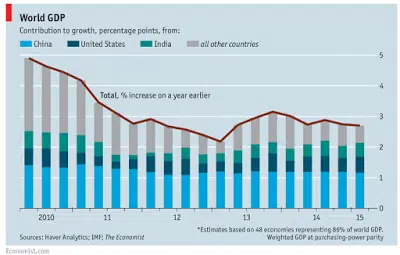
Breaking Down World Growth


The Economist posted this Great Graphic in June but it is arguably even more relevant today.   It shows world growth broken down into four contributors, China, the US, India and ROW (rest of the world).  Europe fits into this catch-all category.

It is measuring world growth based on 48 countries that account for 86% of the world’s GDP.  It also weighted the GDP at purchasing power parity, rather than nominal currency levels.

Graduating from Factor Accumulation to Better Education Systems


Investment in human capital through education, partly by the government, as a precondition for sustainable growth, is almost a universal thought. For Asian countries that can no longer rely on factor accumulation to underpin their continued economic development, improving the quality of national education systems has become of paramount importance.

Home, Home on the (Fed’s Target) Range


Conditioning has trained us to be skeptical when someone says this time is different.  It often means to justify some excess.  However, we still need to be sensitive to changing circumstances and relationships. 

There are three ways that this monetary cycle is objectively different then past cycles.

First, the Fed has adopted a target range for Fed funds as opposed to a fixed level target.  Second, the central bank pays interest on excess reserves.  Third, the size of the Fed’s balance has become a new tool that did not exist previously.

Reading the Same Market News Differently


The US dollar is trading higher against the dollar-bloc, encouraged by the continued decline in commodity prices and energy.  Disappointment with retail sales when petrol is included pushed sterling lower.  The greenback is making new highs against several emerging market currencies, including South African rand, Turkish lira and Mexican peso and Malaysian ringgit.