Finding a Consensus by Degree


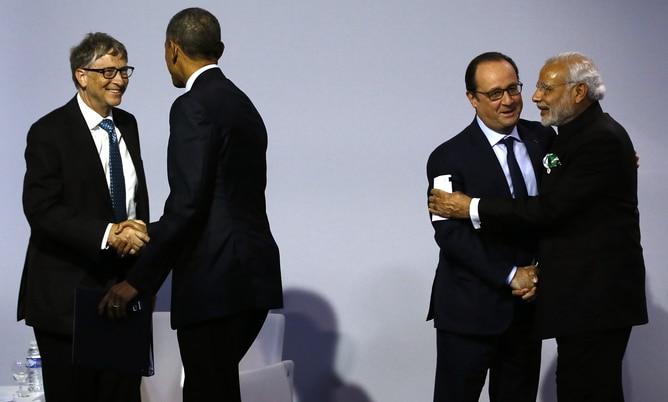
Today, almost 200 nations have united in a global agreement on global change. However, the efforts of a few can still undermine the hopes of the many.

After the 1992 Kyoto Protocol, it took almost a quarter of a century to achieve the Paris accord. . For the first time, it obligates both advanced nations as well as emerging and developing economies into reducing greenhouse-gas emissions.

Long-term challenges
IMF Governance Reforms: Finally, Maybe?


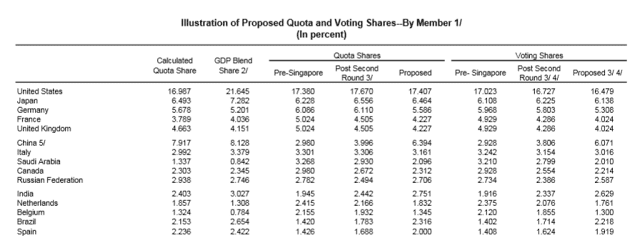
The refusal of the US Congress to accept a new and higher quota (money) to the IMF stymied governance reforms for five years.  This has frustrated efforts to integrate the developing countries, especially the large ones, like China, better into the global economy.  It may have also helped spur China to develop parallel organizations, like the Asian Infrastructure Investment Bank.

The omnibus spending and tax bill that looks likely to be approved by Congress and signed by Obama in the coming days includes a provision to accept the IMF reforms.

Janet Yellen Defends Rate Hike, Points to Strong Economy


The job market is strong and Americans are in great economic shape, Federal Reserve Chairwoman Janet Yellen said in a press conference yesterday.

After making a move that will make credit cards, mortgages, student loans, and many other forms of debt more expensive for Americans, Yellen said the move reflects how strong the economy is and how well positioned Americans are to pay more on their debt.

The Sky Did Not Fall


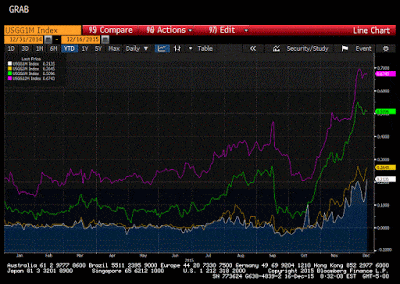
Asia extended the US dollar’s post-Fed gains while Europe has seemed content to consolidate the move, perhaps waiting for US leadership.

A Dovish Interest Rate Hike?


For the first time in 9 years, the Federal Reserve has raised interest rates in a move that could make many loans more expensive for companies and Americans.  Speaking today in Washington D.C., Federal Reserve Janet Yellen discussed the Federal Open Market Committee’s decision to raise its Federal funds rate target 25 basis points, making a new target range of 0.25 to 0.5%.

The Greenspan Conundrum


There are many investors and observers who do not think the Fed ought to raise interest rates today.  The Fed’s targeted inflation measure, the core PCE deflator, stood at 1.3%, well below the 2% target.

They see the fresh sell-off in oil prices and are more concerned disinflation than inflation.  Over the past week or so, more concern has been expressed about the sell-off in the high yield bond market. 

World Bank to Take On Corruption in Fragile Nation States


According to the World Bank, about 1.5 billion people currently live in conflict zones, 19.5 million people live as refugees from these areas, and 38 million people have been displaced within their own countries because of these disputes. Unfortunately, going hand-in-hand with so many people in desperate situations, corruption has become an enormous concern in these “fragile” conflict-zone countries.

Fed Day: Not Tight, Just Less Easy


The much-awaited Fed meeting is here.  A 25 bp increase in the Fed funds range to 25-50 bp is widely expected.  The near certainty of this contrasts to the high uncertainty of the immediate impact stocks, bonds, and the dollar.  There are five components of the Fed’s decision that will command attention.

Consequences of Setting Such a Low Interest Rate Bar


With the US Federal Reserve seemingly set on raising interest rates, it is time to take stock of what low rates have done for the world. In addition, what the prospects are when this era of low interest rates ends.

Since the financial crisis, short-term interest rates have been close to zero in most major economies. The US Federal Reserve has held interests around 0.25% for the last seven years. Meanwhile, the UK’s bank rate remains at 0.5% and in Sweden the central bank has set a negative nominal rate.

Can You Feel the (Climate) Love Tonight?


The Paris climate talks have been heralded as a historic deal. However, while they have been praised for the very feat of reaching an agreement and for setting an ambitious aim to keep warming below 2℃ and endeavouring to limit it to 1.5℃, the agreement has been criticised for being weak. In terms of achieving the 1.5℃ limit, it is up to the states themselves to change their behaviour and they can pull out of the agreement at any point. This, however, might not be such a bad thing.