
Despite the Bangkok Meeting on Migration’s Critical Panning, it was Seen as a First Step


The 29 May Bangkok Special Meeting on Irregular Migration in the Indian Ocean was widely seen as a failure. This is because it did not produce a substantial set of agreed upon actions for coordinated ongoing implementation by attending countries, and by the Rohingya ‘frontline states’ in particular.

The UN, World Bank and IMF Turn 70 and a Top Focus for All Three is Asia


Seventy years ago, the global governance institutions of the United Nations, World Bank, and IMF were created. They have certainly contributed to peace and enabling global economic and financial growth. However, the global environment has undergone an immense evolution since then. Structurally, the world has witnessed a tectonic shift in power distribution, from a bipolar to unipolar and possibly multipolar arrangement. While rising powers are reluctant to lead unless this serves their national interests, declining powers are losing the capacity they once had.

The Week in Review: UK Trade, Russia Inflation, U.S. Recovery


A sluggish economic recovery in Europe is adding pressure to talks between Greek and German policymakers, while to the west and east of the continent signs of economic recovery are mounting.

The Freedom Online Coalition is Working Hard in Asia


The Asian members of the Freedom Online Coalition (FOC) have announced their love of freedom and willingness to guarantee freedom online. However, the reality is that there is a disconnect between stated ambitions and commitments, and actual policy.

The Stakes are Rising in the South China Sea


Since March 2015, the US has hardened its attitude toward China’s activities in the South China Sea. Beijing appears genuinely surprised by the shift in tone and behaviour. In the past, the US has taken a more measured approach. So why has it escalated its language and flagged risky military exercises in the South China Sea? Why does the US risk upsetting the tenor of Sino–American relations over rocks, islets and reefs?

Greece and Ukraine are Comparable Beyond Both Being Untenable Situations


The country is insisting that its creditors take a 40% haircut, or it threatens to declare a unilateral moratorium.  Important but self-imposed deadlines are approaching.  The country is not Greece but Ukraine. 

The IMF initially insisted that Ukraine reach terms with its creditors before getting more assistance.  However, it now signals that sticking with its program is more important that striking a deal with it creditors.  If it must default to the latter, but adhere to the former, assistance will still be forthcoming.

Hints of U.S. Labor Market Strength


Further hints are surfacing that the job market in the United States is recovering.

The total number of job openings and overall demand in hiring new employees has grown at a strong pace. According to a new study by the Bureau of Labor Statistics, the total number of job openings rose to 5.4 million by the end of April, the highest number recorded since the BLS began tracking.

US Healthcare Employment Openings Soars


According to a recent report by BloombergBusiness, jobs in the US healthcare sector are more plentiful than ever before. Indeed, according to statistics for April 2015, job openings in the healthcare industry reached a new record high that surpassed anything seen before in over 14 years of data collection. However, the hiring rate for those record numbers of openings remained almost constant.

International Pressure Sinks the Dollar and China will have to Wait for MSCI Index Inclusion


The US dollar’s losses have accelerated.  The key drivers are not domestic but emanate from Europe and Japan.  Evidence continues to accumulate that point to a moderate recovery in the US economy.  The JOLTS data showed job openings are at new cyclical highs.  The wholesale inventory data was also positive.  Tomorrow the US reports May retail sales.  It is expected to be among the strongest reports in many months. 

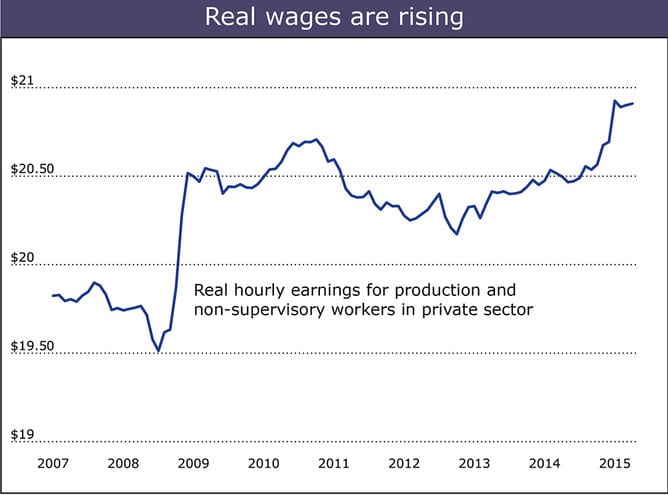
The Real Story about Real Wages


First, monthly jobs growth exceeded expectations, as employers hired 280,000 people. Second, the labor force participation rate ticked up, indicating that people who had stopped looking for work were becoming more optimistic about finding a job and thus had resumed their search for one.

Finally, average hourly earnings for all production and non-supervisory workers in the private sector grew by 2%, compared with May 2014.