
The Global Unevenness about Women as Caregivers and Men as Providers


The historical production-reproduction divide held that mothers are the chief caregivers of children and men are providers. However, this division has fallen rapidly and rightfully by the wayside in much of the world and in most households. Women now make up more than 40% of the paid workforce globally, though women’s pay is still stubbornly lower than men’s by an average of 24%.

The U.S. Government Puts the Country’s Credibility and Reliability at Stake Again


The doomsayers claim that the role of the dollar is being eclipsed by the rise of the Chinese yuan.  Others see the demise of the dollar and some countries, like Iran and Russia, selling oil in other currencies than the greenback.

These all high profile developments, but they are not what they may seem.  The yuan is still a relatively small currency, according to SWIFT.  The transactions on SWIFT remain highly concentrated in dollars and euros. 

China’s Foreign Policy Influenced by Nationals Living Abroad


The concept of ‘protecting nationals abroad’ (haiwai gongmin baohu) became part of the Chinese Communist Party’s priority list at the 18th Party Congress in 2012. But the idea caught the attention of China’s top leadership as early as 2004, with three major attacks against Chinese citizens in Sudan, Afghanistan and Pakistan. That China now systematically evacuates nationals from crises and war zones suggests China is becoming more inclined to support international responses when its own interests are at stake.

There Will Likely be Tactical Limits to the Sino-Russian Relationship


Does the geopolitical relationship between China and Russia portend a major shift in global relations? Many observers focus on the similarities in these nations as the basis for expectations of a deepening relationship. But, despite some commonalities, Russia and China are unlikely to develop more than a tactical and limited relationship.

US Fed Policy Expectation Shift to One Hike in 2015


The US dollar has come back better bid after initially extending yesterday’s pullback.  The euro pushed to $1.1330 after having dipped briefly below $1.1200 yesterday.   However, despite what appears to be an approaching brink with Greece, a softer than expected German ZEW survey, and the two-day FOMC meeting that gets underway today, the euro remains fairly resilient.

President Obama Not Feeling it from the House on Free Trade


Over the last several days, President Barack Obama pulled out all the stops to pass Trade Promotion Authority (TPA) – aka fast track –, which would restrict Congress to an up-or-down vote without amendments on trade deals for the next three years.

Bridging the ‘Academic-Practitioner’ Divide in International Affairs


Any attempt to bridge the divide between scholars and policy-makers in international affairs is so welcome that I could not help but applaud this book, “Scholars, Policymakers, and International Affairs: Finding Common Cause”. The sad truth, however, is that after reading it I am even more convinced that the divide is a chasm.

All Eyes on the FOMC


The FOMC meeting is the most important economic event next week.  The implications are much broader than the impact on the US dollar, which has surprisingly not reacted to the recent string of strong economic data. 

This month’s FOMC meeting had previously been widely seen as a likely timeframe for the first rate hike.  The unexpected weakness in GDP and the well-below trend job growth in March help shift sentiment to September.  This month’s Wall Street Journal survey showed 72% of economists expect that.

Political Cooperation Between China and the EU Moves to a Higher Level


The visit to Beijing by the High Representative of the European Union, Federica Mogherini on 5–6 May 2015 highlighted how the China–EU strategic partnership is moving towards unprecedented levels of political cooperation. In Mogherini’s view, China is now a key strategic partner on many regional and international affairs, such as the Syrian crisis and the Iran nuclear negotiations.

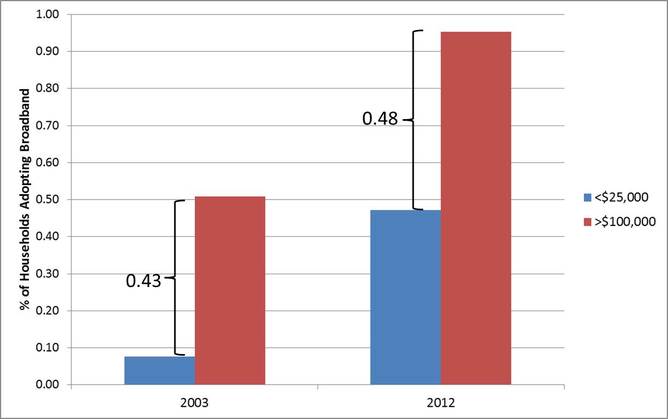
Internet Access is Growing, Albeit Very Unevenly, at All Income Levels


The Federal Communications Commission’s (FCC) recent proposal to expand the current Lifeline program – which provides phone service to low-income households – to include broadband access has drawn both praise and criticism.

Since 1985, the program has helped cover the cost of landline and (20 years later) mobile phone service for low-income households, and it is credited with helping cut the telephone penetration gap between low- and high-income households by two-thirds.