
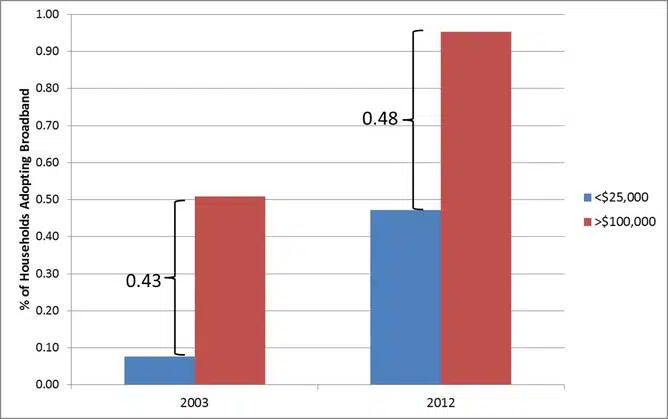
Internet Access is Growing, Albeit Very Unevenly, at All Income Levels


The Federal Communications Commission’s (FCC) recent proposal to expand the current Lifeline program – which provides phone service to low-income households – to include broadband access has drawn both praise and criticism.

Since 1985, the program has helped cover the cost of landline and (20 years later) mobile phone service for low-income households, and it is credited with helping cut the telephone penetration gap between low- and high-income households by two-thirds.

The Freedom Online Coalition is Working Hard in Asia


The Asian members of the Freedom Online Coalition (FOC) have announced their love of freedom and willingness to guarantee freedom online. However, the reality is that there is a disconnect between stated ambitions and commitments, and actual policy.

The Stakes are Rising in the South China Sea


Since March 2015, the US has hardened its attitude toward China’s activities in the South China Sea. Beijing appears genuinely surprised by the shift in tone and behaviour. In the past, the US has taken a more measured approach. So why has it escalated its language and flagged risky military exercises in the South China Sea? Why does the US risk upsetting the tenor of Sino–American relations over rocks, islets and reefs?

The South China Sea Issue is Becoming More of a Mess


The US Secretary of Defense has ordered the US military to develop options for more assertive freedom of navigation (FON) operations around China’s man-made islands in the South China Sea. There are significant legal, operational and political risks involved with these operations.

The Nepalese Government May Not Be Up to the Task of Rebuilding Nepal


After the 25 April 2015 earthquake, and the massive aftershock on 12 May, Nepal is entering the second phase of its recovery and reconstruction. Losses are still being tallied, so it is not yet possible to detail a complete list of the required long-term policies and strategies. However, if the country’s governance were to improve and appropriate policies were adopted, a stronger and more picturesque Nepal could emerge from the crisis.

Japan’s Hopes for a Peaceful and Cooperative China


Japan’s most important foreign policy goal is to create an environment under which China’s rise will be peaceful and cooperative. In strategic terms, maintaining the balance of power in the region and creating crisis prevention and management mechanisms are the most effective means of achieving this policy goal.

Can Jokowi’s Government Offer Hope for Indonesia’s Ethnic Minorities?


During the past decade, attacks on religious minorities have cast a shadow over Indonesia’s reputation as a tolerant and moderate Muslim-majority nation. Across the archipelago Christian, Buddhist, Ahmadi and Shi’ite communities have been exposed to increasing levels of discrimination, harassment, intimidation and violence, largely at the hands of Sunni hardliners.