
China Budget


China’s central budget is prepared annually by the Chinese Ministry of Finance. Provincial budgets are also prepared by the local government. Both the budgets are presented in March, but before revealing the final figure to the public, the budgets are ratified by the National People’s Congress and local people’s congresses. According to the country’s budget law, even the plan of adjustments and final accounts are approved by the Standing Committee of the National People’s Congress and the local congresses before the final presentation.

Published
Categorized as China

China Inflation, Chinese Inflation


Inflation in China soared during the 1930s and 1940s, when the country’s economy became highly unstable. The economic scenario worsened due to a civil war in the late 1940s. Food prices soared and hit purchasing power. In the early 1950s, the government implemented a series of recuperative measures, such as currency reforms, nationalization of banking institutions and the strict regulation of product prices and money supply. These policies continued till 1978. Owing to this, China succeeded in achieving record breaking price stability.

Published
Categorized as China

China Investment


For people who are fluent in Mandarin, China investment is easier and more profitable.

“There’s much more to the Chinese economy than in the 1990s,” said the manager of the Guinness Atkinson China & Hong Kong Fund, Edmund Harriss. According to Harriss, foreign investment has a major role in the growth of a country. The communist government is increasingly opening its doors to free markets, as well as privately owned businesses.

Published
Categorized as China

China Environment


China, the new superpower, is rapidly growing its consumption of the world’s natural resources. In Africa and Central Asia, the country is exploring oil fields. It is searching for gas in Burma, constructing hydropower units in Mekong, exploiting minerals and coal in Australia and destroying forests in the Indonesia. China’s massive appetite for raw materials is taking a toll on nature, causing massive environmental damage and helping to push the planet’s ecological system to the limits.

Published
Categorized as China

World GDP, GNI and Income Per Capita


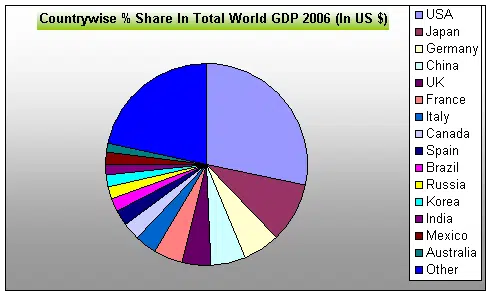
According to the recent statistics, the world GDP (comprising 180 economies) has reached at a sum of US $ 46,747 Billions. Top 15 contributors to the world GDP are USA, Japan, Germany, China, UK, France, Italy, Canada, Spain, Brazil, Russia, Korea, India, Mexico and Australia .

Percentage share of USA to the total world GDP is 28.3. While both the emerging economies such as India and China have a share of 1.82 and 5.41 respectively.

Published
Categorized as Markets

India China Economy, Indo-china trade relation


Among the most encouraging recent developments in India China Economy and India-China ties is the rapid increase in bilateral trade. A few years ago, India Inc had a fear of being swamped by Chinese imports. Today, India enjoys a positive balance of trade with China.In 2004, India’s total trade to China crossed US $13.6 billion, with Indian exports to China touching $ 7677.43 million and imports from china at US $ 5926.67 million. But major industry players in India feel there is no need to give the Chinese a free ride into the domestic market so early.

Published
Categorized as China

China Population Growth


Think about vast population and China is the first country that comes to mind. It is also the world’s most populous country but has achieved tremendous success in controlling China population growth. In mid 2008, the country’s population stood at 1.3 billion.

China’s population growth and uneven distribution span two periods. From 1949 to 1970, the population growth was dispersed evenly but from 1970 to 1990, the population disparity increased and concentrated in the east of China.

Published
Categorized as China

Fastest growing Economy


Economic growth is measured by certain parameters. These parameters include expenditure on food, housing, power, fuel, and transport and communications. Investments in education and medical facilities are important indicators of economic development. Economic growth is also dependent on population size, available labor force, fertility and mortality rates, per capita income and expenditure, regional growth, and literacy. All these parameters constitute social indicators of development (SID) based on which world economies are rated.

Published
Categorized as Markets