
Japan Electricity Losses: Summer Without Air Conditioning ???
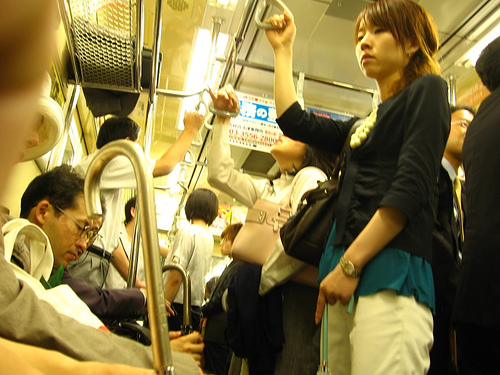
Long Hot Sweaty Summer for Japanese Workers ???
Credit: lowerincase
24 March 2011.
With some 30,000-50,000 dead, half a million evacuees, and the gravest nuclear crisis in decades —
Long Hot Sweaty Summer for Japanese Workers ???
Credit: lowerincase
24 March 2011.
With some 30,000-50,000 dead, half a million evacuees, and the gravest nuclear crisis in decades —
The recent traumatic jolt to Japan’s economy, by lowering global energy demand,
has at least temporarily offset some of the Libyan uprising’s impact on oil prices.
But experts say there are limits to how long that buffering effect might last.
In addition to Japan’s nuclear power industry, the earthquake and tsunami also damaged nine oil refineries,
disrupting nearly one-third of the country’s refining capacity.
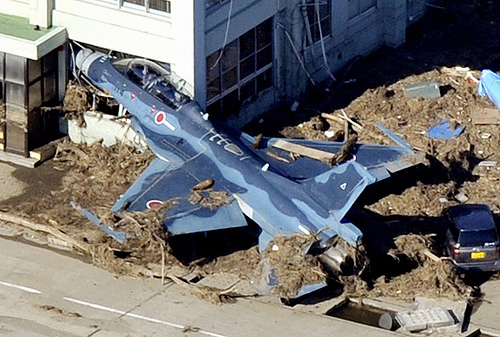
“Past Performance Is No Guarantee of Future Success”
Credit: Euronews
21 March 2011.
Even as ordinary investors look forward to the prospect of larger dividend payouts by the big banks,
another group is poised for a rich payday:
bank chief executives.
On Friday, the Federal Reserve gave a handful of institutions, including JPMorgan Chase and Capital One,
permission to pay higher dividends, another sign of the predictable success of banks since the depths of the financial crisis they created.
Japan’s vaunted “just in time” approach to business has become “wait and see.”
Much of Japan’s industry seems to be in a state of suspension,
as the devastation from an earthquake and tsunami,
combined with fear and uncertainty over the nuclear calamity,
made it difficult for corporate Japan to think about business as usual.
And that has left many overseas customers and trading partners in something of an information vacuum,
With Japan’s nuclear crisis showing no sign of ending, the yen strengthened against the dollar on Thursday,
compounding that country’s economic worries and raising expectations the central bank will soon have to intervene.
Producer prices surged in February at their fastest pace in about 18 months,
lifted by high food and energy prices,
according to a government report on Wednesday that pointed to a buildup in inflation pressures.
In a second report, the government said housing starts declined the most in 27 years in February,
while building permits dropped to their lowest level on record,
a sign that the beleaguered real estate sector has yet to rebound from its deep slump.
The financial aftershocks from the earthquake in Japan gathered force on Tuesday as
investors fled from riskier assets like stocks, oil and gold.
Unnerved by a 16 percent drop in Japanese shares in the first two trading days of the week,
stock markets slumped as investors sought havens like United States dollars and Treasury bonds, pushing interest rates lower.
“This was a very scary day for global stock markets,” said Carl B. Weinberg, chief economist at High Frequency Economics.
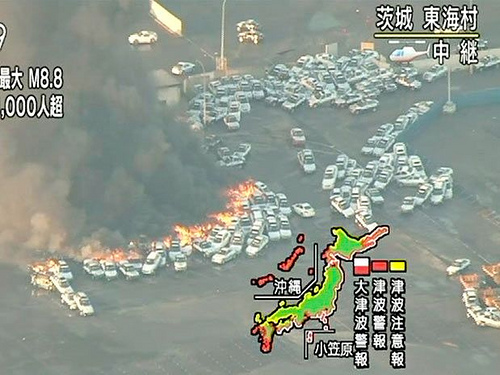
Fukushima Disaster Melting Down Public Confidence Too
Credit: tula_7755
16 March 2011.
As the humanitarian and nuclear crises in Japan escalated after the devastating earthquake and tsunami,
the impact on the country’s economy appeared to be spreading as well.
While the nation’s industrial clusters in the south and west seemed to be spared the worst,
the crisis at damaged nuclear plants north of Tokyo was threatening to cause an energy squeeze that could set back all sectors of Japan’s economy.
To help bring electricity back to the devastated areas, utilities across Japan are cutting back and sharing power,


