Australia Cuts Interest Rates on Currency Slide


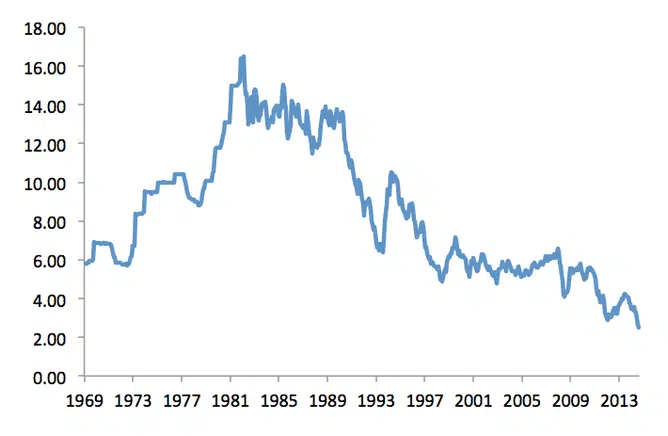
After the worst month on record for the Australian dollar, the nation’s central bank cut its key rate to 2%.

That represents a 25 basis point cut which many analysts had expected. The decision was made as Australia fights falling inflation and weakening exports, as a fall in commodity prices—Australia is a net energy exporter—combined with lower demand in China—the country’s largest trading partner—contributed to economic weakness and a fall in the currency’s value.

Australia’s Current Economic Relationship with its Bond Yields


When the Australian Office of Financial Management borrowed A$4.25 billion for 20 years at an interest rate of just 2.865% this week, economic commentator Peter Martin called it “the deal of the century”.

Governments issue bonds to raise funds to pay for general expenses and projects such as the development of infrastructure. Investors buy government bonds from the governments that issue them. In return, as bondholders, they typically receive periodic interest payments (known as the coupon), in addition to repayment of the principal when the bond matures.

Published
Categorized as Australia

Does Australia Have to Choose Between China and the U.S.?


Will it be China or the US? One is Australia’s largest trading partner, the other its traditional security ally. But what happens if Australia is forced to choose between them — will economics or history win out?

Malcolm Fraser, the former Australian prime minister (1975–83), wants Australia to end its security dependency on the United States and resume its sovereign ability to decide into what wars it will follow the US.

Published
Categorized as Australia

Reserve Bank of Australia Rate Cuts May Continue


The Reserve Bank of Australia cut its benchmark interest rate to an all-time low of 2.25% on February 3. The move came as the Australian government sought to rejuvenate an extremely sluggish economy while at the same time keeping downward pressure on the Australian dollar.

What is Australia to do about China’s Slowdown?


Few countries have done so well out of China’s belated economic awakening as Australia, which has sated much of the People’s Republic’s voracious appetite for overseas iron ore and metallurgical coal. Supply struggled to keep pace with demand and the prices of the raw materials for Chinese growth shot up: this translated into an eye watering increase in the Australian terms of trade. This has undeniably contributed strongly to the sunny economic conditions that have prevailed in Australia for much of the past decade.

Published
Categorized as Australia

Has the Australian Dollar Depreciated Enough to Positively Impact GDP?


The Australian dollar depreciated significantly in the second half of 2014, losing around 14 percent of its value against the US dollar and almost as much against the Chinese renminbi. Nevertheless, the Australian dollar needs to devalue by a further 15 percent in the coming years if the Australian economy is to continue operating at close to full employment.

Published
Categorized as Australia