
US Battles China over Free-Trade Rules in Push for Trans-Pacific Partnership


Representatives from 12 nations in the Americas and the Asia-Pacific region are meeting in Hawaii this week to finalize negotiations for the Trans-Pacific Partnership (TPP). If all goes to plan, they may reach a deal by Friday. Many consider the proposed treaty to be one of the most important free trade agreements since the United States, Canada, and Mexico entered into the North American Free Trade Agreement (NAFTA) in 1994.
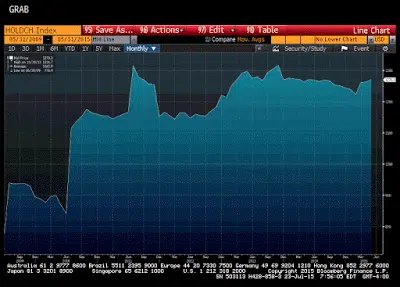

The FOMC’s Statement is Unlikely to Provide any Fireworks


While the markets wait for no man, the FOMC is a different story.  Janet Yellen expects to lead the Federal Reserve into taking the first step toward normalizing monetary policy in the coming months.  Although the statement she crafts is unlikely to contain an overt signal of a hike at the next FOMC meeting in September, it is expected to acknowledge that the economy is moving toward the central bank’s goals.

Waiting on the Fed, the Light Economic Calendar is Highlighted by UK GDP


The US dollar is mixed.  It is recouping some of yesterday’s losses against the euro and yen but it is heavier against the other major currencies.  Short covering in the dollar-bloc that began yesterday extends, and the 0.7% preliminary increase in Q2 GDP aided sterling. 

Should the Bank of Japan Consider the U.S. Fed Method?


The Bank of Japan is engaged in the most aggressive asset purchases, and yet it has largely failed to lift inflation.  National consumer prices for June will report at the end of this week.  The headline rate expects to fall to 0.3% year-over-year from 0.5% in May.  This would be the smallest increase since June 2013. 

Wrapping up the TPP is not without Risks


The largest hurdle for the 12-member Trans-Pacific Partnership (TPP) agreement — the US president’s ability to get Trade Promotion Authority, or fast track — is now clear. Many people think that the TPP can wrap up in a few months.

There are still difficult issues to resolve, but they are trivial compared to the ability to get a straight up-or-down vote in the US Congress, without which the deal would be a non-starter. The remaining issues can easily be horse-traded at the political level and compromises can happen in order to complete the deal.

Signs of Global Slowdown Persist


Signs of a global slowdown in economic activity persist as commodities prices fall, fears of debt defaults rise, and China shows weak manufacturing data.

The Fed’s FOMC Meets During a Heavy Economic Data Release Week


Surveys suggest that a little more than 80% of the economists expect the Federal Reserve to hike rates in September.  The September Fed funds futures, the most direct market instrument, have only about a 50% chance discounted.

WTO Members Make $1 Trillion IT Deal


On Friday (July 24), representatives of the member nations of the World Trade Organization (WTO) met in Washington, D.C. to finalize the terms of a new trade agreement to cut tariffs on $1 trillion worth of information technology products. The deal should generate over $1 trillion in technology related trade.

Different Data Directions a Net Positive for the Dollar


Contrasting data releases underscore the reemergence of the dollar bullish divergence meme that had appeared to stall in the vacuum of economic data in the first half of the week. Yesterday’s unexpectedly large fall in US weekly initial jobless claims had seemed to put a floor under the dollar.  Moreover, today’s poor flash PMIs for China and the euro area drove home the point. 

Measuring the Economic Value of Summer


The Office for National Statistics has produced a report on sales of popular summer-related products. Official data on sales of goods are limited in that they tend to be based on annual spending, but clearly the demand for some products tends to be seasonal. Various cold drinks, meat (for barbecues) and ice cream are identified as typical examples.

While we do not have official data on the extent to which demand for these goods varies over the year, unofficial data allow us to learn a little more about the extent to which a good (or a bad) summer can affect demand.