
Major Economy PMIs Reveal Diverging Paths


After a few sessions of light news, the flash Chinese Caixin flash manufacturing PMI and EMU PMIs provided new economic insight.  However, the macro-picture has not changed very much.  China’s economy has not bottomed while European growth appears to remain largely steady. 

Asian equities fell, following the US slide and the disappointing Chinese news, but after a soft start, European bourses turned higher.  European bonds yields are mostly 2-3 bp higher.
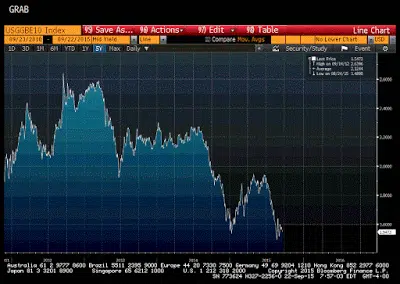
Market-Based vs. Survey-Based Measures


The Federal Reserve threw investors a curve ball last week.  Until then, Fed officials have shown a clear preference for survey-based measures of inflation expectations.  Last week, seemingly out of the blue, that Fed made reference to market-based measures of inflation expectations.  It implied that the decline in the break-evens (difference between conventional and inflation-linked bond yields) got officials’ attention. 

Despite Tensions, China and Japan are Destined to Coexist


Questions of history were the focus of a long hot summer in Northeast Asia. Many speculated that on the 70th anniversary of the end of World War II, Japanese Prime Minister Shinzo Abe, with his cabinet’s approval, would issue a new statement leaning towards a more ‘nationalistic’ understanding of Japanese history from the late 19th century to the Pacific War.

Patrolling New Chinese ‘Territory’, or Not


The US defence establishment’s provocative plan to assert freedom of navigation by patrolling near China’s artificial islands in the South China Sea appears to have stalled. But if the United States abandons the policy it will forego an important opportunity to help stabilise Asia’s contested waters.

Count on Politics Interfering with the Indian Census


Indian governments spend enormous resources to collect data — including 12 billion and 22 billion rupees on decennial censuses in 2001 and 2011, respectively. Yet they appear reluctant to release it. The latest decennial census data on religion, for example, which were released on 25 August 2015, were collected almost half a decade ago in 2011.

Fed Speak Began over the Weekend it Continues All Week


The US dollar started softer in Asia, where Japan is on holiday for the first half of the week, but has come back bid in Europe.  The key issues now seem to revolve around intentions and implementations.  Those are the key unknowns. 

Intentions refer to the major central banks.  Three Fed officials spoke over the weekend.  Williams, Ballard, and Lacker (who dissented) all said a hike before the end of the year may, still be appropriate.  US interest rates are a couple basis points firmer today. 

Fed Inconsistencies and the Persistent Divergent Monetary Policy Undermine Confidence


Temporal Inconsistencies at the Fed:  The Fed’s decision to delay the beginning of the normalization of monetary policy of undermines confidence in when lift-off will actually take place.

The Fed Decides to Not to Decide


The Federal Reserve left the Fed funds target at 0-25 bp.  It recognized continued improvement in the US economy but raised the level of concern over international developments.

Does the Fed Still Wield the Same Influence?


Markets have been speculating for months about whether the US Federal Reserve would raise interest rates in September. The day has finally arrived, and interestingly, there’s much less certainty now about which way it will go than there was just a few weeks earlier.

In August, more than three-quarters of economists surveyed by Bloomberg expected a rate hike this month. Now, only about half do. Traders were also more certain back then, putting the odds at about 50-50. Now the likelihood of a rate hike based on Fed Funds Futures is about one in four.

US Urges More Economic Reforms from India for Treaty to Work


India and the US have discussed a bilateral economic treaty at great length, but little actual progress has occurred. According to a senior US trade official, progress on the bilateral investment treaty has been “slow” due to the absence of economic reforms by India that would ensure ease of doing business. Until such reforms occur, the US estimates the likelihood of reaching an agreement on a bilateral trade agreement as “low.”
