Mobilizing Against Austerity? Grab Your Smartphone
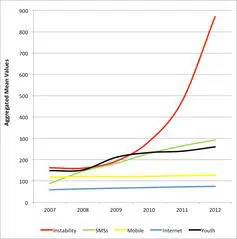
Protests against austerity continue to roil parts of Europe, most recently in Brussels earlier this month when 100,000 people took to the streets and police deployed water cannons.
Protests against austerity continue to roil parts of Europe, most recently in Brussels earlier this month when 100,000 people took to the streets and police deployed water cannons.
When Australia’s Reserve Bank board meets on Melbourne Cup day next week, the question at hand is whether the RBA will seek to offset recent bank rate raises with a cut to the cash rate. With a cut, the hope is banks will then reverse their decision and get mortgage rates back to where we were before.
First Westpac, then Commonwealth Bank, now all of the big four have raised their variable home loan rates, purportedly in response to more stringent capital requirements imposed upon them.
Recent statements suggest that the United States will soon conduct freedom of navigation (FON) operations against China’s artificial formations in the South China Sea (SCS). But there is far more handwringing going on than necessary, as demonstrated in a recent East Asia Forum article in which Mark Valencia warns that proposed FON challenges are ‘ill-advised, and even dangerous’.
The Reserve Bank of New Zealand and Sweden’s Riksbank can still surprise investors, but it is the BOJ and FOMC meetings that are the talk of the markets. Surveys suggest that around 40% of investors expect the BOJ to expand its asset purchases program this week. We are less convinced. Moreover, many real money clients spoken think the BOJ sticks with its current target of increase base money by JPY80 trillion a year. This raises the possibility that the surveys are not sufficiently up-to-date.
The European Central Bank and the People’s Bank of China reanimated divergence as a critical driver just when many observers had all but given up on it. The divergence is about monetary policy, broadly understood, not about the data per se. Of course, there is a relationship between the two but it may not be particularly tight.
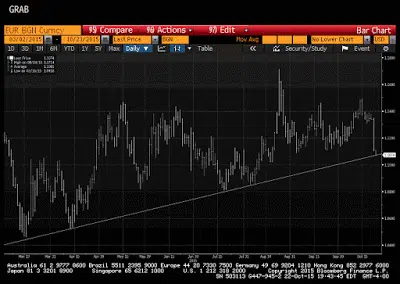
The combination of the dovish signals from the European Central Bank and the rate cut by the People’s Bank of China lifted the US dollar just as it was threatening to fall through the lower end of its recent ranges. Judging from the positioning in the futures market, short-term speculators appeared to be abandoning the dollar bull camp, perhaps driven the disappointment with the Federal Reserve’s seemingly inability to move away from the zero-bound six years into an economic recovery that has driven the unemployment rate to 5.1%.
ECB President Draghi sent an unambiguous signal to investors. Although the economic data from the region has been largely stable, the downside risks have grown, and the ECB will take action at its next meeting, which is in early December.
In the past, Draghi has indicated that the negative 20 bp deposit rate exhausted the scope for rate cuts. However, he did reveal that the possibility of another cut in the deposit rate was discussed. The key takeaway point is that the “degree of easing” would be re-examined at the December 3 meeting in its entirety.
If you read or watch detective stories, you probably do not think about them as an expression of economic principles.
However, at their heart, that is exactly what they are. In addition, it is not just detective stories, but works of fictions of all genres are brimming with economic ideas, from supply and demand to marginal cost.
The Annual Meetings of the World Bank Group and International Monetary Fund (IMF) in Lima, Peru have now concluded. This year’s meetings saw debates on the normalisation of US monetary policy, China’s new growth model, emerging market vulnerabilities and the post-2015 development agenda. There is still no obvious solution to a major thorn in the IMF’s side — the failure to implement long-awaited quota and governance reforms, which would give a greater voice to developing nations.
The main event today is the ECB meeting. Many observers expect a dovish tilt as Draghi prepares to expand QE in December. A Bloomberg survey conducted last week found that 80% of economists expect the ECB to eventually do so, with 56% expecting it at the December 3 meeting. The survey found 86% expect a move by the end of Q1 2016. Every central bank that has tried QE has had to do more than initially anticipated.