Happiest Economies in Which to Invest
Every year it seems financial analysts come up with new ways to rank investments. Bloomberg recently added to the list by ranking world economies by the financial “happiness” of the citizens in those nations.
Every year it seems financial analysts come up with new ways to rank investments. Bloomberg recently added to the list by ranking world economies by the financial “happiness” of the citizens in those nations.
The US dollar is broadly higher as yesterday’s gains are extended. The driving force is not so much a shift in perceptions of the US economy, though the San Francisco Fed that claimed seasonal adjustment quirks are behind the repeated weakness in Q1 GDP helped market sentiment yesterday in North America.
The newly established BRICS New Development Bank (NDB) is going to be headed by Indian banker KV Kamath. The bank is headquartered in Shanghai and is an attempt to bring together emerging economies of Brazil, Russia, India, China and South Africa. Initially the governor of Indian central bank better known as the Reserve Bank of India, Mr. Raghuram Rajan, was in talks to head NDB. After he showed little interest, the role went to KV Kamath who will be taking over the new opportunity in the next ten days. The NDB holds its first meeting in Russia in July this year.
Ever since the post-gold standard age of adjustable exchange rates was inaugurated in the mid-1930s to consensually engineer a negotiated depreciation, the question of exchange rates and of trade have been entwined and subject to international oversight. This certainly should not mean that US trade policy bureaucrats should obtain the power to usurp the IMF’s (and the Treasury Department’s) statutory authority and assess, and enforce, exchange values.
Gas prices are rising in the United States and are expected to rise further, limiting the possibility that Americans will spend more on discretionary goods and services.
In late 2014, many economists expected a rise in discretionary consumer spending and thus higher revenues for the retail sector as cheaper energy costs gave Americans more purchasing power to spend on discretionary goods. Since then, retail sales have consistently disappointed expectations, remaining flat in April. This has left many scratching their heads and rethinking their economic models.
Disappointing US economic data and high volatility in the German bunds kept the dollar under pressure. Over the past week the greenback fell against all the major currencies, save the New Zealand dollar (where interest rate cut expectations have built for as soon as next month). Most currencies from the emerging markets rose against the dollar, except for a handful of Latam currencies, including Argentina, Brazil, Colombia, and Peru.
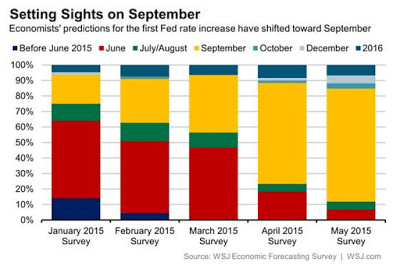
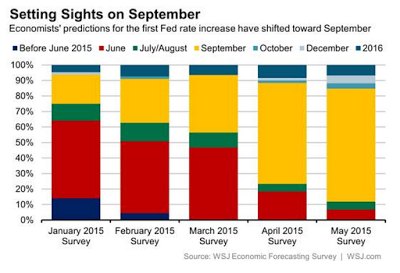
This Great Graphic comes from the Wall Street Journal. It shows the evolution of market expectations for the first Fed rate hike from the monthly survey it conducts. At the start of the year, many economists, like us, thought that a June hike was the most likely scenario. However, the weakness of Q1, and especially the poor job growth in March, spurred a rethink.
The United States is beginning to underperform other developed countries as several economic indicators point to a slowdown.
Earlier this week the United States Census Bureau reported retail sales stagnated in April, despite expectations of a 0.2% rise in spending as more employment encouraged greater spending. Instead, consumers are limiting their discretionary spending in a trend that has established itself over the last year.
Images of children working in hazardous and abusive conditions naturally provoke strong emotional reactions. For this reason, measures designed to stop children from working, and make sure they go to school, attract little opposition or debate.
Yet the reality is that a rigid approach to child labour has a downside. Work is neither all good nor all bad for children. It is often both.
The relationship between China and India will be one of the most important of this century. Their ability to cooperate will be crucial on international issues ranging from climate change to multilateral trade negotiations. Yet for all of its future significance, the relationship remains shallow, unbalanced and stuck in the past. As Narendra Modi visits Beijing this week, there are signs of change but progress will likely be slow, piecemeal and pragmatic.